YK11-0016-DI-002-08
22
2.6 Designing Pumping System
The following is a short note of the knowledge required in using a mechanical booster pump.
The mechanical booster pump cannot be started at the atmospheric pressure and must always be
used in combination with a backing pump (dry pump/rotary pump). Therefore, the vacuum chamber
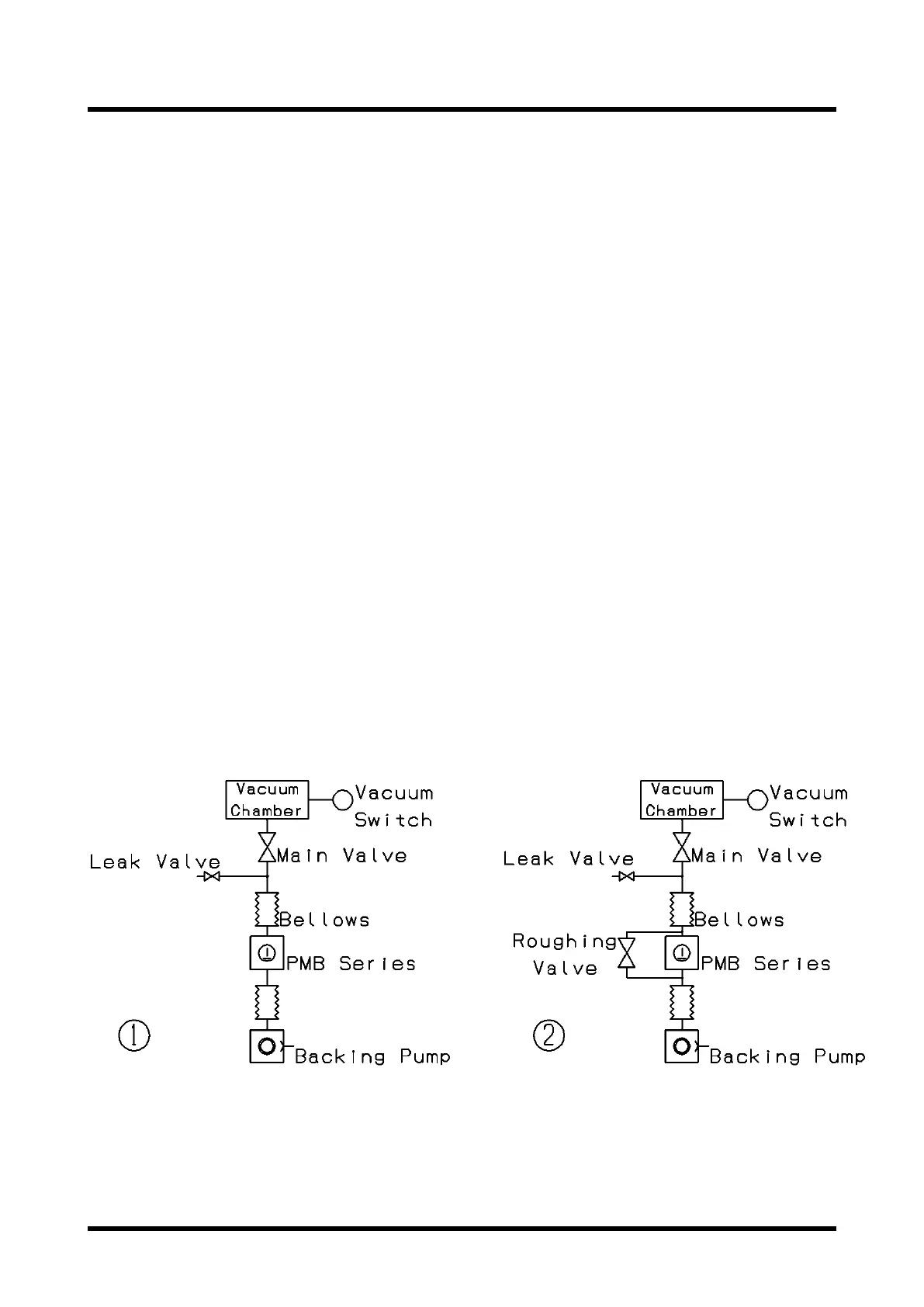
and the piping must be rough-pumped by the methods shown in the “Fig. 19” and the mechanical
booster pump must be started after the pressure has lowered to its operating range.
The rough-pumping methods include those shown by ① and ② in Fig. 19.
The method ① carries out rough-pumping through the mechanical booster pump. This method is
used when the vacuum chamber is small in size, that is, when a long time can be spent for rough-
pumping. Since the mechanical booster pump does not operate when rough-pumping is under
way, the gas to be exhausted is discharged through the clearances between the rotors in the
mechanical booster pump. This increases the pumping resistance (decreases conductance) and a
long rough-pumping time is required.
In the method ②, a rough-pumping circuit is provided for the mechanical booster pump. This
method is used when the vacuum chamber is large in size, that is, when it is desired to shorten the
rough-pumping time.
Rough-pumping is carried out with the main valve and the roughing valve opened and, when the
specified pressure is attained, the mechanical booster pump is actuated and the roughing valve is
closed for high vacuum pumping.
Fig. 22 Evacuation by mechanical booster pump (example)


 To Next Page