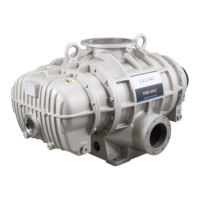
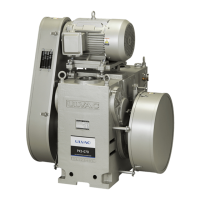
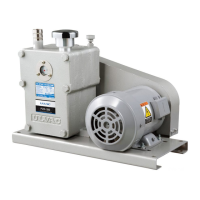
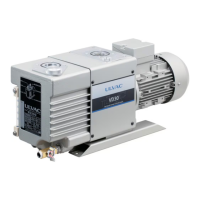
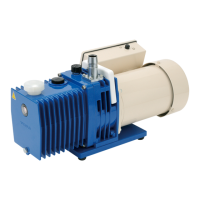
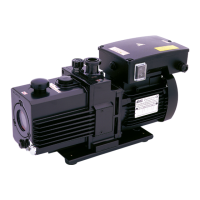
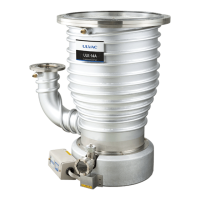
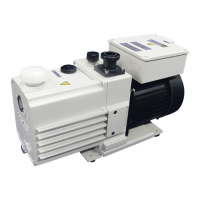
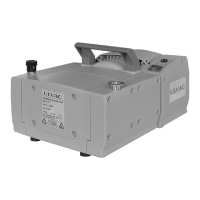
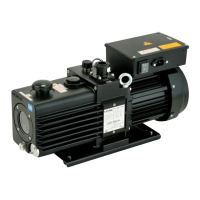
The ULVAC Mechanical Booster Pump is designed to enhance exhaust speed in vacuum systems, particularly in the pressure range of 8.0×10⁻² to 6.7×10⁻¹ Pa, where backing pump exhaust speed tends to decrease. This instruction manual covers models PMB100D, PMB300D, PMB600D, PMB1200D, and PMB2400D, with some models featuring IE3 motor adoption.
Function Description
The mechanical booster pump operates in conjunction with a backing pump. It consists of two cocoon-shaped rotors enclosed within a casing. These rotors rotate in opposite directions without physical contact, maintaining a small clearance between them through a timing gear. The design ensures that the rotors and casing also maintain a small clearance, preventing wear. Since no lubricating oil is used in the rotor chamber, the pump offers stable pumping performance even with water vapor and solvent vapor.
Important Technical Specifications
The PMB series offers a range of pumping speeds and maximum suction pressures depending on the model and operating frequency (50Hz or 60Hz).
-
Pumping Speed (m³/hour):
- PMB100D: 95 (50Hz), 115 (60Hz)
- PMB300D: 280 (50Hz), 330 (60Hz)
- PMB600D: 500 (50Hz), 600 (60Hz)
- PMB1200D: 1000 (50Hz), 1200 (60Hz)
- PMB2400D: 2500 (50Hz), 3100 (60Hz)
-
Maximum Suction Pressure (Pa):
- PMB100D: 9.3×10³ (50Hz), 6.2×10³ (60Hz)
- PMB300D: 1.2×10³ (50Hz), 9.3×10² (60Hz)
- PMB600D: 2.0×10³ (50Hz), 1.5×10³ (60Hz)
- PMB1200D: 3.5×10³ (50Hz), 3.0×10³ (60Hz)
- PMB2400D: 5.6×10³ (50Hz), 4.7×10³ (60Hz)
-
Ultimate Pressure: 4.0×10⁻¹ Pa (3.0×10⁻³ Torr) for standard models, and 6.7×10⁻¹ Pa (5.0×10⁻³ Torr) for others. Ultimate pressure is 0.67Pa when using GR series standard roughing pump.
-
Allowable Drive Pressure: Up to 1.0×10⁵ Pa (atmospheric pressure start type) or 760 Torr (atmospheric pressure start type).
-
Motor Power (kW/poles):
- PMB100D: 0.4 (2)
- PMB300D: 0.75 (2)
- PMB600D: 2.2 (2)
- PMB1200D: 3.7 (2)
- PMB2400D: 7.5 (2)
-
Oil Quantity (L):
- PMB100D: 0.35
- PMB300D: 0.7
- PMB600D: 1.5
- PMB1200D: 1.9
- PMB2400D: 4 (2.2 for horizontal exhaust model)
-
Cooling Method: PMB100D is air-cooled. Other models are air-cooled or water-cooled. Water-cooled models require a cooling water volume of 2 L/min or more (PMB300D, PMB600D) or 3 L/min or more (PMB1200D, PMB2400D), with a temperature range of 5°C to 30°C.
-
Dimensions (W x D x H in mm) and Weight (kg):
- PMB100D: 267 x 576 x 180, 26 kg
- PMB300D: 321 x 685 x 260, 51 kg
- PMB600D: 362 x 784 x 320, 82 kg
- PMB1200D: 417 x 970 x 340, 115 kg
- PMB2400D: 520 x 1260 x 460, 260 kg
-
Motor Specifications: PMB100D uses an IE2 motor. PMB300D, PMB600D, PMB1200D, and PMB2400D use IE3 motors. Multi-voltage motors are available, allowing operation at different voltages by changing connections in the terminal box.
-
Safety Features: The pump is not designed as a withstand pressure structure; the ensured pressure value is 0.03MPaG (0.3kg/cm²G). Overload protection devices are imperative to prevent motor burnout and fire. Earth leakage breakers are recommended.
Usage Features
- Installation: The pump must be installed horizontally in a location with minimal dust and humidity, fixed with bolts at four places. For PMB100D, the pipe connection serves as the installation point. For other models, anti-vibration rubber mounts are available.
- Piping: Proper inlet and outlet piping is crucial. Bellows should be used to prevent direct load and vibration transfer to the pump flange. Leak valves should be placed close to the vacuum valve to prevent oil backflow into the vacuum chamber when the pump stops.
- Electrical Connection: Wiring must comply with safety regulations. Correct grounding is essential to prevent electrical shock. For IE3 motors, striking current can be high, requiring readjustment of MCCB, ELCB, and THR settings.
- Operation: The pump cannot be started at atmospheric pressure and must always be used with a backing pump. It should only be started after the pressure has lowered to its operating range. Inverter-equipped models allow operation from atmospheric pressure. Continuous operation in the 300Pa to 4000Pa range for more than 1 hour can damage PMB600D, 1200D, and 2400D models, necessitating water-cooled types.
- Cooling Water: For water-cooled models, ensure continuous flow of cooling water at the specified volume and temperature. Lack of cooling water can damage bearings, gears, and shaft seals. In cold environments, drain cooling water to prevent freezing and damage.
- Oil Type: ULVAC recommends ULVOIL R-42 (mineral oil) as standard. ULVOIL R-72 (mineral oil) is for air-cooled operation, and J25F (fluorine-based synthetic oil) is an option for chemically stable and heat-resistant applications. Using incorrect oil can impair performance.
- Automatic Operation: A vacuum switch is necessary for automatic operation, starting the mechanical booster pump when intake pressure falls below the maximum intake pressure.
- Separate Evacuation of Lubricating Chamber (Optional): This feature minimizes oil flow into the rotor chamber by evacuating the lubricating chamber with a separate vacuum pump.
Maintenance Features
- Regular Checks: Daily visual checks and utility checks are recommended. For high-load operations, increase the frequency of checks. Key points include:
- Vacuum oil pump oil level (between two level lines).
- Vacuum pump oil discoloration and viscosity.
- Oil leaks from the pump and mechanical seal.
- Cooling water flow and leaks.
- Foreign noise.
- Motor current value.
- Oil Change: The first pump oil should be replaced within 10 days of operation start, then the replacement cycle determined based on oil contamination. Severely contaminated oil may require multiple changes or an overhaul.
- Lubrication: Lubrication oil should be supplied to the lubrication chamber via the oiling port on the gear cover. For the mechanical seal, lubricate with 20ml of oil after draining the old oil, especially after long periods of inactivity or relocation.
- Mechanical Seal Leak Check: A slight oil leak from the mechanical seal is normal. However, if oil pooling exceeds 0.15mL/hour at the motor flange, the mechanical seal needs replacement.
- Inlet Metal Mesh Check: Periodically check the metal mesh at the suction inlet for clogging by dust or welding scale, which can deteriorate pump performance.
- Rotor and Casing Inspection: Every 3 months, remove the inlet port piping to inspect the rotor and casing surfaces for attachments, especially when exhausting organic gases that can condense and narrow the gap, potentially causing rotation failure.
- Coupling and Spider Check: The rubber spider of the coupling should be inspected periodically (e.g., once every six months or 7,200 start/stop cycles) and replaced annually or if damaged.
- Overhaul: Regular overhauls are recommended annually or sooner if significant contamination or performance deterioration is observed. This involves replacing main displacement parts. A Contamination Certificate must be submitted for overhaul requests.
- Troubleshooting: The manual provides a comprehensive troubleshooting guide for common issues like pump not running, unusual sounds, pressure not declining, and abnormal heating, along with processing methods and references to relevant sections.
- Disposal: Disposal must comply with local regulations. A dedicated disposal agency should be used, especially if toxic gases were exhausted, as pump oil and the unit itself may become hazardous.

 Need help?
 General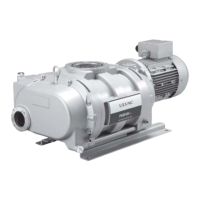

 To Next Page