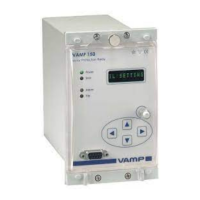
VAMP Ltd Feeder and motor manager
Technical description
VAMP 257
VM257.EN002 VAMP 24h support phone : +358 (0)20 753 3264
67
frequency back to the original value. However, in case of a
heavy short circuit fault or in case the new load exceeds the
generating capacity, the average frequency keeps on
decreasing.
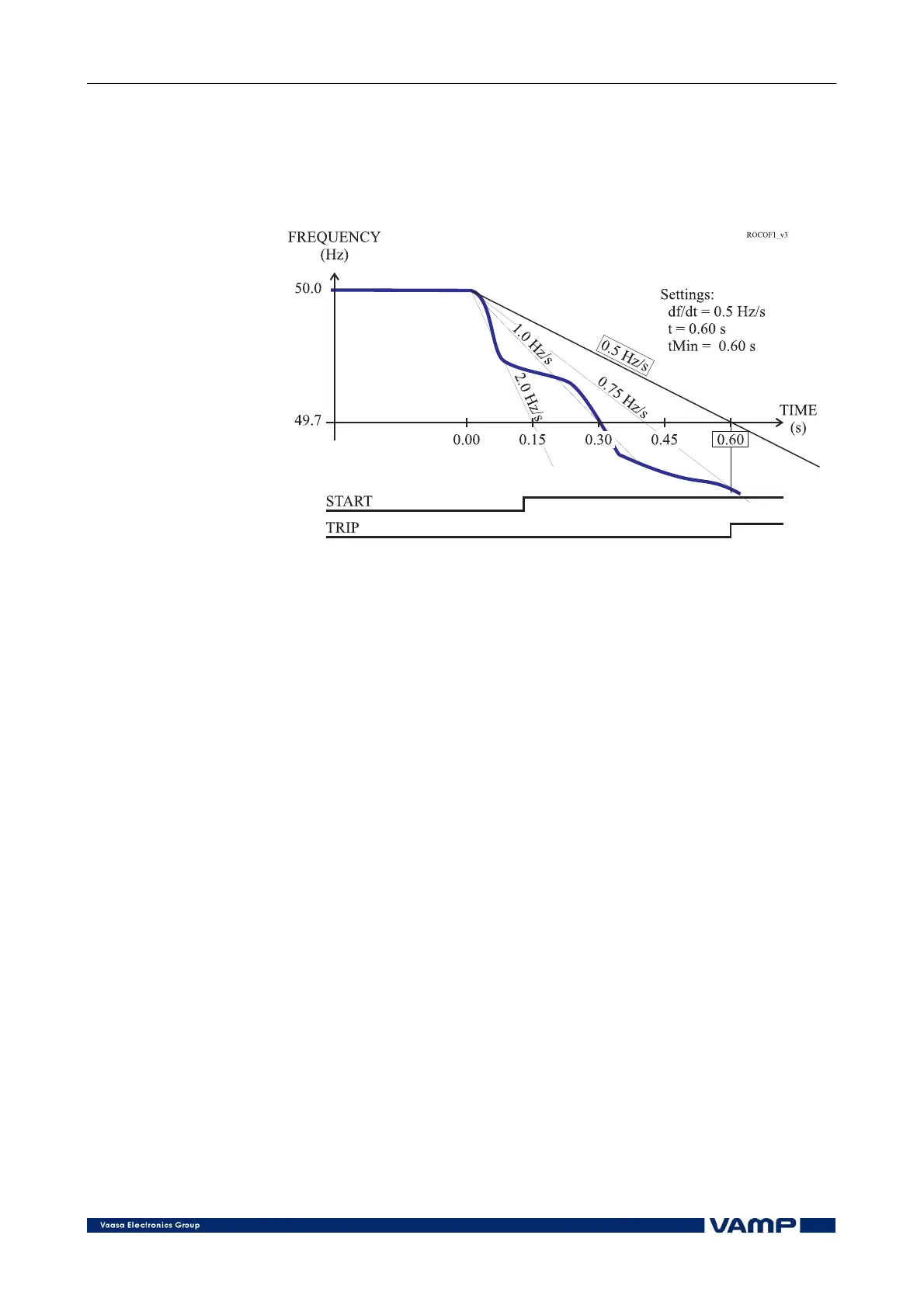
Figure 2.3.22-1 An example of definite time df/dt operation time. At 0.6 s,
which is the delay setting, the average slope exceeds the setting 0.5 Hz/s
and a trip signal is generated.
Description of ROCOF implementation
The ROCOF function is sensitive to the absolute average value
of the time derivate of the measured frequency |df/dt|.
Whenever the measured frequency slope |df/dt| exceeds the
setting value for 80 ms time, the ROCOF stage picks up and
issues a start signal after an additional 60 ms delay. If the
average |df/dt|, since the pick-up moment, still exceeds the
setting, when the operation delay time has elapsed, a trip
signal is issued. In this definite time mode the second delay
parameter "minimum delay, t
Min
" must be equal to the
operation delay parameter "t".
If the frequency is stable for about 80 ms and the time t has
already elapsed without a trip, the stage will release.
ROCOF and frequency over and under stages
One difference between over-/under-frequency and df/dt
function is the speed. In many cases a df/dt function can
predict an overfrequency or underfrequency situation and is
thus faster than a simple overfrequency or underfrequency
function. However, in most cases a standard overfrequency
and underfrequency stages must be used together with ROCOF
to ensure tripping also in case the frequency drift is slower
than the slope setting of ROCOF.


 To Next Page