Operating instructions
Braking 69
Retarder
The transmission's retarder is a brake, and its retarding action
depends on which gear is engaged, that is:
– lower gear – more retarder power (braking action)
– higher gear – less retarder power (braking action)
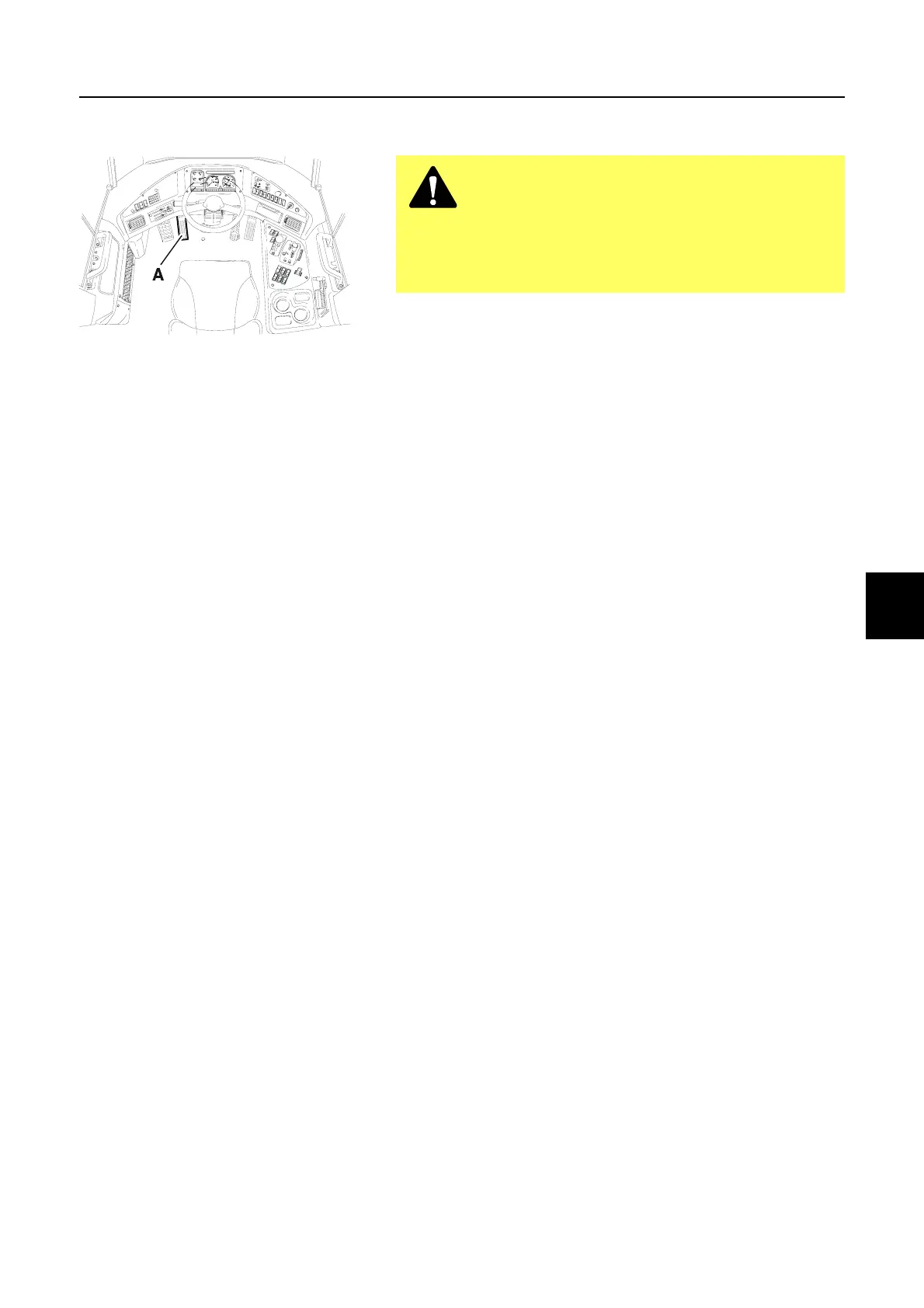
The retarder is engaged together with the exhaust brake using the
retarder pedal (A). The retarder action is infinitely variable, that is,
harder pressure on the pedal gives higher retarder action.
The retarder is engaged when the retarder pedal is pressed
down and:
– the accelerator pedal is fully released
– the speed exceeds 2 km/h
– the gear selector is in forward or reverse
– the temperature in the transmission oil is not too high
NOTE! The longitudinal differential lock and 6-wheel drive are
engaged automatically if the retarder pedal is pressed down.
Braking with retarder
1 Let up the accelerator pedal.
2 Press down the retarder pedal (A) all the way and wait for the
braking action. Then adjust the braking action to the operating
conditions by letting up on the pedal.
3 Plan the operation by pressing down the retarder pedal a little
before braking action is needed for optimal performance.
4 The retarder function disengages when the retarder pedal is let
up.
It is advantageous to use the gearshift lock-out at retarder
braking to increase the speed range of the engaged gear.
Frequent retarder use means increased oil temperature in the
transmission. Keep an eye on the temperature gauge for
transmission/retarder. When using the retarder, a reading in the
temperature gauge's yellow range is permitted.
WARNING!
The retarder's braking power is reduced if the oil
temperature in the transmission becomes too high. This
means that braking performance and deceleration may be
insufficient when operating downhill.
1
4
A Retarder pedal


 To Next Page