Operating instructions
68 Braking
Braking
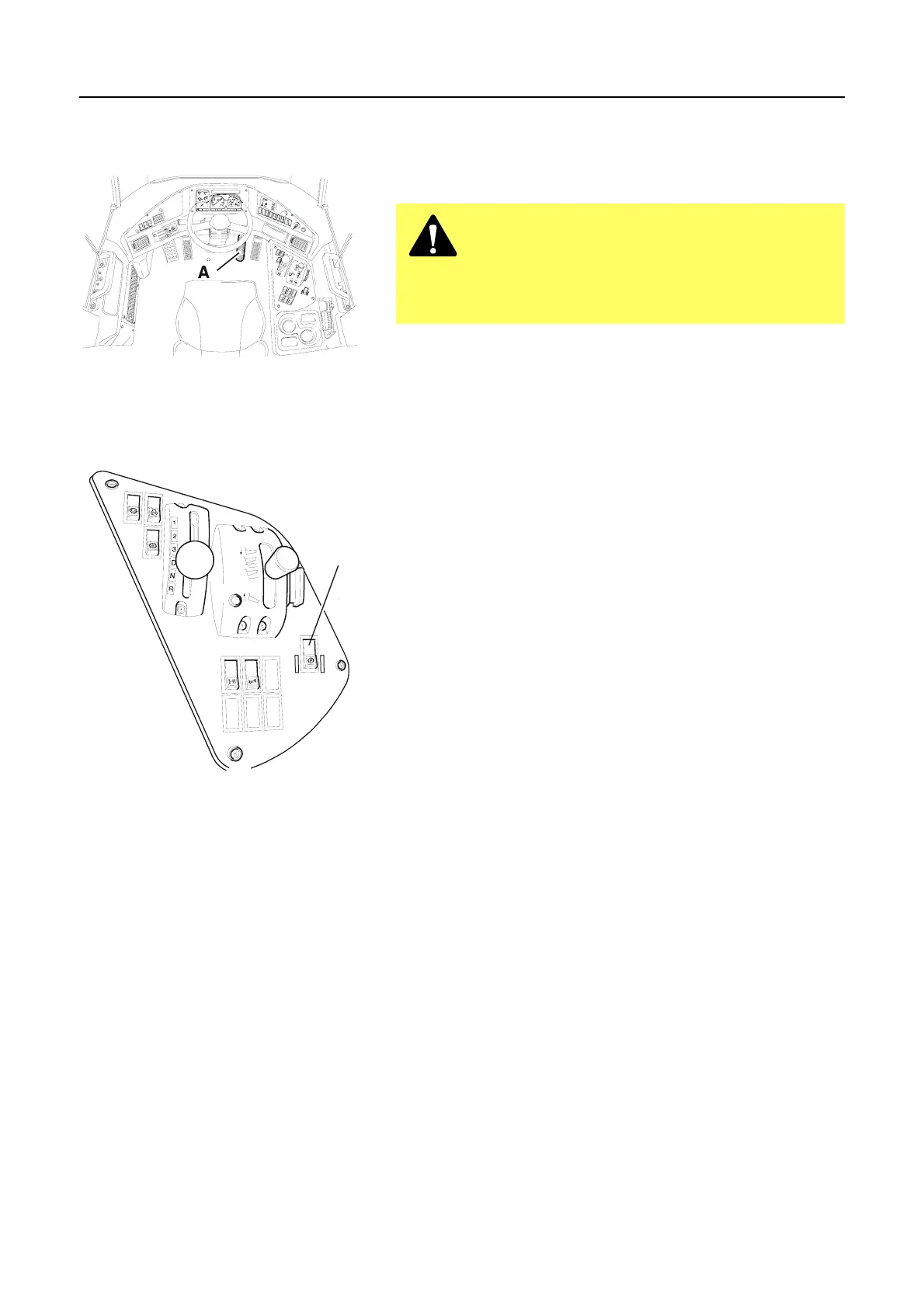
Service brakes
The service brakes are divided into two separate circuits. If a fault
arises in one of the circuits, the machine can still be braked with
the intact circuit.
If brake action is lost in both brake circuits, engage the exhaust
brake and apply the parking brake and stop the machine.
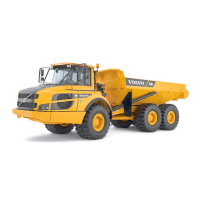
Parking brake
The parking brake should not be applied until the machine is
completely stationary.
Application and release, see page 49.
The parking brake is self-adjusting (no after-adjustment is
needed).
NOTE! When the parking brake is applied, it is not possible to
engage a gear.
Emergency brake
Q In an emergency situation the parking brake may be used as an
emergency brake. If the parking brake is used as an
emergency brake, the load and dump brake will be engaged
automatically if the speed is above 2 km/h.
Q The parking brake is applied automatically if the brake pressure
is lost in both the front and rear circuits.
Auxiliary brake
The auxiliary brake is a complement to the machine's ordinary
brakes. Exhaust brake and retarder are both auxiliary brakes.
The exhaust brake reinforces the engine's braking power.
The retarder is a hydraulic brake that acts inside the transmission.
The auxiliary brakes give good braking power throughout the
entire engine speed range, however, the braking power is slightly
higher at high engine speeds.
The auxiliary brakes are used to achieve smooth and comfortable
operation that drastically reduces wear of the machine's ordinary
brake system.
WARNING!
In case of faulty brakes, stop the machine immediately and
contact a workshop authorised by Volvo CE for action to be
taken.
A Service brakes
1
B Parking brake
1008423
B


 To Next Page