Operating instructions
72 Parking
Parking
1 If possible, park the place on level ground. If this is not possible,
block the wheels so that the machine cannot start rolling.
2 Make sure that the dump body is lowered or secured. Avoid
parking a loaded machine.
3 Check that switches and controls are in the "Off" position or in
neutral.
4 Apply the parking brake.
5 Close windows, remove the start key and lock the cab door.
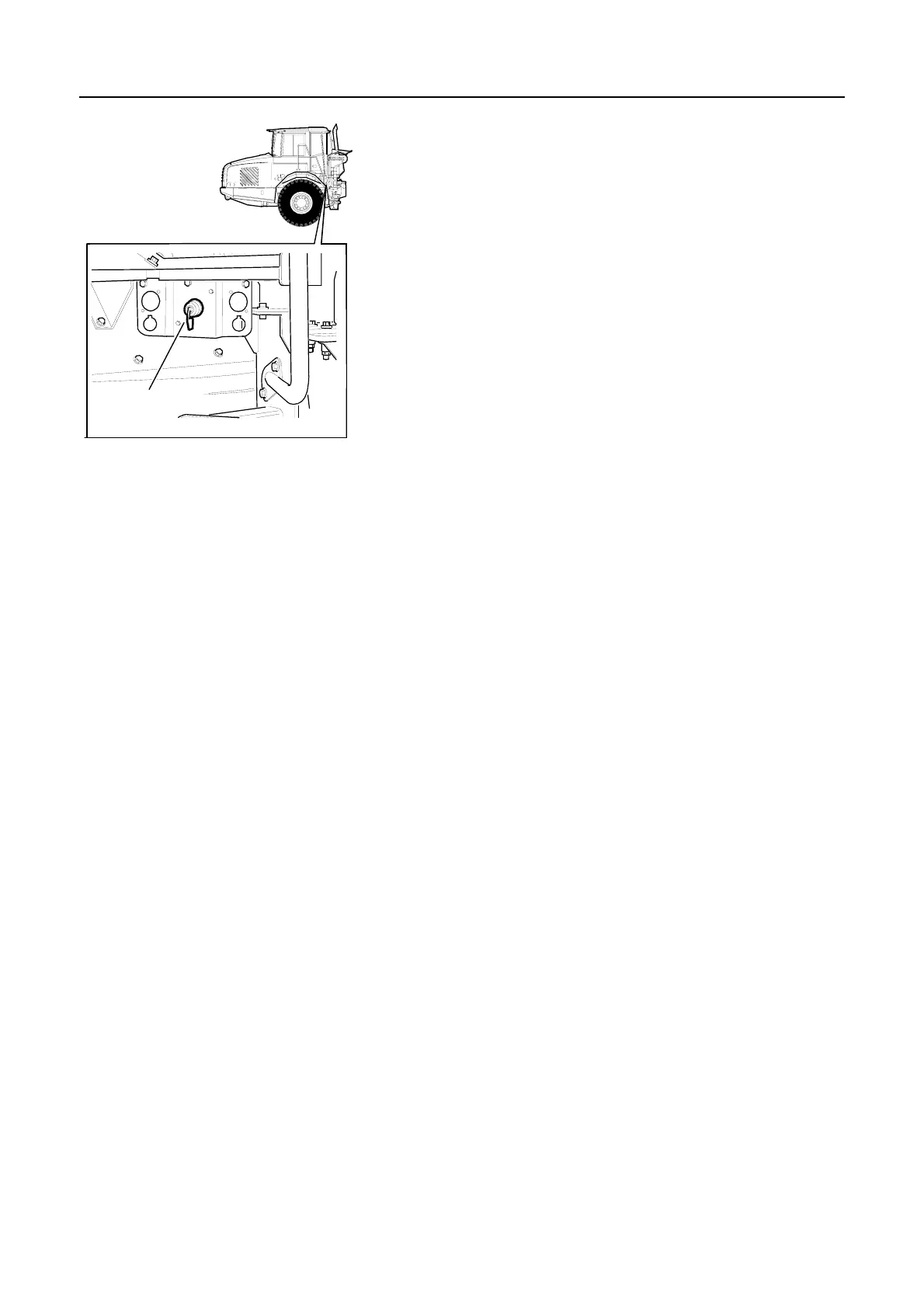
6 Turn off the battery disconnect switch (A), which is
positioned on the left side of the cab under the entry step.
Long-term parking
1 Carry out the measures as described above. Remember that
the ground on which the machine is to stand may shift
depending on the weather. Therefore take suitable action.
2 Wash the machine and touch up the paint finish on damaged
surfaces to avoid rusting.
3 Rustproof exposed parts, lubricate the machine thoroughly,
grease all unpainted surfaces (tipping cylinders, steering
cylinders).
4 Check the tyre pressure.
5 Fill the fuel and hydraulic oil tanks to the max. marks.
6 Cover the exhaust pipe (applies when parking out-of-doors).
7 Drain water from the compressed-air reservoirs
8 Remove the fuse for the voltage converter (fuse 41).
Otherwise there is a risk that the batteries will be discharged.
Remember that the risk of theft and break-in can be minimised if
one:
– removes the start key when the machine is left unattended
– locks doors and covers after the end of the work shift
– turns off the current with the battery disconnect switch and
removes the handle
– avoids parking the machine in places with high risk of theft,
break-ins, and malicious damage
– chains the machine to an immobile object.
It is easier to identify stolen machines if the PIN number or
registration number is etched onto the windows.
After long-term parking check
– all oil and fluid levels
– all belt tensions
– tyre pressure
– air cleaner.
– battery status.
A Battery disconnect switch
A
41
1
A


 To Next Page