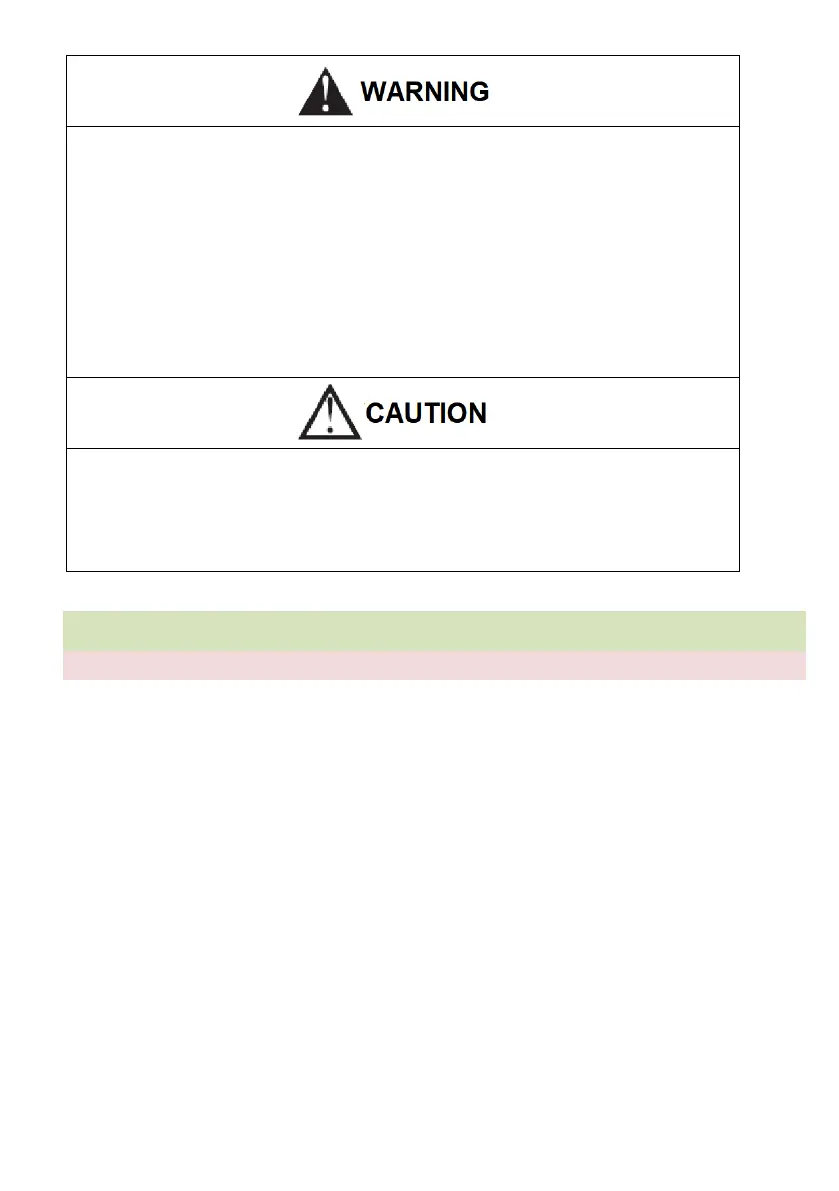
• A person without proper training handling the device or a device in the event of a "WARNING"
indication can cause serious injury or property damage.
Only a person who has received training in the design, installation, commissioning and operation of
the equipment and has obtained a certificate is entitled to operate this equipment.
• The power wire must be securely connected and the device must be securely grounded.
• Even though the inverter does not work, there is still dangerous voltage at the following
terminals: - power terminals: R, S, T - motor connection terminals: U, V, W.
• After turning off the power, you should not operate the inverter for 5 minutes to ensure that the
device is completely discharged.
• The cross-sectional size of the ground wire must not be smaller than the power wire.
• When moving the inverter, hold it by the base and do not lift it by the panel, as the main unit may
fall, which may result in personal injury.
• To prevent fire, install the inverter on a fireproof surface (eg metal).
• When installing two or more inverters in one cabinet, a cooling fan should be available to ensure
that the air temperature in the cabinet is below 45 ° C. Failure to do so could result in fire or
damage to the equipment.
Chapter 2: Installation and wiring
2.1 Environment and installation requirements
The installation environment affects the life of the inverter and has a direct effect on the normal function, failure
to comply with the environmental specifications could lead to a fault in the inverter.
For the VECTOR V 810 series inverter, use the vertical installation to ensure the best possible air flow and heat
dissipation effect.
Ensure that you can meet the inverter's installation environment:
(1) - 10 ° C to + 40 ° C ambient temperature.
(2) Ambient humidity 0 ~ 95%, no condensation.
(3) Avoid direct sunlight.
(4) The surrounding environment does not contain corrosive gas and liquid.
(5) Dust-free environments, flying fibres, cotton and metallic particles.
(6) Without radioactive material and fuel.
(7) Distance from an electromagnetic interference source (e. g. an electric welding machine, a large powering
machine).
(8) Install on a flat, vibration-free surface, if you cannot avoid vibrations, add anti-vibration pad to reduce
vibration.
(9) Install the inverter in a well-ventilated place, easily accessible for maintenance and for solid non-flammable
material outside the heat source (e.g. braking resistor, etc.).
(10) Installing the inverter requires plenty of space, especially in case more inverter installations, be careful with
the location of the frequency inverter and place the cooling fans so that the ambient temperature is below 45°C.
(11) The rated output of the inverter applies to installations with an altitude of less than 1000 m. At an altitude
above 1000 m the inverter performance decreases.


 To Next Page