18 Diagnostics and Calibration
2
2.3 PDA Calibration
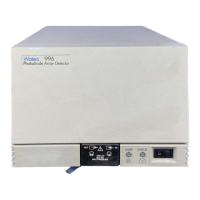
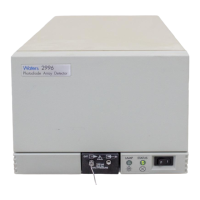
You can adjust, or calibrate, the 2996 Detector to ensure that wavelength readings are
accurate. Recalibrate the 2996 Detector only if the Wavelength Accuracy diagnostic (in
the Internal Diagnostics tests) fails. Calibration allows you to correct small errors in
wavelength which may be caused by aging optics or excessive vibration.
You calibrate the 2996 Detector using the PDA Calibration window, which you access
from Run Samples and which allows you to:
• View the effects of exposure time on photodiode saturation for a given wavelength
range.
• Verify the wavelength location of the deuterium spectrum Balmer lines (486.0 nm
and 656.1 nm).
• Recalibrate to set the 486-nm peak at the proper wavelength.
• Ensure precise data for library matching.
Note: The system administrator can restrict access to the PDA Calibration window by
disabling access to Run Samples.
Note: Ensure that the flow cell is clean before you check calibration (Section 3.1.1,
Flushing the Flow Cell).
To prepare for calibration:
1. Set the pump to deliver 1 mL/min of degassed methanol for 10 minutes. If methanol
is not miscible with the previous solvent, flush with a miscible sovent before
switching to methanol.
2. If you have been using buffers, flush with HPLC-quality water at 1 mL/min for
10 minutes, then switch to methanol for 10 minutes.
Note: Ensure that the solvent is miscible with the previous mobile phase.
For information on performing calibration, refer to the Millennium
32
Help.
STOP
Attention: Recalibrating the wavelength requires that spectral libraries be reentered.


 To Next Page