Computing Absorbance Data Points 35
4
Note: Changing exposure times within a set of samples can cause changes in baseline
noise.
Be aware that increasing the Exposure Time parameter has the potential to saturate the
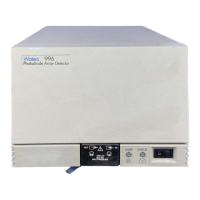
photodiodes. A longer exposure time may cause the 2996 Detector to lose the signal at
certain wavelengths because of diode saturation. When specifying the Exposure Time,
select a value that provides settings for an optimum signal-to-noise ratio over the
wavelength range of your analysis (see the next topic “Optimizing the Signal-to-Noise
Ratio”).
Optimizing the Signal-to-Noise Ratio
To optimize signal-to-noise ratios, choose an acquisition wavelength range that includes
only the wavelengths of interest and over which the mobile phase absorbs minimally
(Appendix C, Mobile Phase Absorbance). Setting the bandwidth to higher values can
improve signal-to-noise ratios.
4.4 Computing Absorbance Data Points
The 2996 Detector calculates absorbance values before transmitting the data to the
Millennium
32
database. To calculate absorbance, the 2996 Detector:
• Computes the absorbance at each diode using the dark current and reference
spectrum (Section 4.4.1, Calculating Absorbance)
• Averages the absorbances at a particular wavelength as specified in the spectra per
second sample rate and reports the average as a single data point (Section 4.4.2,
Resolution)
• Can apply a filter (Section 4.4.3, Filtering Data)
4.4.1 Calculating Absorbance
The detector computes absorbance by subtracting the dark current and reference spectrum
from the acquired spectrum. Absorbance is based on the principles of Beer’s Law.


 To Next Page