Representing Spectra as Vectors 43
5
5.2.1 Vectors Derived from Two Wavelengths
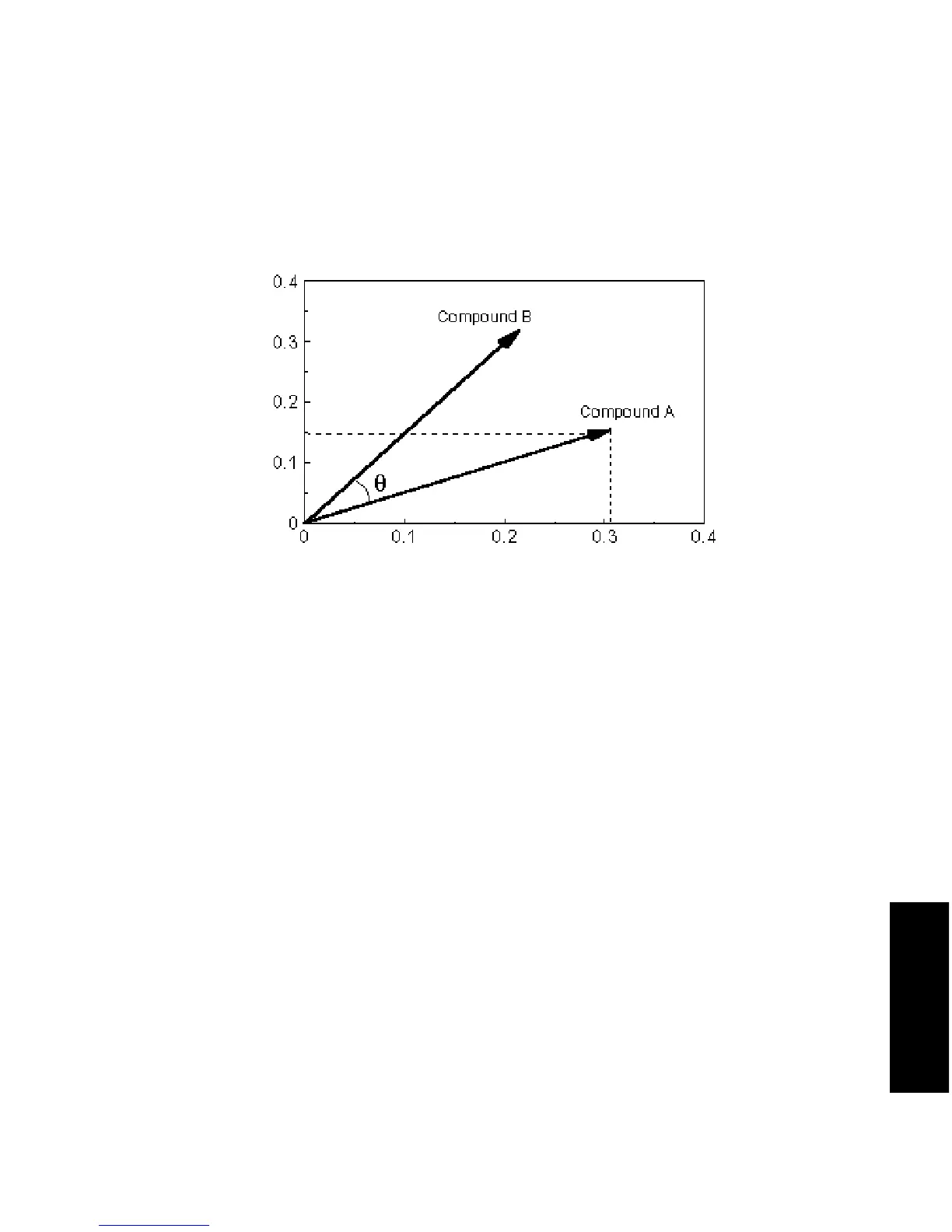
The Spectral Contrast algorithm uses vectors to characterize spectra (Figure 5-2). To
understand the vector principle, consider two vectors (Figure 5-2) based on the spectra
depicted in Figure 5-1.
Figure 5-2 Plotting Vectors for Two Spectra
The axes in Figure 5-2 are in absorbance units at the two wavelengths used to calculate the
absorbance ratio shown in Figure 5-1. The head of the vector for Compound A is at the
intersection of the absorbance values (for Compound A) at the two wavelengths
represented by each axis. The other vector is similarly derived for the spectrum of
Compound B.
The vector for Compound B points in a direction different from that of the vector for
Compound A. The difference in direction, which reflects the difference in the absorbance
ratios of the two compounds at wavelengths 245 nm and 257 nm, is called the Spectral
Contrast angle. A Spectral Contrast angle (e.g., θ in Figure 5-2) greater than zero indicates
a shape difference between spectra (Section 5.3, Spectral Contrast Angles). The length of
the vector is proportional to the concentration.
5.2.2 Vectors Derived from Multiple Wavelengths
When absorbance ratios are limited to two wavelengths, the chance that two different
spectra will have the same absorbance ratio is much greater than if comparison is made
using absorbance ratios at many wavelengths. Therefore, the Spectral Contrast technique
AU at 257 nm
AU at 245 nm


 To Next Page