New channel numbering system
Edition 2 of the radio interface standard ETS 300 392-2 defines how values for
the frequency band, duplex spacing and channel number parameters are as-
signed (see Annex F of the afore-mentioned standard). This definition makes a
difference between the radio channel number and the carrier number. In the
STABILOCK context, if the STABILOCK requires an entry of a "channel number"
then this always means the "carrier number" mentioned in Annex F.
The actual downlink carrier frequency is defined as:
DL carrier freq. = base freq. + (carrier number * 25 kHz) + offset
or
DL carrier freq. = freq.band * 100 MHz + (carrier number * 25 kHz) + offset
where
•
the base frequency is a multiple of 100 MHz; the frequency band N is
determined by base frequency = N * 100 MHz.
•
the carrier number is the actual channel number (eg base channel or traffic
channel).
•
offset is one of the values 0 kHz, -6.25 kHz, +6.25 kHz, +12.5 kHz.
In addition, the UL carrier frequency is determined by the DL carrier frequency
and the duplex spacing:
UL carrier freq. = DL carrier freq. - duplex spacing
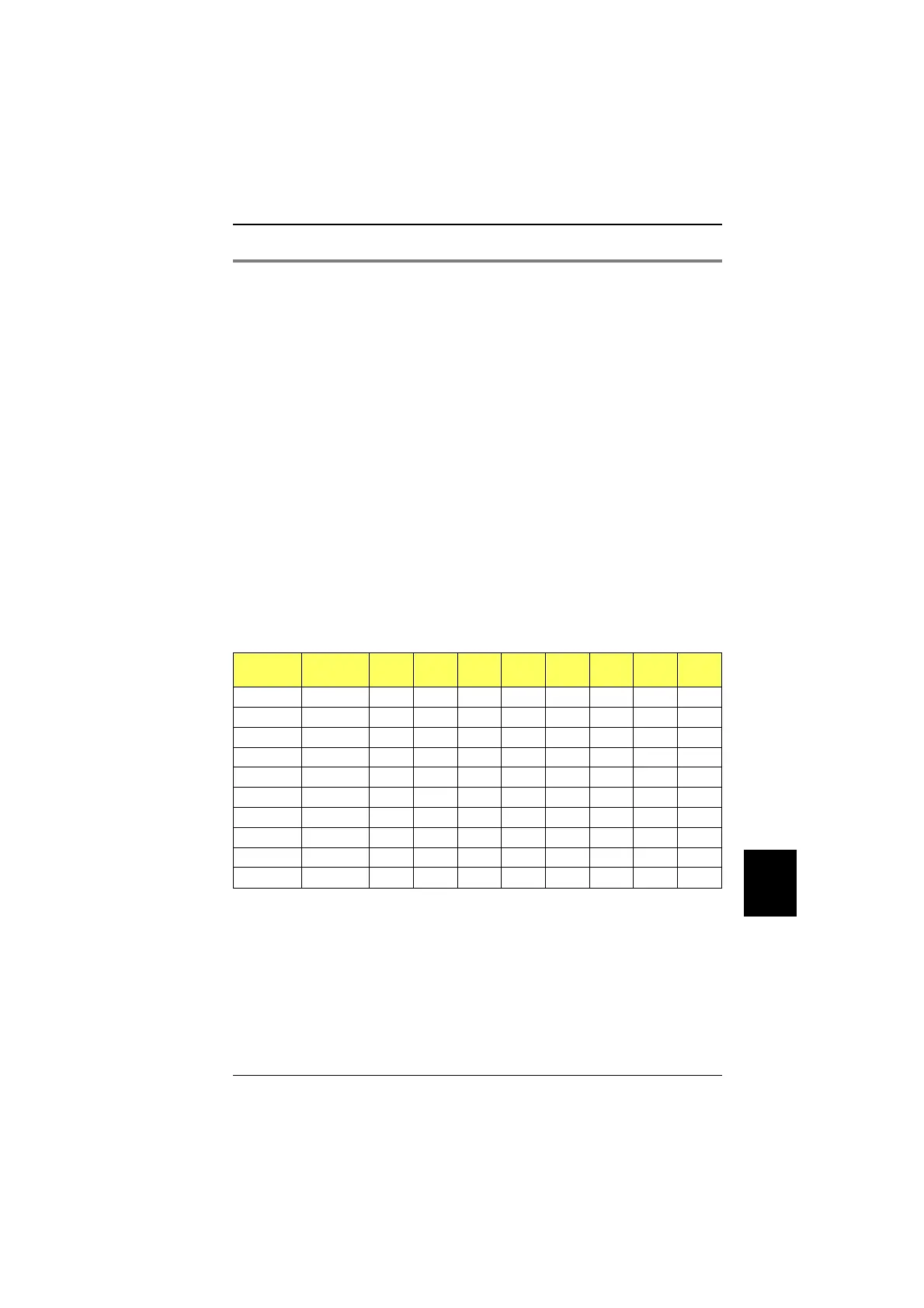
The duplex spacing (in MHz) is coded into the SYSINFO message as a value in
the range from 0 to 7, the coding has so far been standardized as follows:
Frequency
band
base freq. Duplex
= 0
Duplex
= 1
Duplex
= 2
Duplex
= 3
Duplex
= 4
Duplex
= 5
Duplex
= 5
Duplex
= 6
0
0
1
100 MHz 1.6 4.5 0
2
200 MHz 10 0
3
300 MHz 10 0 8
4
400 MHz 10 0 8
5
500 MHz 10 0
6
600 MHz 10 0
7
700 MHz 0
8
800 MHz 45 0 18
9
900 MHz 45 0 18 39
"
Note that the base frequency (which is defined as a multiple of 100 MHz) refers
to the downlink frequency. The Channel 0 TX Frequency in the DEF.SET mask,
however, refers to the uplink. Therefore, the entry in this field is calculated
according to the following formula:
Channel 0 TX Frequency = base frequency - duplex spacing
10
Appendix TETRA MS Test
10-47



 To Next Page