Part number 550-142-903/1016
39
!LLOWABLEVENTAIRPIPEMATERIALS
LENGTHS
Use only the vent materials and kits
listed in Figure 40, page 33. Provide
pipe adapters if specified.
1. Locate the termination such that the total air
piping and vent piping from the boiler to the
termination will not exceed the maximum
length given in Figure 39, page 32.
$ETERMINETERMINATIONLOCATION
1. The air and vent terminations must be in-
stalled as shown in Figure 47, page 39 and
Figure 49, page 40.
2. The terminations must comply with clearances
and limitations shown in Figure 41, page 35.
3. Locate the terminations so they are not likely
to be damaged by foreign objects, such as
stones or balls, or subject to buildup of leaves
or sediment.
Do not exceed the maximum lengths
of the outside vent piping shown in
Figure 47, page 39. Excessive length
exposed to the outside could cause
freezing of condensate in the vent
pipe, resulting in potential boiler
shutdown. In extremely cold cli-
mates, install an insulated chase
around the vent piping, particu-
larly when using longer lengths. The
chase must allow for inspection of
the vent pipe, and insulation must
be protected from water.
-ULTIPLEVENTAIRTERMINATIONS
1. When terminating multiple GV90+ boilers,
terminate each vent/air connection as de-
scribed in this manual.
All vent pipes and air inlets must
terminate at the same height to
avoid possibility of severe personal
injury, death or substantial property
damage.
2. Place wall penetrations to obtain minimum
clearances shown in Figure 48, page 40 for
U. S. installations. For Canadian installations,
provide clearances required by CSA B149.1
Natural Gas and Propane Installation Code
or B149.2 Installation Code.
3. The air inlet of a GV90+ boiler is part of a
direct vent connection. It is not classified as a
forced air intake with regard to spacing from
adjacent boiler vents.
4. Combustion air (NOT vent piping) can be
manifolded as shown in Figure 37, page 31.
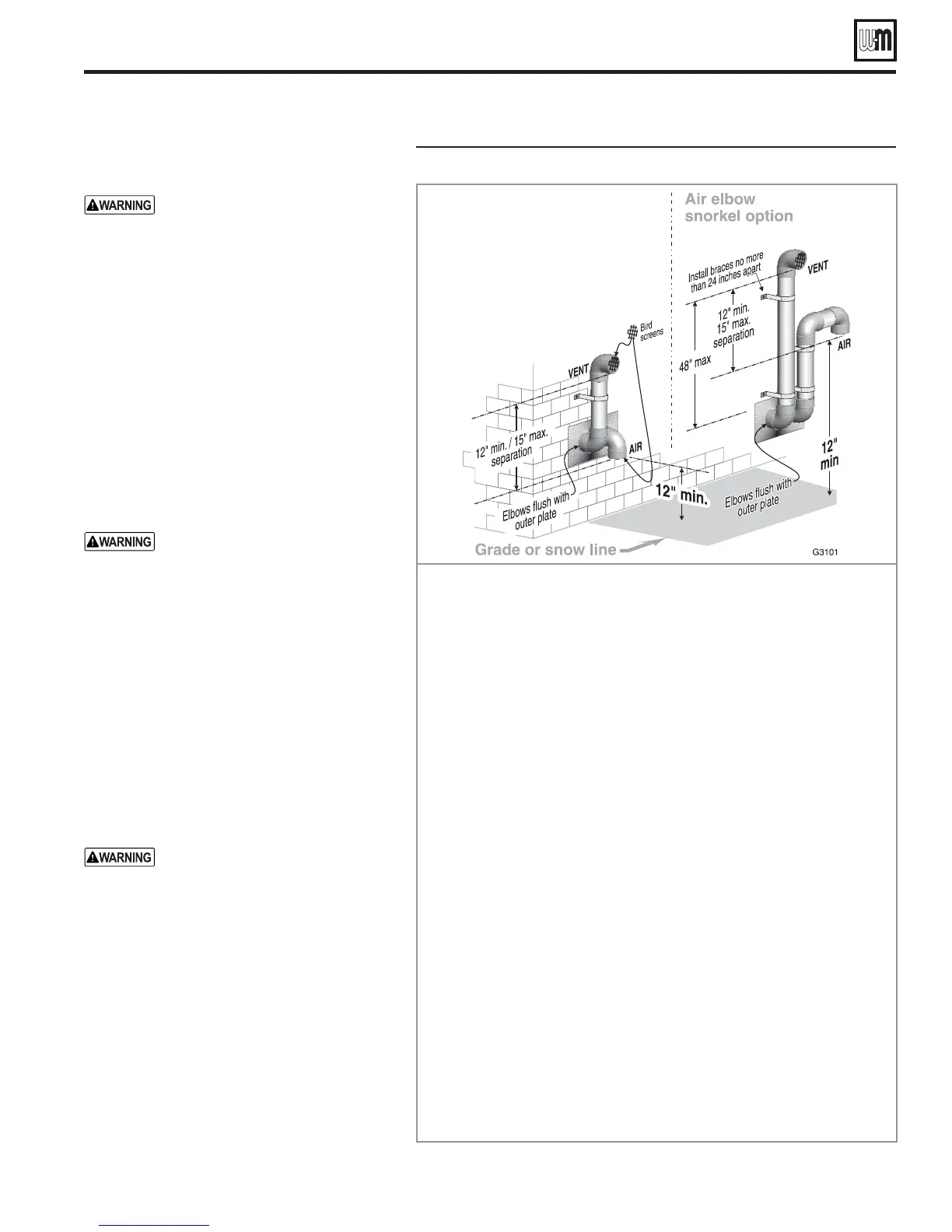
&IGURE ).34!,,!4)/.3%15%.#% — Separate pipes sidewall
3TEP Read and follow all instructions in this manual. $/./4PROCEEDWITH
VENTAIRINSTALLATIONUNTILYOUHAVEREADPAGETHROUGHPAGE
3TEP Install the boiler in a location that allows proper routing of all vent and air
piping to the selected sidewall location.
3TEP Make sure the selected sidewall termination location complies with Fig-
ure 41, page 35. (Multiple boiler sidewall plates must also comply with
Figure 48, page 40.)
3TEP Use only the vent materials listed in Figure 40, page 33. Provide pipe adapt-
ers where required. Vent piping and air piping lengths must not exceed the
values shown in Figure 39, page 32.
3TEP Prepare the sidewall penetrations and secure the sidewall plates as instructed
in this section. See “Prepare wall penetrations” on page 40.
3TEP The air piping must terminate in a DOWNTURNEDELBOW as shown above.
The vent piping must terminate in an ELBOWPOINTEDOUTWARDORAWAY
FROMTHEAIRINLET as shown above. See illustration above.
3TEP Install vent and air piping between the boiler and the sidewall openings.
Slope horizontal piping downward toward the boiler at least 1/4 inch per
foot. See page 48 for general guidelines.
3TEP Install pipe supports every 5 feet on both the horizontal and vertical runs.
Install a hanger support within 6 inches of any upturn in the piping.
3TEP Attach the vent termination exterior piping: Use either of the configurations
shown above, as needed to ensure clearance above grade or snow line. Keep
vents/air intake area clear of accumulating snow.
3TEP The vent and air pipes may run up as high as 4 feet with no enclosure.
The vent and air pipes must be secured with braces, and all clearances and
lengths must be maintained. Space braces no further than 24 inches apart.
3TEP External venting greater than 4 feet requires an insulated enclosure around
the vent and air pipes. The vent and air terminations must exit through
the enclosure as shown in the illustration above, maintaining all required
clearances.
GV90+ Series 2 GAS-FIRED WATER BOILER — Boiler Manual
DIRECT VENT — 3IDEWALLWITHSEPARATEPIPES






 To Next Page