Part number 550-142-903/1016
60
2. See Replacement parts, Figure 96, page 91 of this manual for
Weil-McLain part numbers to obtain antifreeze through a Weil-
McLain distributor.
5SETHECORRECTAMOUNTOFANTIFREEZE
1. Determine the freezing temperature needed (to protect against
lowest likely temperature the system water will encounter).
2. Find the antifreeze concentration by volume needed for this tem-
perature from the antifreeze manufacturer’s data on the antifreeze
container.
3. Add up the volume (gallons) of all system piping and components,
including the expansion tank and boiler.
a. Boiler water content is listed in Figure 109, page 103.
b. Remember to include expansion tank water content.
4. Multiply this volume by the (percent) antifreeze needed to find the
number of gallons of antifreeze to add.
Fill and test water system
1. Fill system only after ensuring the water meets the requirements
of this manual.
0URGEAIRFROMWATERSYSTEM
1. Connect a hose to the purge valve (see purge/drain valves in piping
diagrams beginning with Figure 17, page 16. Route hose to an area
where water can drain and be seen.
2. Close the boiler or system isolation valve between the purge valve
and fill connection to the system.
3. Close zone isolation valves.
4. Open quick-fill valve on cold water make-up line.
5. Open purge valve.
6. One zone at a time, open the isolation valves. Allow water to run
through the zone, pushing out the air. Run until no noticeable air
flow is present. Close the zone isolation valves and proceed with
the next zone. Follow this procedure until all zones are purged.
7. Close the quick-fill water valve and purge valve and remove the
hose. Open all isolation valves. Watch that system pressure rises to
correct cold-fill pressure.
8. After the system has operated for a while, eliminate any residual
air by using the manual air vents located throughout the system.
9. If purge valves are not installed in system, open manual air vents
in system one at a time, beginning with lowest floor. Close vent
when water squirts out. Repeat with remaining vents.
10. Open automatic air vent (diaphragm-type or bladder-type expan-
sion tank systems only) one turn.
11. Starting on the lowest floor, open air vents one at a time until
water squirts out.
12. Repeat with remaining vents.
0RESSURIZESYSTEM
1. Close manual and automatic air vents and boiler drain valve.
2. Fill system to correct system pressure. Correct pressure will vary
with each application.
a. Typical cold water fill pressure for a residential system is 12 psi
(when using a 30 PSIG boiler relief valve).
b. Pressure will rise when boiler is turned on and sys-
tem water temperature increases. Operating pressure
must never exceed 5 PSIG less than the boiler relief
valve setting.
3. At initial fill and during boiler startup and testing, check
system thoroughly for any leaks. Repair all leaks before
proceeding further.
Eliminate all system leaks. Continual fresh
make-up water will reduce boiler life. Minerals
can build up in sections, reducing heat trans-
fer, overheating heat exchanger, and causing
heat exchanger failure.
Use inhibitor supplied with boiler
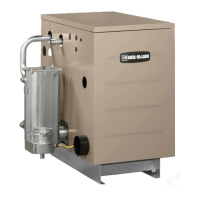
1. The GV90+ boiler is shipped with Sentinel X100 inhibi-
tor and Sentinel inhibitor test kit. See Replacement parts
at the end of this manual for re-ordering information.
2. After filling the system as directed in these instructions,
use a caulking gun to inject the X100 inhibitor into the
system, following the instructions on the tube.
3. Inject all of the inhibitor supplied with the boiler. Allow
time for the water to circulate and mix. Then check the
inhibitor level. Add additional inhibitor if necessary.
Check/verify water chemistry
1. The system may have residual substances that could
affect water chemistry.
2. After the system has been filled and leak tested, verify
water pH and chlorine concentrations are acceptable.
3. Verify antifreeze concentration, when used.
4. Follow the instructions on the Sentinel test kit to sample
the system water and verify inhibitor concentration.
Check inhibitor concentration
annually
1. Test the pH of a sample of system water at least annu-
ally. The pH of the water mixture must be between 7.0
and 8.5. (Or use the Sentinel inhibitor test kit to check
concentration.)
2. If pH is outside this range (or inhibitor test kit indicates
low level), the inhibitor level may not be sufficient to
prevent corrosion.
3. Test antifreeze concentration.
Test antifreeze concentration at least annually.
If concentration is low, add antifreeze or drain
system and refill with correct mixture.
4. Follow instructions on antifreeze container to determine
the amount of antifreeze needed.
$/./4 exceed 50%
by volume concentration of antifreeze.
5. Check inhibitor level after adjustments are made.
GV90+ Series 2 GAS-FIRED WATER BOILER — Boiler Manual
Start-up (continued)






 To Next Page