DC
ELECTRICAL
SYSTEM/ALTERNATOR
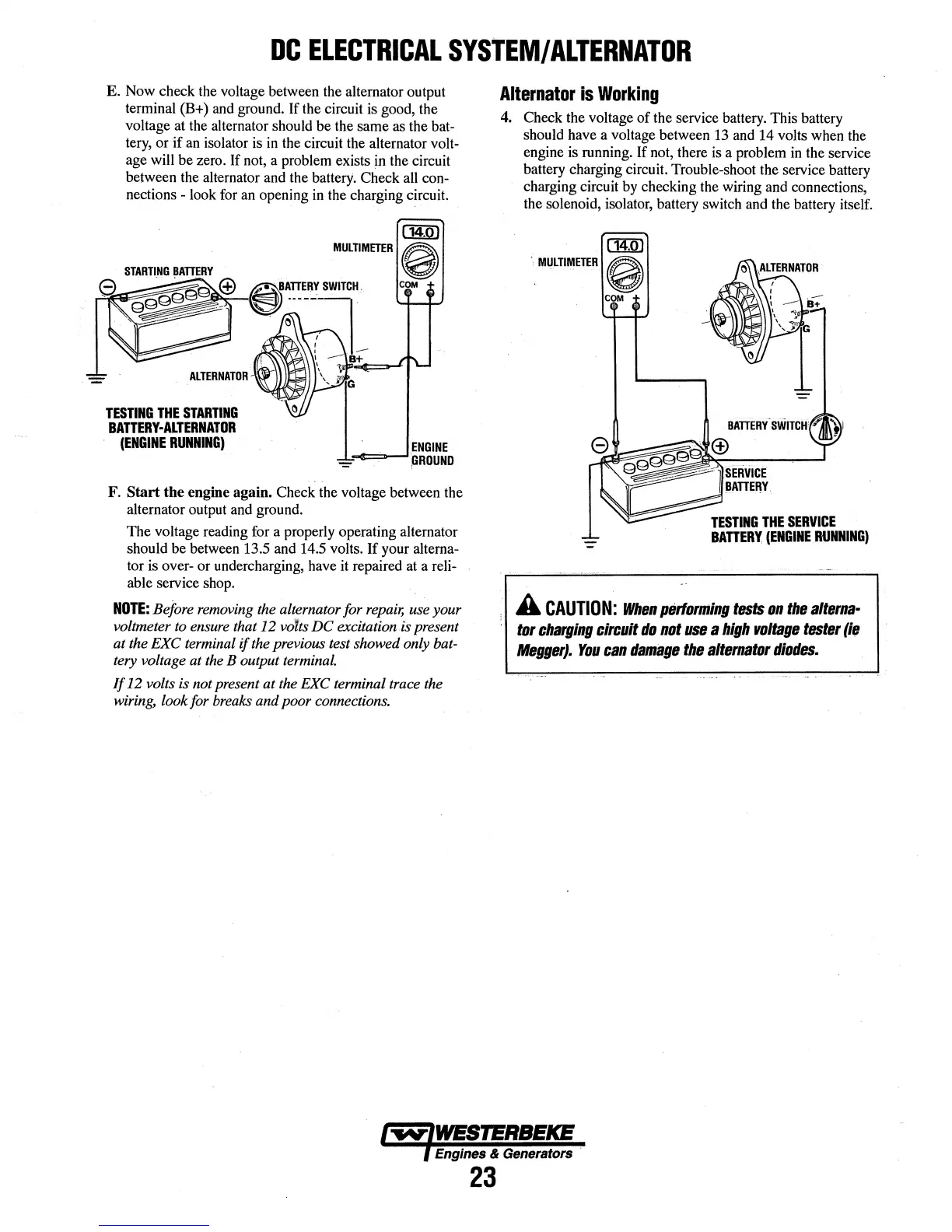
E.
Now check the voltage between the alternator output
terminal (B+) and ground. If the circuit is good, the
voltage at the alternator should
be
the same as the bat-
tery, or
if
an isolator is
in
the circuit the alternator volt-
age will
be
zero. If not, a problem exists in the circuit
between the alternator and the
battery. Check all con-
nections - look for an opening
in
the charging circuit.
TESTING
THE
STARTING
BAnERY-ALTERNATOR
(ENGINE
RUNNING)
M
ULTIMETER
ITCH,
-
L
miD
0
COM
/
t'L
,ENGIN
E
~ROUND
F.
Start
the
engine
again.
Check the voltage between the
alternator output and ground.
The
voltage reading for a properly operating alternator
should be between 13.5 and 14.5 volts.
If
your alterna-
tor is over-
or
undercharging, have it repaired at a reli-
able service shop.
NOTE:
Bejore removing the alternator for
repair,
use
your
voltmeter
to
ensure
that 12 vofts DC excitation is present
at the EXC terminal
if
the previous test showed only bat-
tery
voltage at
the
B output
terminaL
If
12 volts is not present at the EXC terminal trace
the
wiring,
look for breaks and poor connections.
Alternator
is
Working
4. Check the voltage
of
the service battery. This battery
should have a voltage between 13 and 14 volts when the
engine is running. If not, there is a problem
in
the service
battery charging circuit. Trouble-shoot the service battery
charging circuit by checking the wiring and connections,
the solenoid, isolator, battery switch and the battery itself.
am
.
MULTIMETER
0
COM
-
SERVICE'
JIATT~IW.
TESTING
THE
SERVICE
BAnERY
(ENGINE
RUNNING)
...
A
CAUTION:
When
pfidorm/ng
tests
on
the
alterna·
tor
charging
cln:ult
do
not
use
a
high
voltage
testsr
(le
Megger}.
You
can
damage
the
alternator
diodes.
Engines & Generators ·
23



 To Next Page