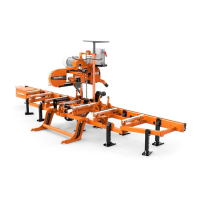
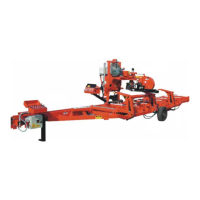
Sawmill Operation
Loading, Turning and Clamping Logs
Sawmill Operation doc072221 3-22
3
3.19 Loading, Turning and Clamping Logs
To load a log:
1. Move the saw head to the front end of the frame.
CAUTION! Before loading a log, be sure the saw head is moved far
enough forward so the log does not hit it. Failure to do so may result in
machine damage.
2. Lower the log clamp completely and move it toward the loading side of the sawmill frame.
CAUTION! Be sure the log clamp is all the way down before loading a
log onto the bed. Failure to do so may result in machine damage.
3. Raise the side supports on the sawmill bed to prevent the log from falling off the side of the bed.
4. Position the log parallel to the sawmill bed.
5. Use a cant hook to roll the log onto the sawmill bed. Position the log against the side supports.
If your sawmill is not equipped with the loading ramps, use other log loading equipment to load the
log onto the sawmill bed. You can also use boards to do this.
To turn a log:
1. Use a cant hook to spin the log against the side supports until it is turned the way you want it for the
first cut.
To clamp a log:
1. Position the log clamps against the log, far enough down so they are below your cuts on a given
sideof the log. Using the clamp handle, move the log firmly against the side supports.
2. Be sure to leave the crank in the bottom position to avoid damage to the blade during sawing
operation.



 To Next Page
 Loading...