RM200QC User Manual
15
Selecting Samples
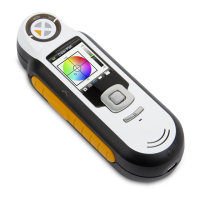
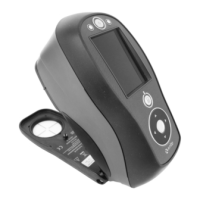
The RM200QC instrument is unique in that is has been designed to measure a wide variety of samples
without the limitations on minimum size or surface textures. RM200QC employs the principle of
WYSIWYG (What You See Is What You Get).
The advanced X-Rite camera technology and state of the art multi directional LED illumination enables
the instrument to:
• Compensate for surface irregularities with the use of a surface flatten algorithm. This
enables comparison between textured sample measurements.
• Measure Small (4 mm) and Large (8 mm) sample areas.
Obtaining a Good Measurement
The instrument works best on samples that are dry and opaque. Samples can be oriented
horizontally (on a table top), vertically, or at an angle. To obtain a good measurement, make
sure the instrument is flat against the sample and is held steady during the measurement.
Curved or uneven sample: If the standard or sample has a curved or uneven surface, use the
averaging option (refer to the Settings menu section). This allows you to take more than one
measurement of a sample to obtain an average value.
Thin or translucent sample: If the sample is thin, place it on a flat surface before taking a
measurement. If the sample is not opaque, place it on a white (plain paper) backing before
taking a measurement.
Non-ideal Samples
Successful measurements will be difficult or impossible to obtain if samples appear unusually
bright (may contain fluorescing pigments).




 To Next Page