EasyManua.ls Logo

Yamaha RX5 - Page 14

Yamaha RX5
81 pages
Print Icon
To Next Page IconTo Next Page
To Previous Page IconTo Previous Page
Loading...
10
PATTERN
OPERATIONS
During
play,
the
RUN
LED
will
light.
Also,
as
Pattern
00
is
a
two-bar
Pattern,
the
LCD
will
alternate
between
bar
1
and
bar
2,
as
these
bars
are
played.
2.
New
Patterns
can
be
selected
during
play,
using
either
of
the
two
methods
described
in
PATTERN
SELECTION.
The
newly
selected
Pattern
will
commence
playing
immediately
after
the
last
beat
of
the
first
Pattern.
3.
To
stop
play,
press
STOP/CONTINUE.
The
RUN
LED
will
go
out,
and
the
LCD
will
show
the
bar
in
which
play
was
stopped.
4.
To
restart
play,
press
START
to
play
from
the
beginning
of
the
Pattern,
or
STOP/
CONTINUE,
to
play
from
the
point
at
which
play
was
stopped.
e
During
Pattern
Play,
you
can
alter
the
Tempo,
turn
on
the
Click
function
and
change
the
Click
rate.
These
functions
are
described
later
in
this
chapter
REAL
TIME
WRITE
MODE
NOTE:
The
Quantize
Function,
described
later
in
this
chapter,
needs
to
be
understood
before
you
сап
write
a
Pattern.
We
suggest
that
you
read
the
Quantize
section,
after
reading
this
section,
before
writing
a
Pattern
FUNCTION
write
a
Pattern
using
the
Real
Time
Write
function.
This
is
the
first
of
two
ways
of
writing
Patterns
on
the
RX5.
It
lets
you
"play"
a
Pattern
on
the
instrument
keys,
while
listening
to
a
click
guide.
You
can
add
instruments
and
rhythms
until
the
Pattern
is
complete.
The
advantage
of
this
methed
is
that
you
can
actually
hear
the
Pattern
being
built
up
as
you
write
it,
as
opposed
to
Step
Write,
where
a
Pattern
is
built
up
without
hearing
it.
OPERATION
SETTING
PATTERN
PARAMETERS
Prior
to
writing
a
new
Pattern
its
parameters
the
time
signature
and
length
{in
bars)
must
be
set.
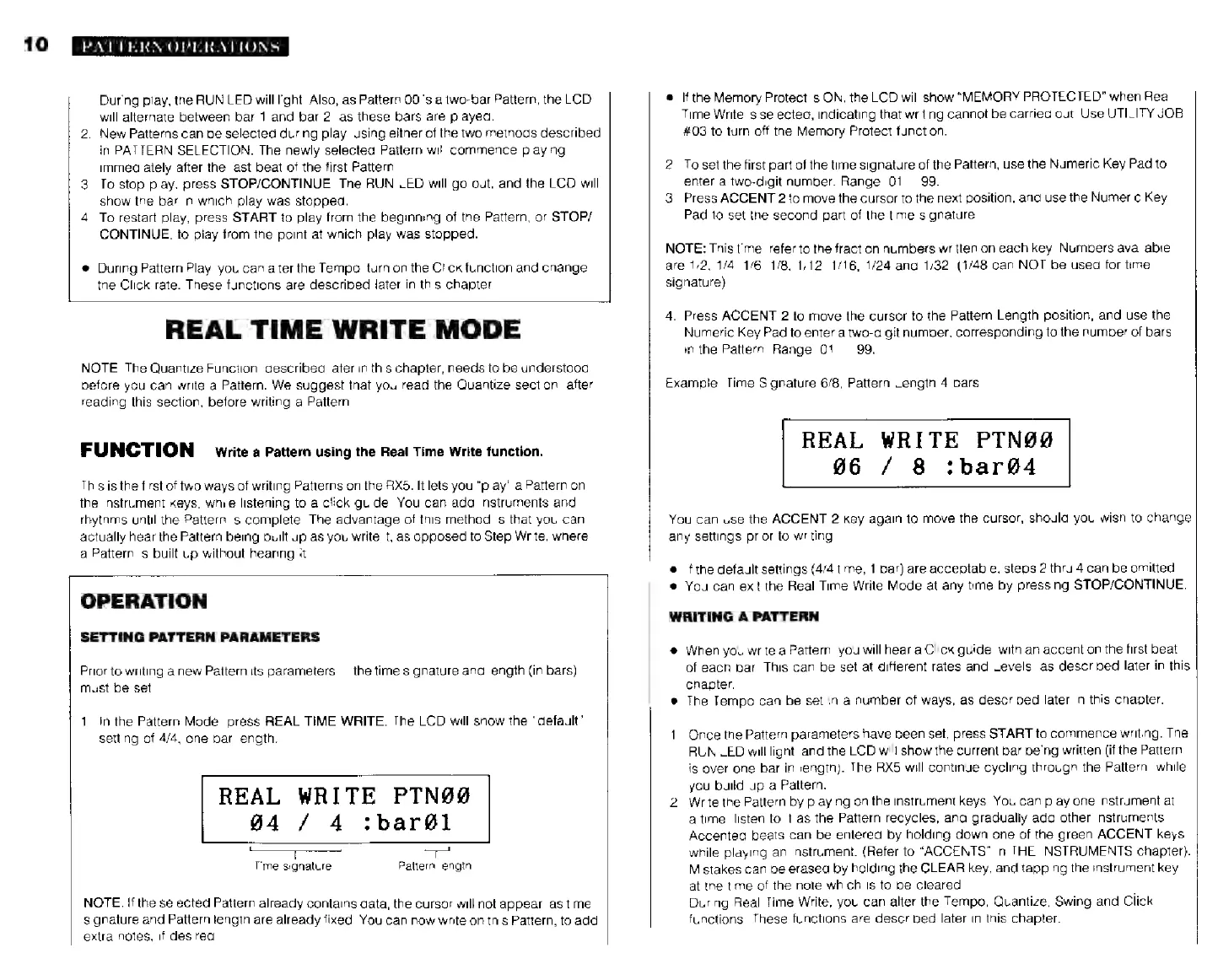
1.
Inthe
Pattern
Mode,
press
REAL
TIME
WRITE.
The
LCD
will
show
the
“default”
setting
of
4/4,
one
bar
length.
REAL
WRITE
PTN99
04
/
4
:bar@l
Tirne
signature
Pattern
length
NOTE:
If
the
selected
Pattern
already
contains
data,
the
cursor
will
not
appear,
as
time
signature
and
Pattern
tength
are
already
fixed.
You
can
now
write
on
this
Pattern,
to
add
extra
notes,
if
desired.
e
Ifthe
Memory
Protect
is
ON,
the
LCD
will
show
"MEMORY
PROTECTED"
when
Real
Time
Write
is
selected,
indicating
that
writing
cannot
be
carried
out.
Use
UTILITY
JOB
#03
to
turn
off
the
Memory
Protect
function.
2.
To
set
the
first
part
of
the
time
signature
of
the
Pattern,
use
the
Numeric
Key
Pad
to
enter
a
two-digit
number.
Range:
01
99.
3.
Press
ACCENT
2
to
move
the
cursor
to
the
next
position,
and
use
the
Numeric
Key
Pad
to
set
the
second
рап
of
the
time
signature.
NOTE:
This
time,
refer
to
the
fraction
numbers
written
on
each
key.
Numbers
available
аге
1/2, 1/4, 1/6,
1/8,
1/12,
1/16,
1/24
and
1/32.
(1/48
can
NOT
be
used
for
time
signature).
4.
Press
ACCENT
2
to
move
the
cursor
to
the
Pattern
Length
position,
and
use
the
Numeric
Key
Pad
to
enter
a
two-digit
number,
corresponding
to
the
number
of
bars
in
the
Pattern,
Range:
01
99.
Example:
Time
Signature
6/8,
Pattern
Length
4
bars.
REAL
WRITE
PTN99
96
/
8
:bar£4
You
can
use
the
ACCENT
2
key
again
to
move
the
cursor,
should
you
wish
to
change
апу
settings
prior
to
writing
е
|fthe
default
settings
(4/4
time,
1
bar)
are
acceptable,
steps
2
thru
4
can
be
omitted
*
You
can
exit
the
Real
Time
Write
Mode
at
any
time
by
pressing
STOP/CONTINUE.
WRITING
A
PATTERN
ж
When
you
write
a
Pattern,
you
will
hear
a
Click
guide,
with
an
accent
on
the
first
beat
of
each
bar.
This
can
be
set
at
different
rates
and
Levels,
as
described
later
in
this
chapter.
*
The
Tempo
can
be
set
in
à
number
of
ways,
as
described
later
in
this
chapter.
1.
Once
the
Pattern
parameters
have
been
set,
press
START
to
commence
writing.
The
RUN
LED
will
light,
and
the
LCD
will
show
the
current
bar
being
written
(if
the
Pattern
is
over
one
bar
in
length).
The
RX5
will
continue
cycling
through
the
Pattern,
while
you
build
up
a
Pattern.
2.
Write
the
Pattern
by
playing
on
the
instrument
keys.
You
can
play
one
instrument
at
a
time,
listen
to
it
as
the
Pattern
recycles,
and
gradually
add
other
instruments.
Accented
beats
can
be
entered
by
holding
down
one
of
the
green
ACCENT
keys
while
playing
an
instrument.
(Refer
to
“ACCENTS”
in
THE
INSTRUMENTS
chapter).
Mistakes
can
be
erased
by
holding
the
CLEAR
key,
and
tapping
the
instrument
key
at
the
time
of
the
note
which
is
to
be
cleared
During
Real
Time
Write,
you
can
alter
the
Tempo,
Quantize,
Swing
and
Click
functions.
These
functions
are
described
later
in
this
chapter.