EasyManua.ls Logo

Yamaha V50 - Micro Tuning Select

Yamaha V50
81 pages
Print Icon
To Next Page IconTo Next Page
To Previous Page IconTo Previous Page
Loading...
Micro
tuning
select
Æ
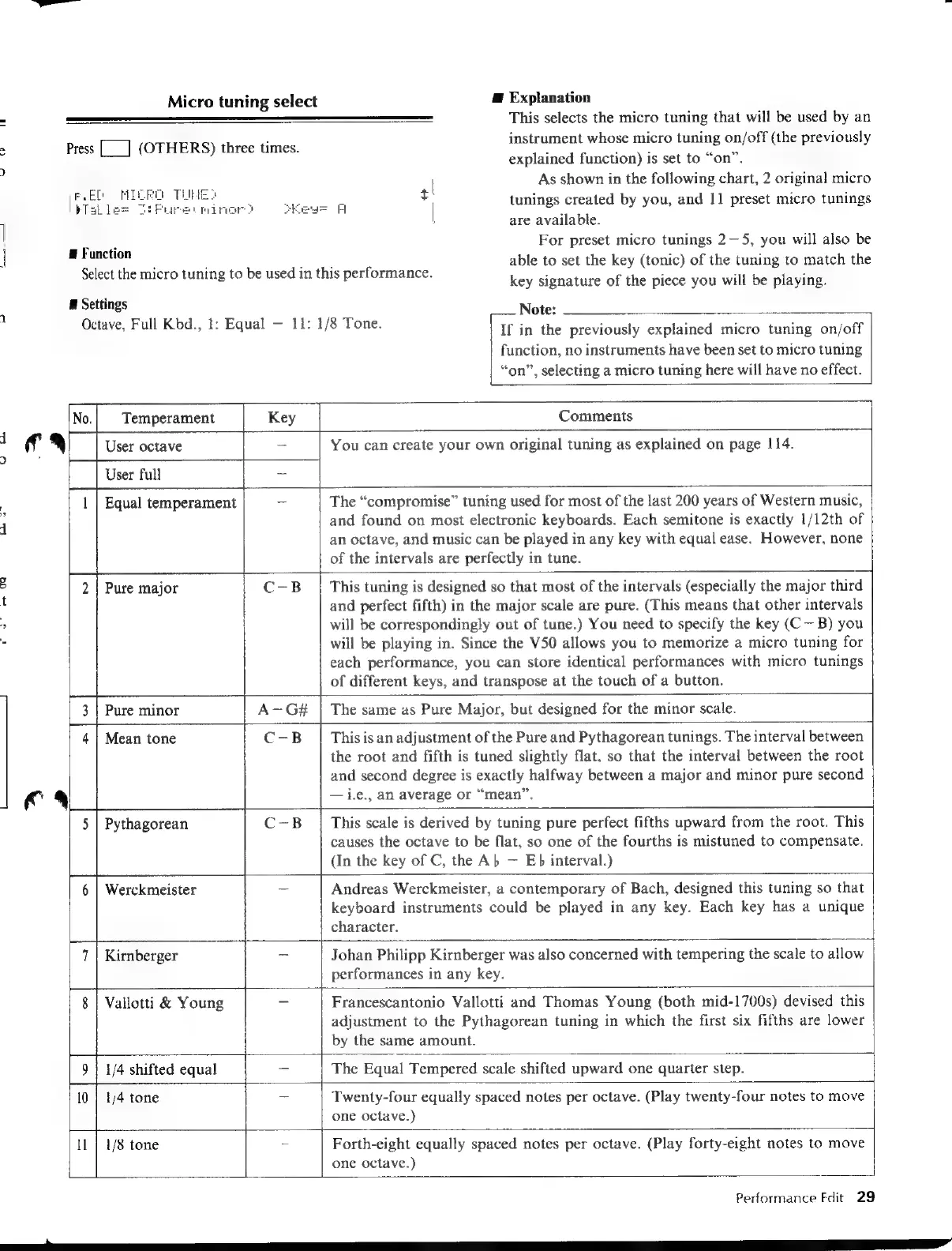
Explanation
Press
FEL
eT
i
TUHE
i
2
Pye
HIE
ables
#
Function
Select
the
micro
tuning
to
be
used
in
this
performance.
E
Settings
Octave,
Full
Kbd.,
t:
Equal
11:
1/8
Tone.
minori
L]
(OTHERS)
three
times.
“Kes=
This
selects
the
micro
tuning
that
will
be
used
by
an
instrument
whose
micro
tuning
on/off
(the
previously
explained
function)
is
set
to
“on”.
i
As
shown
in
the
following
chart,
2
original
micro
tunings
created
by
you,
and
11
preset
micro
tunings
are
available.
For
preset
micro
tunings
2—5,
you
will
also
be
able
to
set
the
key
(tonic)
of
the
tuning
to
match
the
key
signature
of
the
piece
you
will
be
playing.
Note:
If
in
the
previously
explained
micro
tuning
on/off
function,
no
instruments
have
been
set
to
micro
tuning
“on”,
selecting
a
micro
tuning
here
will
have
no
effect.
No.
f
h
|
User
octave
Temperament
Key
Comments
User
full
You
can
create
your
own
original
tuning
as
explained
on
page
114.
Pure
major
Equal
temperament
The
“compromise”
tuning
used
for
most
of
the
last
200
years
of
Western
music,
and
found
on
most
electronic
keyboards.
Each
semitone
is
exactly
1/12th
of
an
octave,
and
music
can
be
played
in
any
key
with
equal
ease.
However,
none
of
the
intervals
are
perfectly
in
tune.
This
tuning
is
designed
so
that
most
of
the
intervals
(especially
the
major
third
and
perfect
fifth)
in
the
major
scale
are
pure.
(This
means
that
other
intervals
will
be
correspondingly
out
of
tune.)
You
need
to
specify
the
key
(C~
B)
you
will
be
playing
in.
Since
the
V50
allows
you
to
memorize
a
micro
tuning
for
each
performance,
you
can
store
identical
performances
with
micro
tunings
of
different
keys,
and
transpose
at
the
touch
of
a
button.
3
|
Pure
minor
|
A-~G#
|
The
same
as
Pure
Major,
but
designed
for
the
minor
scale.
4
|
Mean
tone
C-B
This
is
an
adjustment
of
the
Pure
and
Pythagorean
tunings.
The
interval
between
the
root
and
fifth
is
tuned
slightly
flat,
so
that
the
interval
between
the
root
and
second
degree
is
exactly
halfway
between
a
major
and
minor
pure
second
«
4
i.e.,
an
average
or
“mean”.
e
5
|
Pythagorean
C-B
This
scale
is
derived
by
tuning
pure
perfect
fifths
upward
from
the
root.
This
causes
the
octave
to
be
flat,
so
one
of
the
fourths
is
mistuned
to
compensate.
(In
the
key
of
C,
the
Ap
Eb
interval.)
6
|
Werckmeister
i
Andreas
Werckmeister,
a
contemporary
of
Bach,
designed
this
tuning
so
that
keyboard
instruments
could
be
played
in
any
key.
Each
key
has
a
unique
character.
7
|
Kirnberger
T
Johan
Philipp
Kirnberger
was
also
concerned
with
tempering
the
scale
to
allow
performances
in
any
key.
MoT
8
|
Vallotti
&
Young
=
Francescantonio
Vallotti
and
Thomas
Young
(both
mid-1700s)
devised
this
adjustment
to
the
Pythagorean
tuning
in
which
the
first
six
fifths
are
lower
j~
by
the
same
amount.
9
|
1/4
shifted
equal
e
The
Equal
Tempered
scale
shifted
upward
one
quarter
step.
10
|
1/4
tone
a
Twenty-four
equally
spaced
notes
per
octave.
(Play
twenty-four
notes
to
move
one
octave.)
l
1/8
tone
Forth-eight
equally
spaced
notes
per
octave.
{Play
forty-eight
notes
to
move
one
octave.)
Performance
Edit
29
E
Se
A
A
e

Table of Contents

Other manuals for Yamaha V50

Related product manuals