EasyManua.ls Logo

Yamaha V50 - Voice Editing Core Functions

Yamaha V50
81 pages
Print Icon
To Next Page IconTo Next Page
To Previous Page IconTo Previous Page
Loading...
ABOUT
VOICE
EDITING
Broadly
speaking,
there
are
two
ways
to
edit
voices.
(1)
Partially
modify
an
existing
voice
to
create
a
new
voice.
(2)
Create
a
completely
new
voice
from
scratch.
When
first
learning
how
to
edit
voices,
it
will
be
easier
to
start
with
method
(1).
You
can
modify
internal,
card,
or
preset
voices.
Remember
that
the
voice
you
create
can
be
stored
only
as
an
internal
voice
or
card
voice.
(It
is
not
possible
to
store
a
voice
into
preset
voice
me-
mory.)
When
using
method
(1),
enter
single
play
mode
and
select
the
voice
you
want
to
edit.
When
using
method
(2),
you
must
first
create
an
“initialized”
voice
using
the
OTHERS]
function
“Init”
(initialize)
(see
page
117).
Note:
After
editing
a
voice,
do
not
forget
to
store
it
(see
page
119).
If
after
editing
a
voice,
you
select
another
voice
without
storing
the
voice
you
edited,
your
edits
will
be
replaced
by
the
previous
voice
data.
However,
you
can
recall
the
data
you
were
editing
by
using
the
recall
function
in
[OTHERS]
(see
page
117).
Initialized
voice
“Initialized”
means
that
many
of
the
settings
are
set
to
their
minimum
or
most
basic
value.
The
initialized
voice
will
produce
the
simplest
possible
sound
(a
sine
wave)
from
operator
1.
While
editing
a
voice,
you
can
compare
the
results
of
your
editing
with
the
original
voice
by
using
the
“compare”
function
(see
page
121).
OPERATOR
ON/OFF
LE
IE
TE
LT
LT
ITNT
A
A
ET
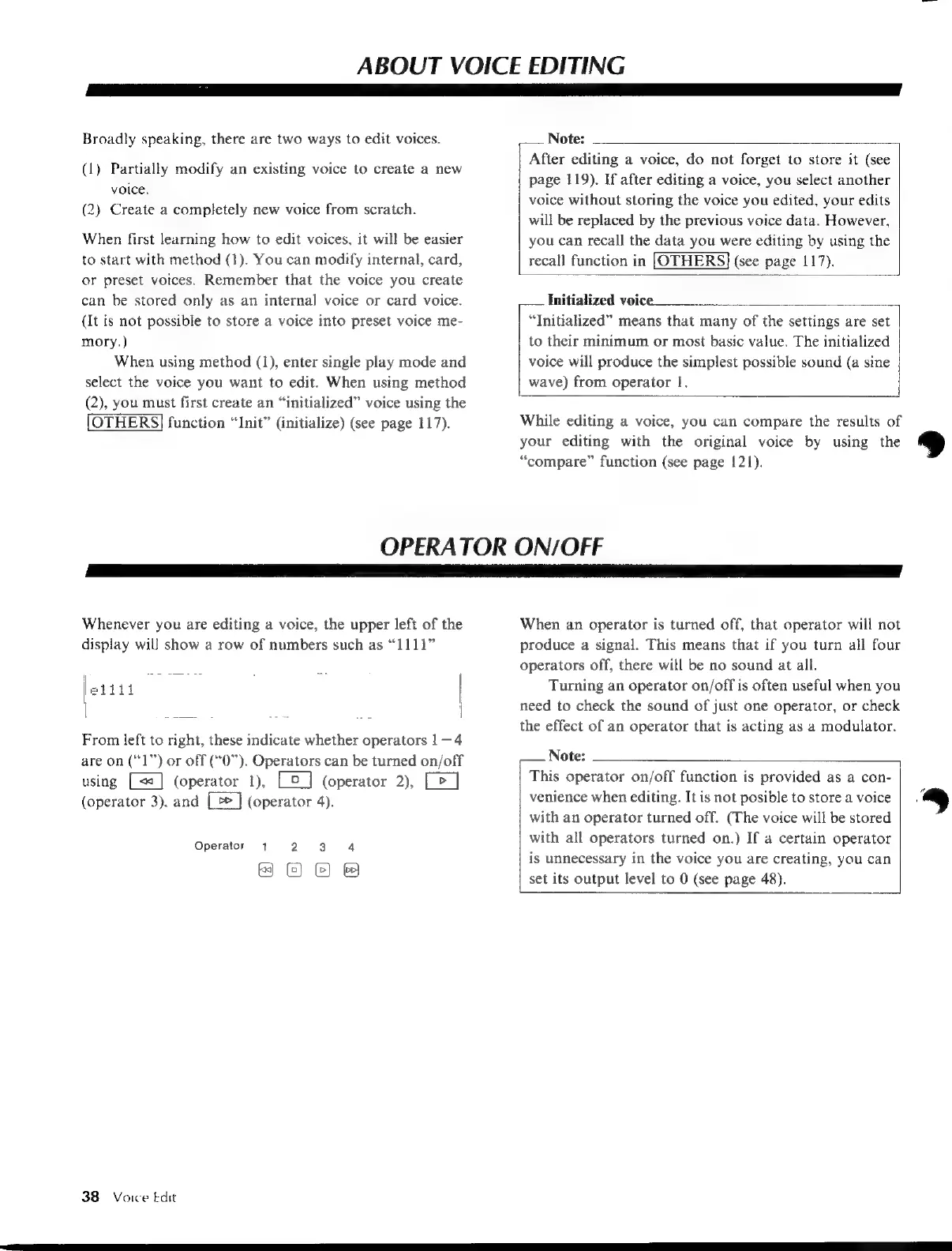
Whenever
you
are
editing
a
voice,
the
upper
left
of
the
display
will
show
a
row
of
numbers
such
as
“1111”
aa
|
|
s
À
l
|
From
left
to
right,
these
indicate
whether
operators
|
4
are
on
(“1”)
or
off
(“0”).
Operators
can
be
turned
on/off
using
(operator
1),
Le]
(operator
2),
[>
]
(operator
3),
and
(operator
4).
Operator
(Bos
1
2
3
@
()
e
38
Voice
Edit
When
an
operator
is
turned
off,
that
operator
will
not
produce
a
signal.
This
means
that
if
you
turn
all
four
operators
off,
there
will
be
no
sound
at
all.
Turning
an
operator
on/off
is
often
useful
when
you
need
to
check
the
sound
of
just
one
operator,
or
check
the
effect
of
an
operator
that
is
acting
as
a
modulator.
Note:
This
operator
on/off
function
is
provided
as
a
con-
venience
when
editing.
It is
not
posible
to
store
a
voice
with
an
operator
turned
off.
(The
voice
will
be
stored
with
all
operators
turned
on.)
If
a
certain
operator
is
unnecessary
in
the
voice
you
are
creating,
you
can
set
its
output
level
to
0
(see
page
48).

Table of Contents