EasyManua.ls Logo

Yamaha V50 - Algorithmi Ieena Ea; Factors Determining the Tone of a Voice

Yamaha V50
81 pages
Print Icon
To Next Page IconTo Next Page
To Previous Page IconTo Previous Page
Loading...
le
—————OOOOEOEeeeeeeeeeeeeeeeeeeeeeeeeeeEeEeEEeeEeEeeeee
cy
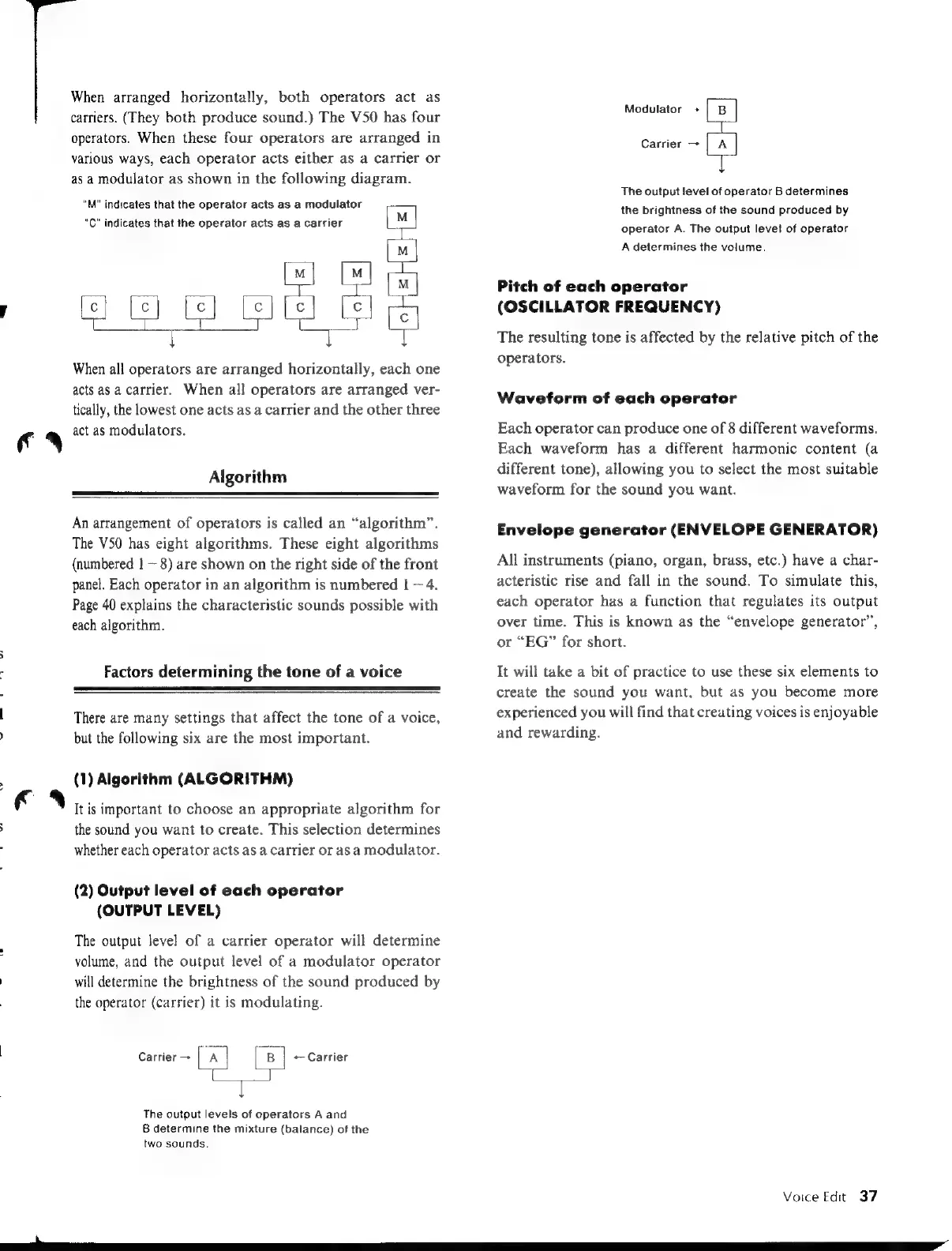
When
arranged
horizontally,
both
operators
act
as
carriers.
(They
both
produce
sound.)
The
V50
has
four
operators.
When
these
four
operators
are
arranged
in
various
ways,
each
operator
acts
either
as
a
carrier
or
as
a
modulator
as
shown
in
the
following
diagram.
“M”
indicates
that
the
operator
acts
as
a
modulator
“C”
indicates
that
the
operator
acts
as
a
carrier
M
M
M
M
M
(03
Cc
Cc
C
C
Cc
Cc
When
all
operators
are
arranged
horizontally,
each
one
acts
as
a
carrier.
When
all
operators
are
arranged
ver-
tically,
the
lowest
one
acts
as
a
carrier
and
the
other
three
act
as
modulators.
Algorithm
An
arrangement
of
operators
is
called
an
“algorithm”.
The
V50
has
eight
algorithms.
These
eight
algorithms
(numbered
|
8)
are
shown
on
the
right
side
of
the
front
panel.
Each
operator
in
an
algorithm
is
numbered
|
4.
Page
40
explains
the
characteristic
sounds
possible
with
each
algorithm.
Factors
determining
the
tone
of
a
voice
There
are
many
settings
that
affect
the
tone
of
a
voice,
but
the
following
six
are
the
most
important.
(1)
Algorithm
(ALGORITHM)
It
is
important
to
choose
an
appropriate
algorithm
for
the
sound
you
want
to
create.
This
selection
determines
whether
each
operator
acts
as
a
carrier
or
as
a
modulator.
(2)
Output
level
of
each
operator
{OUTPUT
LEVEL)
The
output
level
of
a
carrier
operator
will
determine
volume,
and
the
output
level
of
a
modulator
operator
will
determine
the
brightness
of
the
sound
produced
by
the
operator
(carrier)
it
is
modulating.
Carrier
+
[a]
[B]
+
Carrier
Į
The
output
levels
of
operators
A
and
B
determine
the
mixture
(balance)
of
the
two
sounds.
Modulator
>
|
B
Carrier
>
|
A
The
output
level
of
operator
B
determines
the
brightness
of
the
sound
produced
by
operator
A.
The
output
leve!
of
operator
A
determines
the
volume.
Pitch
of
each
operator
(OSCILLATOR
FREQUENCY)
The
resulting
tone
is
affected
by
the
relative
pitch
of
the
operators.
Waveform
of
each
operator
Each
operator
can
produce
one
of
8
different
waveforms.
Each
waveform
has
a
different
harmonic
content
(a
different
tone),
allowing
you
to
select
the
most
suitable
waveform
for the
sound
you
want.
Envelope
generator
(ENVELOPE
GENERATOR)
All
instruments
(piano,
organ,
brass,
etc.)
have
a
char-
acteristic
rise
and
fall
in
the
sound.
To
simulate
this,
each
operator
has
a
function
that
regulates
its
output
over
time.
This
is
known
as
the
“envelope
generator”,
or
“EG”
for
short.
It
will
take
a
bit
of
practice
to
use
these
six
elements
to
create
the
sound
you
want,
but
as
you
become
more
experienced
you
will
find
that
creating
voices
is
enjoyable
and
rewarding.
Voice
Edit
37

Table of Contents

Other manuals for Yamaha V50

Related product manuals