EasyManua.ls Logo

Yamaha V50 - Quick Edit (Brilliance); Algorithm, Feedback

Yamaha V50
81 pages
Print Icon
To Next Page IconTo Next Page
To Previous Page IconTo Previous Page
Loading...
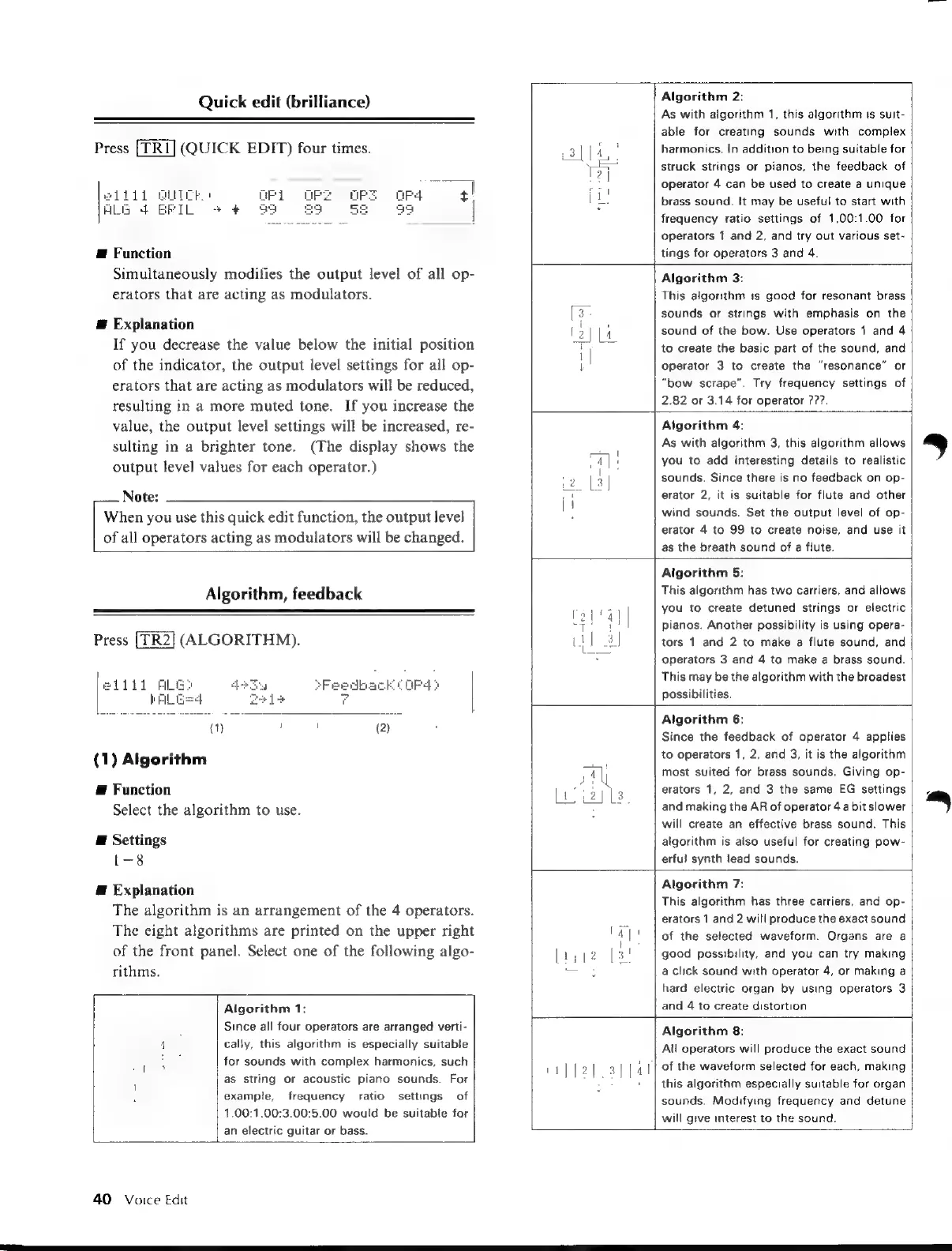
Quick
edit
(brilliance)
Press
(QUICK
EDIT)
four
times.
E
Function
Simultaneously
modifies
the
output
level
of
all
op-
erators
that
are
acting
as
modulators.
@
Explanation
If
you
decrease
the
value
below
the
initial
position
of
the
indicator,
the
output
level
settings
for
all
op-
erators
that
are
acting
as
modulators
will
be
reduced,
resulting
in
a
more
muted
tone.
If
you
increase
the
value,
the
output
level
settings
will
be
increased,
re-
sulting
in
a
brighter
tone.
(The
display
shows
the
output
level
values
for
each
operator.)
Note:
When
you
use
this
quick
edit
function,
the
output
level
of
all
operators
acting
as
modulators
will
be
changed.
Algorithm,
feedback
Press
(ALGORITHM).
(1)
Algorithm
Æ
Function
Select
the
algorithm
to
use.
@
Settings
1-8
Æ
Explanation
The
algorithm
is
an
arrangement
of
the
4
operators.
The
eight
algorithms
are
printed
on
the
upper
right
of
the
front
panel.
Select
one
of
the
following
algo-
rithms.
Algorithm
1:
Since
all
four
operators
are
arranged
verti-
cally,
this
algorithm
is
especially
suitable
for
sounds
with
complex
harmonics,
such
as
string
or
acoustic
piano
sounds.
For
example,
frequency
ratio
settings
of
1.00:1.00:3.00:5.00
wouid
be
suitable
for
an
electric
guitar
or
bass.
40
Voice
Edit
Algorithm
2:
As
with
algorithm
1,
this
algorithm
is
suit-
able
for
creating
sounds
with
complex
harmonics.
In
addition
to
being
suitable
for
struck
strings
or
pianos,
the
feedback
of
operator
4
can
be
used
to
create
a
unique
brass
sound.
It
may
be
useful
to
start
with
frequency
ratio
settings
of
1.00:1.00
for
operators
1
and
2,
and
try
out
various
set-
tings
for
operators
3
and
4.
Algorithm
3:
This
algorithm
is
good
for
resonant
brass
sounds
or
strings
with
emphasis
on
the
sound
of
the
bow.
Use
operators
1
and
4
to
create
the
basic
part
of
the
sound,
and
Operator
3
to
create
the
“resonance”
or
“bow
scrape”.
Try
frequency
settings
of
2.82
or
3.14
for
operator
???.
Algorithm
4:
As
with
algorithm
3, this
algorithm
allows
you
to
add
interesting
details
to
realistic
sounds.
Since
there
is
no
feedback
on
op-
erator
2,
it
is
suitable
for
flute
and
other
wind
sounds.
Set
the
output
level
of
op-
erator
4
to
99
to
create
noise,
and
use
it
as
the
breath
sound
of
a
flute.
sa
PS
a
Algorithm
5:
This
algorithm
has
two
carriers,
and
allows
you
to
create
detuned
strings
or
electric
pianos.
Another
possibility
is
using
opera-
tors
1
and
2
to
make
a
flute
sound,
and
Operators
3
and
4
to
make
a
brass
sound.
This
may
be
the
algorithm
with
the
broadest
possibilities.
Algorithm
6:
Since
the
feedback
of
operator
4
applies
to
operators
1,
2,
and
3,
it
is
the
algorithm
most
suited
for
brass
sounds.
Giving
op-
erators
1,
2,
and
3
the
same
EG
settings
and
making
the
AR
of
operator
4
a
bit
slower
will
create
an
effective
brass
sound.
This
algorithm
is
also
useful
for
creating
pow-
erful
synth
lead
sounds.
Lo
ails.
als
Liye
L!
Algorithm
7:
This
algorithm
has
three
carriers,
and
op-
erators
1
and
2
will
produce
the
exact
sound
of
the
selected
waveform.
Organs
are
a
good
possibility,
and
you
can
try
making
a
click
sound
with
operator
4,
or
making
a
hard
electric
organ
by
using
operators
3
and
4
to
create
distortion.
Algorithm
8:
All
operators
will
produce
the
exact
sound
of
the
waveform
selected
for
each,
making
this
algorithm
especially
suitable
for
organ
sounds.
Modifying
frequency
and
detune
will
give
interest
to
the
sound.

Table of Contents

Other manuals for Yamaha V50

Related product manuals