PARSTAT MC Hardware Manual
PARSTAT MC Hardware Manual 17
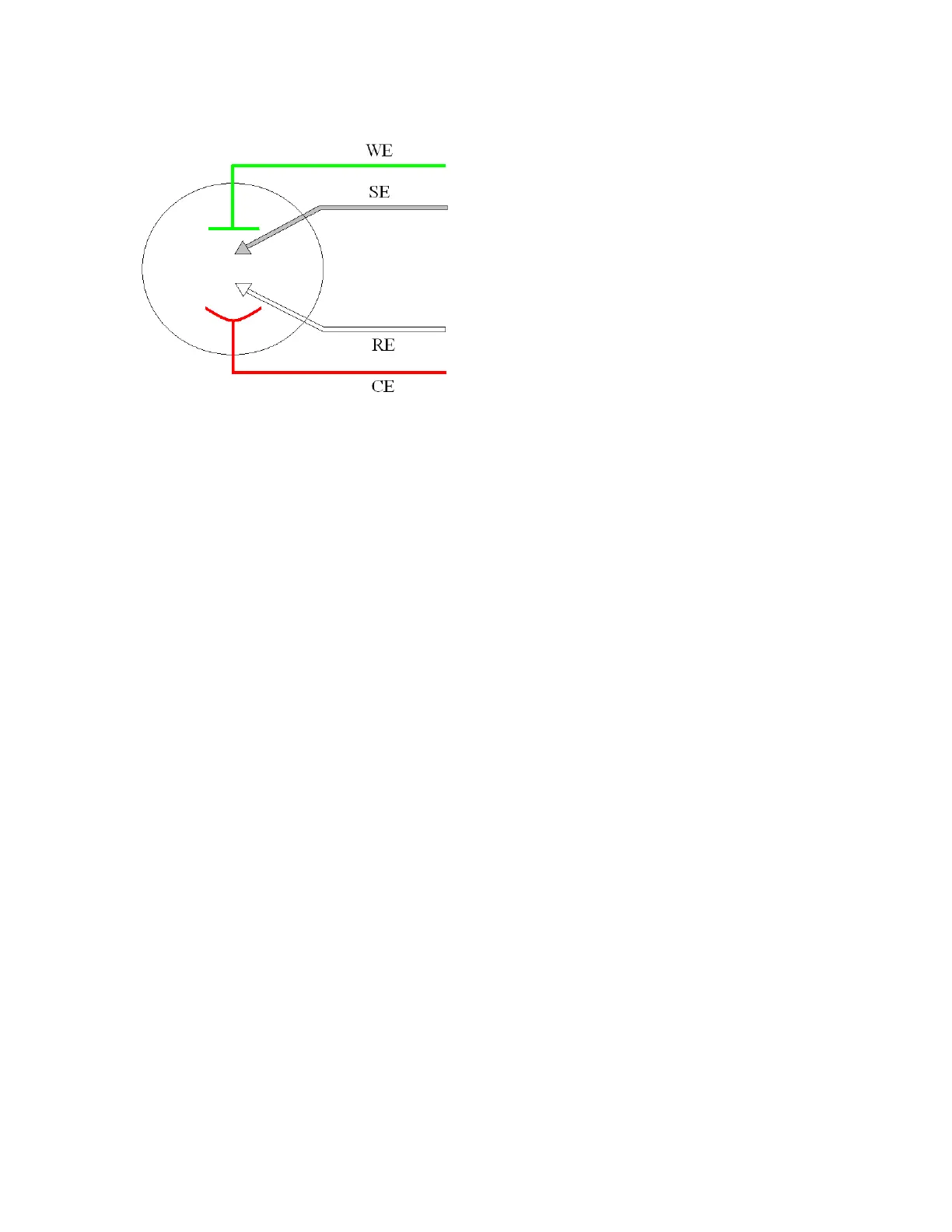
Figure 8. Four-Electrode Connection
CAUTION: Take care that the leads do not accidentally short together. Because the black ground lead
is often unused, it tends to be overlooked and is more likely to accidentally short together with another lead.
The polarity of the potential at the counter electrode will be opposite the “applied potential”. This is
necessary to establish the correct polarity relationship at the working electrode versus the reference
electrode.
After all other connections to the PMC-1000 are made, experiments can be set up and performed.
3.5. Floating Operation
The PMC-1000 and PMC-1000/DC were designed to operate in either a “normal” mode or a “floating” mode.
The floating mode provides the capability to operate with cells where one of the electrodes or the cell itself
is at earth ground. Examples of earth grounded cells include autoclaves, strain apparatus, storage tanks
and pipelines, and additional electrodes connected to a separate potentiostat that is not floating.
In floating mode, the internal ground of the PMC-1000 and PMC-1000/DC (as well as the cell leads and
external connections at the rear panel) is allowed to float with respect to earth ground which allows it to
operate with these grounded cells.
NOTE: Instrument performance, particularly with regards to current and voltage noise, can be substantially
degraded when operating in float mode on grounded cells, the level of degradation depending on the
technique and the impedance between the electrodes and ground. Therefore specifications listed in
Section 5 apply only to isolated cells with the PMC-1000 set to normal mode.
The following section gives instructions on setting the PMC-1000 and PMC-1000/DC to the floating mode.
3.5.1. Setting Operation Modes of Float and Normal











 To Next Page