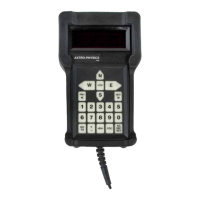
31
OBJECTS MENU – HAVE SOME FUN!
Tips for Using the Buttons and Menus
● Correcting data entries – When entering catalog numbers into the Keypad,
you can use <PREV button to delete last digit entered. Enter correct digit.
● Scrolling object lists – Some of the object selection screens will display
“<“ and/or “>“, usually in the corners. These symbols indicate that you can
scroll a list of objects using the <PREV or NEXT> buttons. If you hold these
buttons, the object names will scroll quickly in some screens (e.g. stars).
● N–S–E–W directional buttons – The N-S-E-W directional buttons can be used when you are in the Main Menu,
Objects menu, Photographic Timer, most Setup menus, and when the object data screens are displayed. They are not
active when you are in object selection screens, i.e. when entering a Messier number.
● Review object data of catalog items prior to slew – Enter the number of the object that you are considering, then
press NEXT>. The magnitude, object type (galaxy, globular cluster, etc.) and constellation will display. You can press
GoTo in this screen to initiate a slew, if you wish, or press MENU to exit to make an alternate selection.
● Display current object – Return to Objects menu and press <PREV button. The object data for the last object that
was selected for a slew (or that you synced on) will display.
● Display coordinates of catalog object after a slew – Press <PREV button. The catalog R.A. and Dec. coordinates
will display. Note that the coordinates of the solar system objects display on the selection screen before you slew.
● Actual current R.A./Dec. coordinates – When you are in Objects menu, press NEXT>. The R.A./Dec. coordinates
of the exact position of your mount will display. These may be slightly different from the above display since the
calculations that compensate for atmospheric refraction and precession will change the coordinates slightly. Also, if
you move the mount with the N-S-E-W directional buttons or with a software program such as TheSky™, this display
screen will be updated.
● Actual current Alt/Az coordinates – When you are in Objects menu, press NEXT>. The Alt/Az coordinates of the
exact position of your mount will display. Also, if you move the mount with the N-S-E-W directional buttons or with a
software program such as TheSky™, this display screen will be updated and the display by current object screen will
not.
● Re-calibration – You can re-calibrate on current object at any time to ne-tune your calibration. Simply press the RA/
DEC REV button on the Keypad, center the object in your eyepiece with the N-S-E-W directional buttons and select
9=Re-calibrate. Please read section of the manual that discusses the uses of the re-calibrate and sync functions.
● Sync – You can sync on a current object after a slew by pressing the NEXT> button and selecting 1. Please read
section of the manual that discusses the uses of the re-calibrate and sync functions.
● Cancel slewing at any time – Press STOP to cancel a slewing operation. Your telescope will stop immediately. The
mount will know where it is, so proceed to the next object using the N-S-E-W buttons or catalog requests described
below. Do not move the telescope by hand or you will lose calibration.
Procedures Common to all Slewing Commands
● Begin all slewing requests at the Objects menu (Main Menu → “1=Objects”).
● When you press GoTo, if the object is visible from your location and within your safe-zone setting, the mount will
slew automatically. If not, the screen will display the message “Object below horizon” or “Outside Safe Zone Slewing
canceled …”
● When you are ready to choose the next object to observe, press MENU once or twice as needed to return to a
selection menu.
● Although the procedures for each catalog are outlined below, you will nd that it is very easy to navigate. The
commands are either intuitive or the screen provides instruction. You will quickly move from one object to another.
● If you move the telescope manually at any time, other than the initial calibration routine, you will lose calibration. See
section “What if I lose my calibration?”
● A word about catalog databases. The R.A. and Dec. coordinates for the objects in these catalogs are based on the
year 2000. Nevertheless, you will undoubtedly nd differences when comparing the data to other sources even it they
are also based on the year 2000. Slight differences are acceptable. We have added precession and atmospheric
<=Object RA/DEC=>
1=M 4=Sol 7=R/D
2=NGC 5=STRS 8=Tour
3=IC 6=More 9=AlAz
Objects Menu


 To Next Page