59
point source. Avoid double or multiple stars if possible. Solar system objects can be useful for daylight syncing or re-
calibrating. In addition, remember that pointing accuracy is also dependent on the accuracy of the polar alignment and the
orthogonality of the entire system.
CAUTION: It is important to note that external software programs may not make the same distinction between the 2 terms,
so be careful when syncing or re-calibrating (or whatever they call it) with other programs. For safety sake you may want
to treat any similar command in external software like a Sync command and use it only with the object and telescope on
opposite sides of the meridian.
Meridian Delay / Advance Function
This function should be used with caution to prevent accidental telescope contact with the pier.
In normal use, the telescope will track through the meridian when you are following an object. However, when you
enter the object again, or if you enter a nearby object that has drifted past the meridian and then slew, the telescope
automatically switches sides so that the scope will be “right side up” instead of diving under the mount. Sometimes,
for astro-photography, you may wish to delay the meridian swap, especially if you are imaging mosaics and the area is
beginning to drift across the meridian.
Remember, it is the GoTo slew that will ip the mount...not tracking!
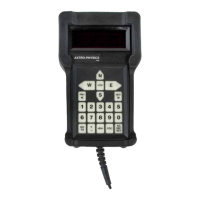
To delay the swap, press the button marked RA/DEC REV. The last menu item is the meridian, set normally to zero. By
using the <PREV and NEXT> buttons you can enter a 1 hour to 6 hour delay or advance of the meridian swap. A setting
of 1W means that the scope will continue to slew to objects up to 1 hour past the meridian in the west. It effectively delays
the meridian swap by 1 hour. A 6 hour delay means the scope will slew all the way to the horizon on the “wrong” side
of the mount. Entering a 1E means that the scope can be placed on the other side of the mount by 1 hour earlier than
normal.
Mnemonic devices: “E” will ip the mount early and “W” will wait to ip! ...or...
“E” will move the meridian east and “W” will move the meridian west.
As a general rule, objects on the pole side of your zenith are poor choices for using the meridian delay. When the
telescope is pointed at an object on the pole side, the back of the instrument can hit the pier if you go past the meridian.
Objects away from the pole (south if you are in the north and north if you are in the south) are less likely to be a problem.
You can see this quite easily by loosening your clutches and swinging your telescope around your mount. Point your
scope at various points in the sky along a north / south line and then see how far you can swing the R.A. past the meridian
before striking the pier. In so doing, you can learn a range of “safe” declination values and meridian delay parameters for
your location and particular setup.
When you turn the power off, the meridian hour offset will return to the default setting of “0W.” You will have to make a
conscious decision to change it during each observing session. If you are permanently mounted and leave your power on
after parking, be sure to remember that you have made this setting. We encourage you to return to “0W” at the end of your
observing session.
Note to programmers: The meridian delay is accomplished by sending a time to the mount that is from 1 to 6 hours
different than the clock time. 6 hours plus delays the meridian to the east; 6 hours minus delays the meridian to the west.
So, if you want to delay the meridian from your computer terminal, just send the revised time to the servo drive per the
AP protocol. Caution: If you park the mount with this fake time and turn off the power, then unpark it later, the mount will
point at the wrong R.A. It will be off by the amount you faked. If you are going to send a fake time to the mount with your
computer, then make sure you reset to the correct time before you park the mount and turn off the power.


 To Next Page