53
3. Choose “alf”. The magnitude will display.
4. Press GoTo. The scope will now slew to Arcturus in the west.
5. Center the star on reticle using your N-S-E-W buttons.
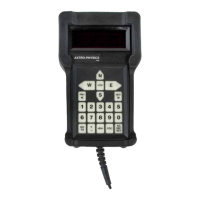
6. Press the RA/DEC REV Button.
7. Press “9=Re-Calibrate”. You will hear a beep letting you know you re-calibrated. This will re-calibrate your scope
precisely on Arcturus.
8. Return to Tours. In this example, the constellation Boötes will display since you are now pointed to it.
9. Choose “eps”.
10. Press GoTo. The scope will now slew all the way around the Dec. axis to point east to Epsilon Boötes. If the polar
alignment was not exact, the new star will appear displaced north or south in declination. Ignore that error for the
moment (you can bring the star back in Dec. with the buttons, but NOT R.A.). The amount that the star is displaced in
R.A. will be equal to twice the optical tube assembly orthogonal error.
11. Correct orthogonality. Simply shim up one of the tube rings to bring the star half way toward the reticle. You can use
commercially available shim material from your hardware store or pieces cut from a soda can.
12. Center the star with the N-S-E-W buttons.
13. Press the RA/DEC REV Button
14. Press “9=Re-Calibrate”. You will hear a beep letting you know you re-calibrated.
15. Slew back to the rst star. Add additional shims as necessary (or adjust your optics if that is the problem) until both
stars appear on the centerline of the reticles.
This procedure can be carried out on the SAME star for even more accuracy by using the Meridian Delay feature. For
instance, point the scope to a star within 1 hour of the meridian, then advance the meridian delay by 1 hr E. Slew to the
same star. This time, the scope will point to the star from the other (east) side of the mount. This feature is detailed in the
GTO Quick Star Drift method for polar alignment.
Effect of Non-orthogonality on Polar Alignment
The whole idea of polar alignment is to achieve drift-free tracking. Therefore, it is the mount that needs to point to the pole,
not the optical axis of the scope. When the optics are not orthogonal, you cannot use the scope to point accurately near
the pole. As an example, if the scope had a 1 degree orthogonal error, the mount would be off by 4 minutes in R.A. at the
celestial equator, about 8 minutes in R.A. at 80 degrees Dec, and a whopping 6 hrs in R.A. at 89 degrees Dec. Anything
beyond 89 degrees cannot be reached at any orientation of the mount. Therefore, when the scope has an orthogonal
error, it is useless to try to polar align using Polaris or any star near the pole.
Polar Alignment with Non-orthogonal Telescopes
In this situation, a 2-step method to align the mount is recommended. See the section on the “GTO Quick Star Drift
Method” of Polar Alignment under the “Alternate Polar Calibration Routines & Tips” section earlier in the manual.
1. Choose 2 stars with nearly the same R.A. on the same side of the mount. Do not use 2 stars where the mount has to
ip sides. Avoid stars above 60 degrees (“N”) or below -60 degrees (“S”) in declination. As an example, in the sum-
mer we have Vega in the north and Kaus Borealis (Lam Sag – the top of the teapot’s lid) in the south. Using the 2-star
alignment, select one as a pivot star, and use the other to adjust the azimuth axis.
2. To set the altitude axis, choose a 3rd star different in R.A. and Dec, such as Enif (ePegasus) and slew back & forth
between it and Nunki.
Very Important: You must point to stars in the west when your telescope is on the east side of the mount and stars in the
east when your scope is on the west side. When the stars are high and close to the zenith, this can be tricky. However,
you can tell which side the star is on by looking at the “z” number (also called the LST) in the upper right corner of the
Choose Star screen, then comparing that number with the R.A. number of the star you choose. If the R.A. number is
larger, the star is in the east; if the R.A. is smaller, the star is in the west. If your scope is not on the correct side, the mount
will not slew properly and the telescope could strike the pier/tripod.


 To Next Page