Chapter 3 Analog Output Settings (ANALOG OUTPUT)
16
● Closed captioning / V-Chip
■ What is closed captioning?
This is a subtitled broadcast developed in the US so that hearing impaired viewers can enjoy movies and news.
Because it does not appear on the screen during usual playback, it is called “closed.“ On the other hand, subtitles in Japanese
that are permanently embedded into video from the start are called “open captioning.“
Although CC technology was originally developed for visually impaired persons, it is now gaining attention as a tool to assist
educators, those engaged in language study, and for listening practice.
CC subtitle data is superimposed on and output from NTSC output line 21 (1st field) and line 284 (2nd field). Subtitle data
includes two modes: captions and text. Extended Data Service (EDS) is also available. This service uses line 284 (2nd field) to
transfer program information such as titles and ratings. The V-chip described later uses the EDS function.
Up to 32 characters per line can be displayed in CC. Although 15 lines are available, the maximum number of lines is limited to
4 in caption mode (CC1 to 4). Up to 15 lines can be displayed in text mode (T1 to 4).
■ What is the V-chip?
The V-chip is a semiconductor chip that removes TV programs containing violent and sexual content. V stands for “violence”,
and this chip blocks programs which are rated according to extreme content. When ratings are set on a receiver (TV) that
includes a V-chip function, EDS rating information is decoded and automatically determined whether or not to output the
program to the screen.
■ Closed captioning/V-chip specifications
Closed captioning/V-chip are compatible with the following TV signals.
Closed captioning is superimposed on composite signals, and Y/C signals.
・ NTSC-M, NTSC-J, NTSC-443
・ PAL-60, PAL, PAL-M, PAL-N, PAL-Nc
* However, caption data is superimposed on 21 lines (334 lines) during 625-line timing (PAL, PAL-Nc) output.
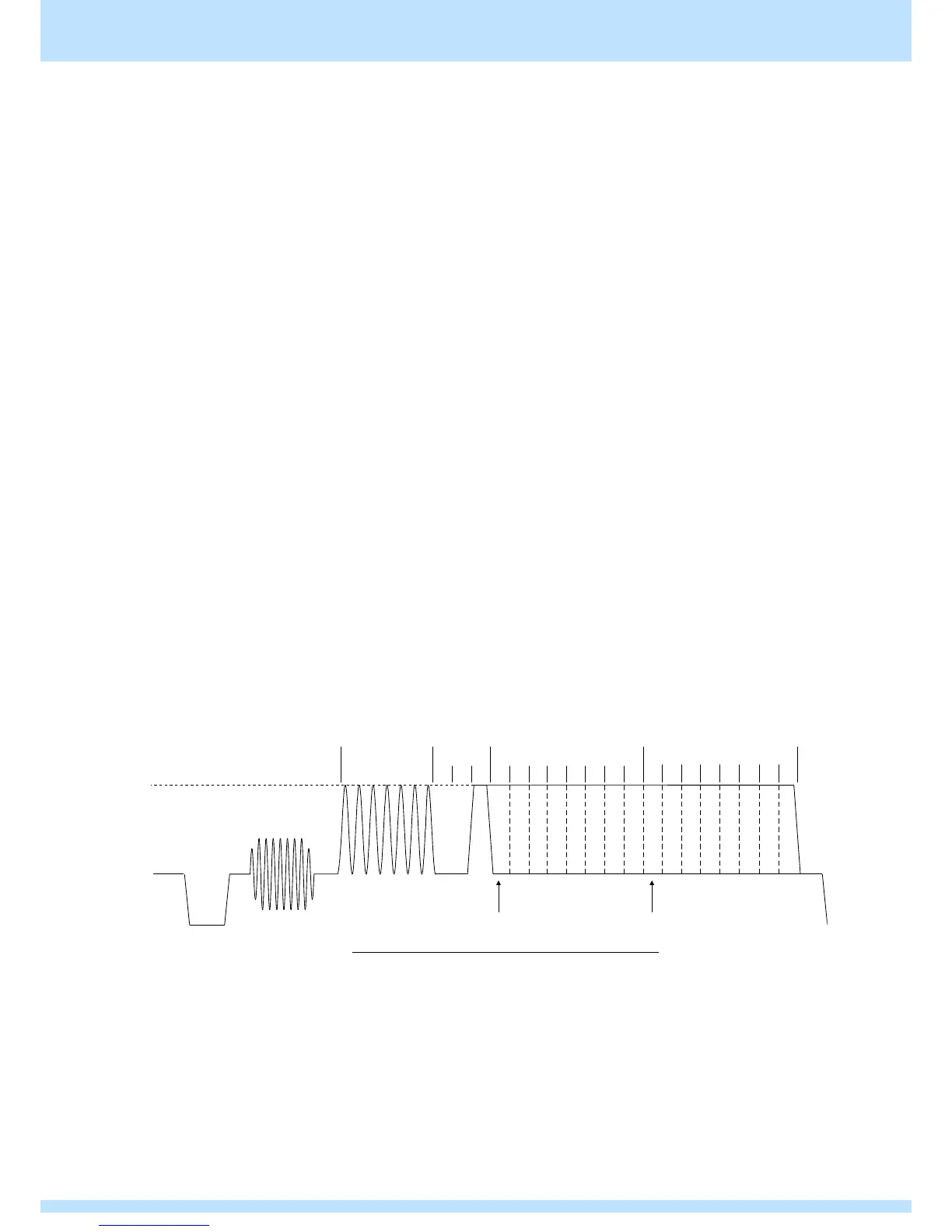
Waveforms for closed captioning/V-chip are shown below. Color burst is followed with a sin wave called Clock Run-In, then start
bit. Start bit is always “001.“ Two bytes of data (Char1, Char2) are sent on each line. Char1 and Char2 are decoded from LSB,
and usually an odd parity is appended to MSB (Bit8).


 To Next Page