99User Manual
TWR TOWER FREQUENCY - The radio frequency for contacting the tower.
UNICOM UNICOM FREQUENCY - Used for general traffic advisories. Provides airport information for
non controlled airports.
UTC UNIVERSAL TIME - The current time at the Prime Meridian. Abbreviated as UT or UTC. Also ref. to
as Zulu time (Z)
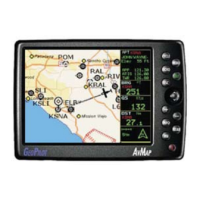
USER COMPACT FLASH The EKP-IV uses the optional User COMPACT FLASH to save user data: it is a
convenient medium to store and retrieve your information.
USER WAYPOINT Place on the chart identified by its coordinates and displayed on the screen with a reference
symbol .
UTM Universal Transverse Mercator - Metric Grid system used on most large and intermediate scale land topo-
graphic charts and maps.
VDOP (Vertical Dilution Of Precision) VNAV Vertical Navigation - The actual path of the aircraft descending
to a final destination. Provides descent point, Altitude and rate information.
VORTAC A navaid that provides a VOR, DME and TACAN at one site.
WAAS Wide Area Augmentation System - The Federal Aviation Administration (FAA), in cooperation with
other DOT organizations and DOD, is augmenting the GPS/SPS with a satellite-based augmentation system, the
WAAS. It will provide a signal-in-space to WAAS users to support en route through precision approach naviga-
tion. After achieving initial operational capability, the WAAS will then be incrementally improved over the next
years to expand the area of coverage, increase the availability of precision approaches, increase signal redundancy
and reduce operational restrictions.
WAYPOINT Any point to which one intends to navigate. A sequence of Waypoints makes up a Flight Plan.
WGS84 World Geodetic System 1984 Coordinates System or Datum developed by the Defense Mapping Agency
(DMA).
XTE Cross Track Error - The perpendicular distance between the present position and the course line. Given as
a distance right or left of course when facing the destination. Displayed in NAV as XTE or on the CDI as a
deflection.
ZOOM IN Shows more detail in a smaller area.
ZOOM OUT Shows a wider area with less details.
Appendix C - Map Datum
A map datum is a mathematical description of the earth or a part of the earth and is based on the ellipsoid or the
arc of an ellipsoid that most closely represents the area being described. In addition, the datum is centered at a
specific location (the datum origin). A datum may describe a small part of the earth, such as California or Iceland
or may describe the entire earth, such as WGS84, depending on which ellipsoid or ellipsoidal arc is selected.
Since datums use different ellipsoids and origins, the LAT/LON coordinates of the same position differs from one
datum to another. The difference may be slight or great, depending on the datums involved, but will affect the
apparent accuracy of the positioning information provided by a GPS receiver. GPS (and all of the EKP-IV car-
tridges) use the WGS84 datum, which is the model of the earth that is the closest possible average of the planet as a
whole. Your chart datum is usually found in the legend. If the datum is not WGS84 means that position coordinates
determined with the EKP-IV may not appear to agree with coordinates determined from a printed chart.
Appendix D - ICAO codes
The EKP-IV Database of airports is drawn from the system of ICAO (International Civil Aviation Organization)
identifiers. Unlike the IATA (International Airline Transport Association) identifiers seen on charts and luggage


 To Next Page