10-24
reaction of interest occurs at the diffusion limited rate. This technique is useful for
discriminating between a reversible redox process (rapid electron transfer) and an
irreversible redox process (slow electron transfer on the reverse step), since both can
be detected by NPV/P, whereas only the reversible process can be detected by
RPV/P. One example of this is the detection of metal ions (reversible) in the presence
of oxygen (irreversible).
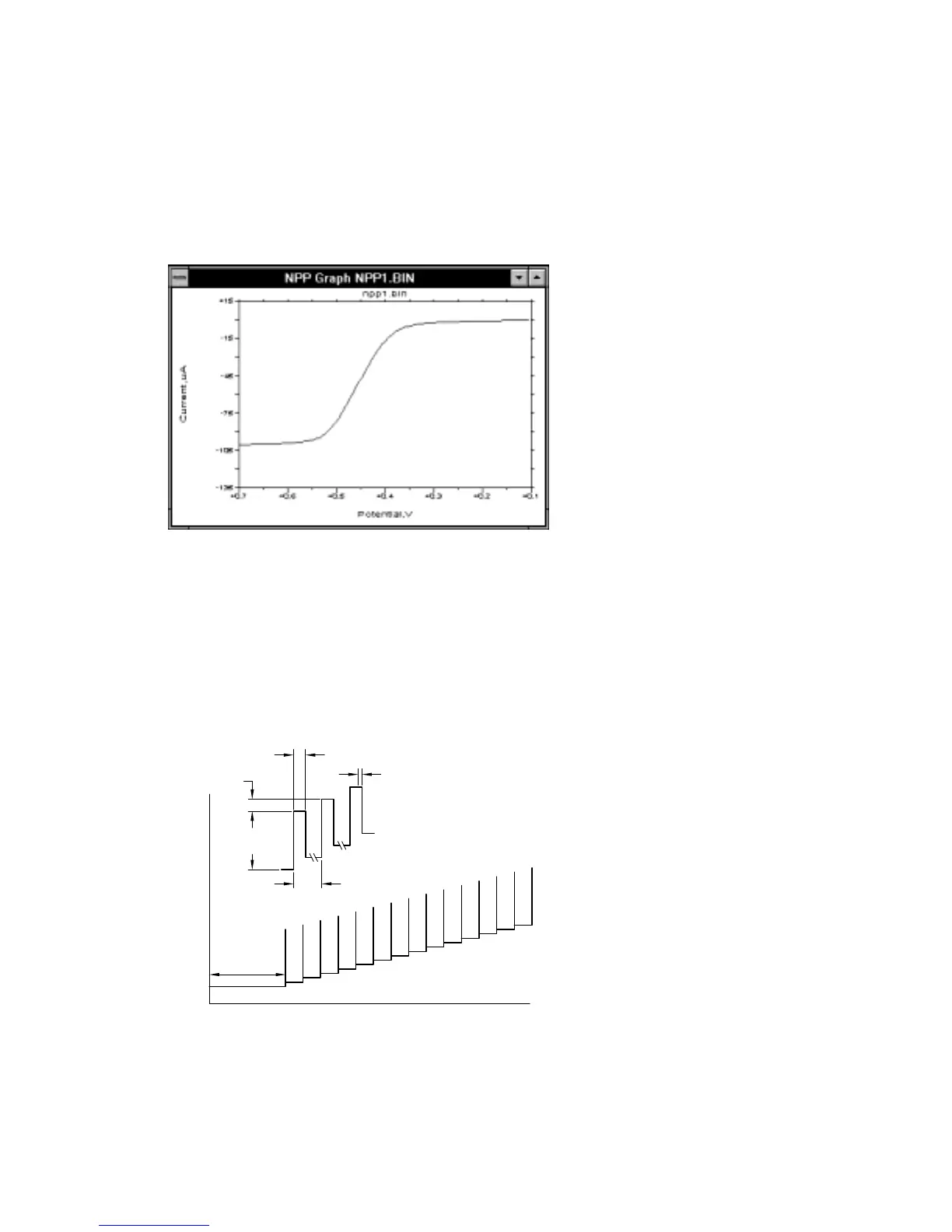
Figure 10-13.
Typical current response for
NPV/P
.
Differential Pulse Voltammetry/Polarography (
DPV/P
) is different from the previous
two techniques in that the current is sampled twice in each
Pulse Period
. The
potential wave form is shown in Figure 10-14. The
Pulse Amplitude
is constant with
respect to the base potential, and the base potential increases in small steps; that is,
the potential wave form consists of small amplitude pulses superimposed upon a
staircase waveform.
E
SAMPLE
WIDTH
PULSE WIDTH
PULSE
AMPLITUDE
PULSE PERIOD
QUIET
TIME
E
∆
t
Figure 10-14.
Potential wave form for
DPV/P
.
The current is sampled just before the pulse (i
1
) and at the end of the pulse (i
2
), and
the difference (i
2
- i
1
) is recorded as a function of the base potential. Consider a



 To Next Page