10-25
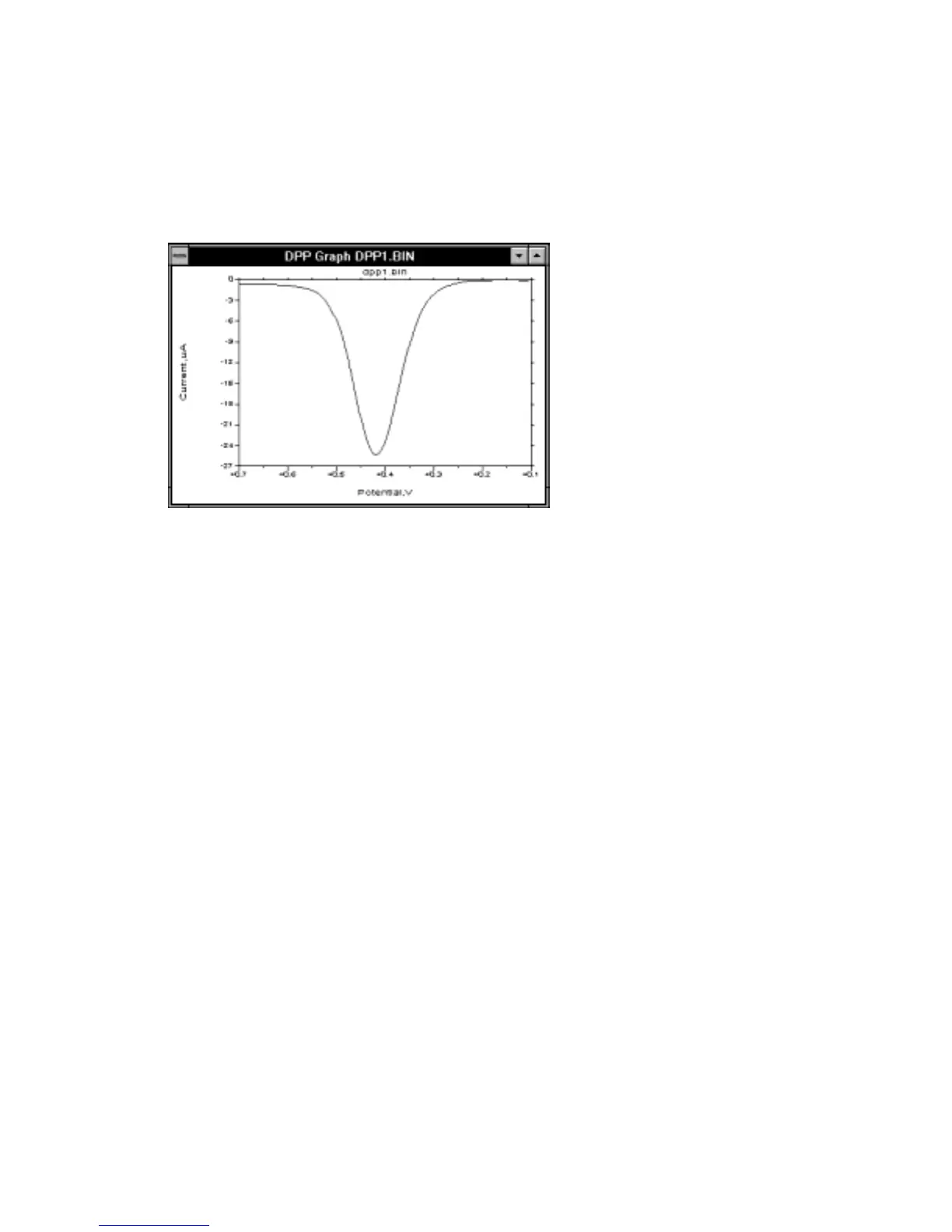
reduction. At potentials well positive of the redox potential, there is no faradaic
reaction is response to the pulse, so the differential current is zero. At potentials
around the redox potential, the differential current reaches a maximum and decreases
to zero as the current becomes diffusion-controlled. The current response is therefore
a symmetric peak (Figure 10-15).
Figure 10-15.
Typical current response for
DPV/P
.
The sensitivity of
DPV/P
is intermediate between
NPV/P
and
SCP
(20
µ
A/mM), but
the detection limit of
DPV/P
is significantly lower (10
-7
M) due to more effective
discrimination against the charging current.
Mode = SCP
General Parameters
Initial E (mV) = 0 -3276 to 3276
Final E (mV) = 0 -3276 to 3276
Sensitivity = 1
µ
A/V 100 mA/V to 100 nA/V (10 pA/V with the
Low Current Module)
Specific Parameters
Scan Rate (mV/s) = 4 1 to 200
Sample Width (msec) = 17 1 to 250
Drop Time (msec) = 1000 100 to 8000
Quiet Time (sec) = 2 0 to 65535
Comments
a) Increasing the
Sample Width
can reduce noise.
b) The step height (or sampling interval) is the product of the
Scan Rate
and the
Dropping Time
(e.g. the default values is 4 mV).



 To Next Page