33 Bender Operation Manual
NOTE:
Loose hoses and hydraulic components will not
always show a visual sign of leakage, however
they can cause aeration of the system by
“sucking” air. It is very important to tighten all
hoses and mounting bolts on hydraulic
components monthly.
PRESSURE SETTINGS
There are three critical pressure settings on your bender
that affect its performance These pressures should be
checked weekly. The following is a brief description of
the pressures and the roles they play.
BACK PRESSURE - Back pressure is actually resis-
tance pressure applied to the back gates during the
bending process. The pressure is transferred to the back
gates via the bottom cylinder and chain assembly. The
setting itself is controlled by the sequence valve. This
“resistance” pressure is required in order to form the
shape of the tubing as the radius die advances. This
pressure is read on the gauge attached to the sequence
valve located near the front left side of the machine. The
pressure reading is taken as the dies advance through
the gates during a bend. The normal operating back
pressure should be set at 1600 P.S.l. In some cases it
may be necessary to adjust this pressure. (See Three
Inch and Stainless Bending Procedures found on pages
21 & 22.)
If the back pressure needs adjusting, proceed as follows.
1. Turn the machine on.
2. Place a radius die and set of back shoes in position.
Tubing will not be required for this operation.
3. Advance the radius die until it begins to pass through
the gates.
4. At this time read the pressure shown on the gauge
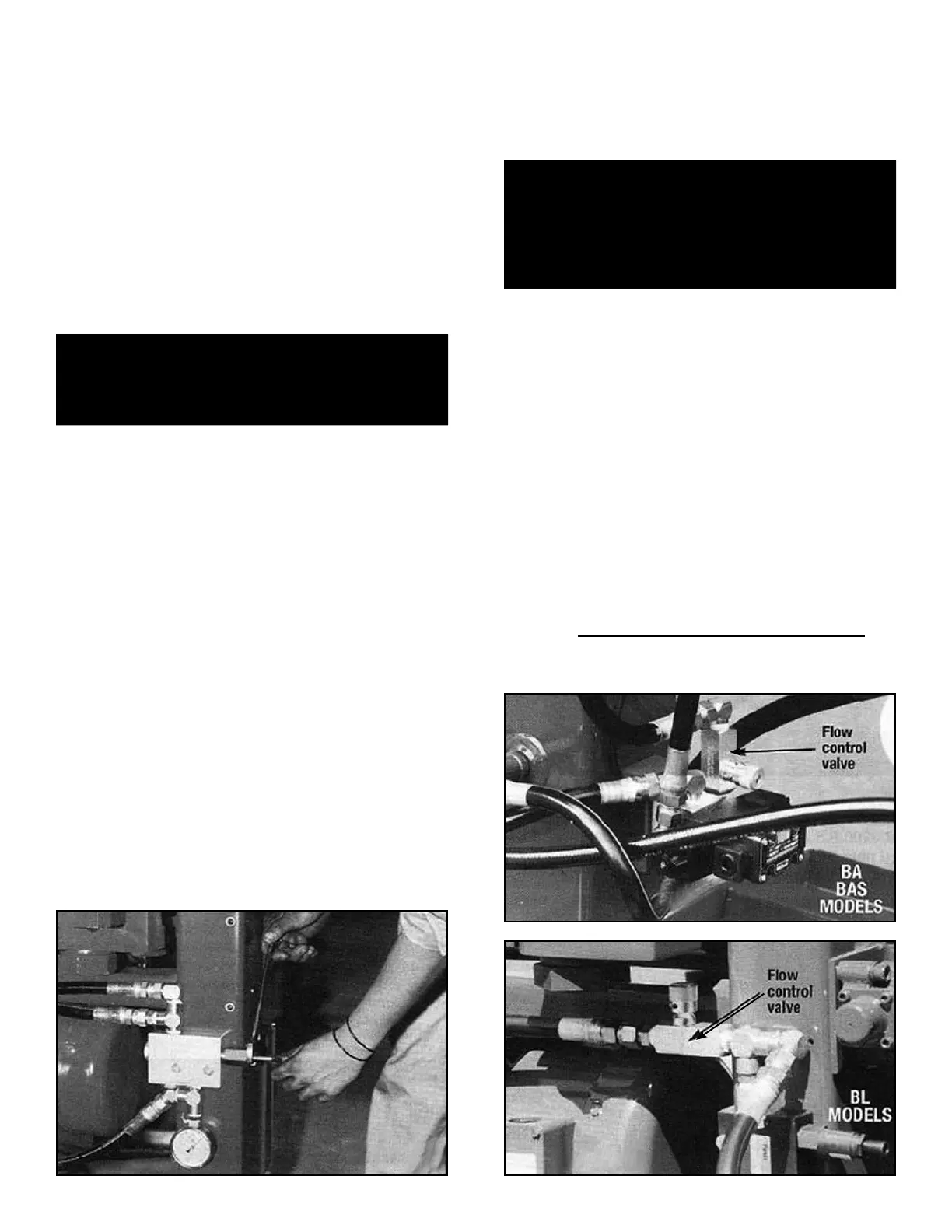
attached to the sequence valve. (See figure 3-B)
5. If an adjustment is required, loosen the locking nut
that secures the adjusting screw.
6. To increase the pressure, turn the adjusting screw
clockwise; to decrease, counterclockwise. Never
exceed 2000 P.S.I.
RETURN PRESSURE - This pressure reading is also
taken on the gauge located near the front left side of the
machine. The purpose of this pressure is to maintain
adequate tension on the chain assemblies during the
retract sequence. This is important so that the gates
close in unison with the radius die. Upon initiating the
return sequence, hydraulic fluid is “split” and redirected,
so that an equal portion is transferred to the top cylinder
and bottom cylinder simultaneously. If the pressure is set
too high, the machine will groan and strain when revers-
ing as the top cylinder tries to overcome the bottom cyl-
inder. If the pressure is too low, the gates may hesitate
or remain open when the radius die retracts as the top
cylinder receives more fluid than the bottom cylinder. It is
seldom necessary to readjust this pressure setting. The
normal operating return pressure should be set at
350 P.S.l. This pressure reading is taken as the radius
die retracts just after it releases from the back shoes.
This pressure setting is controlled by the flow control
valve. (See figure 1-A and 2-A)
Bender Operation Manual 33
CAUTION!
Never exceed 2000 P.S.I. for the back pressure unless
specifically instructed to do so by the factory for special
circumstances. If it is necessary to increase the back
pressure, always remember to return the pressure back
to 1600 P.S.I. before proceeding with the next bend.
CAUTION!
Improper back pressure settings will cause tubing to
wrinkle and/or collapse and may also damage
machine and/or dies.
Figure 1-A
Figure 2-A
Figure 3-B


 To Next Page