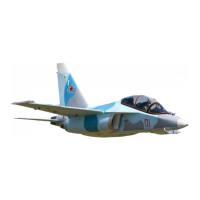
YAK 130
BVM ©2016 56 Mar. 23, 2016
Slow Flight Testing
To best prepare for the practice approaches, first climb to a safe altitude and trim the model
for all flap settings and landing gear extended. Execute nose high power-on approaches. As
soon as the nose falls through, add full power and establish level flight again.
Note if a wing (right or left) drops. That wing might be heavier than the other.
Following 3-4 approaches to stall you will become familiar with the Yak’s gentle stall
characteristics and feel more confident about the first practice approaches and go-around’s.
Save all of the aerobatic stuff for future flights. Get the approaches and landings
accomplished first and gain confidence in the Yak-130.
Properly set-up, the Yak executes take-off’s and landings with ease.
Practice Approaches
A few minutes of the first flight, should be devoted to practice approaches and go-around’s. It
is beneficial to become familiar with the low speed handing of the aircraft before the first
landing.
Landing
Landing the Yak-130 is like most jets, “power on” during the approach. It is best to land
slightly nose high, touching on the main wheels first, then retard the throttle to idle and apply
the speed brake and wheel brakes.
RX Battery Consumption
Note: BVM prototypes used (2) 3000 mAh Magnum-ion EXB batteries. See BVMJets.com
(2) 4000 mAh Lipo batteries will also work
The average flight using the lights consumes about 500 mAh. Use this data and results of the
first few flights to calculate how many flights you can achieve from your system. The use of
the smoke pump will consume more mAh per flight.
BVM is synonymous with “Success Jets.” It is very important to us that you are successful
with our products. This extensive manual reflects our sincerity. As always, your comments
and suggestions on BVM products are appreciated.


 To Next Page