©2023 CAE 905K600152 v1.4 59
Using Juno
Cardiovascular System
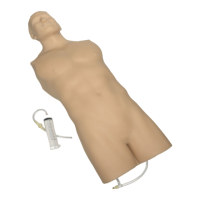
The Juno manikin includes cardiovascular features that allow learners to practice basic assessment
and life support skill sets. With the Juno manikin, learners can:
• Palpate pulses
• Place IV lines and catheters
• Administer IM and SQ injections
• Auscultate realistic heart sounds
• Perform ECG monitoring
Cardiovascular System Controls
With Juno’s Cardiovascular system, users can replicate the clinical signs associated with cardiac
activity, including palpable pulses, heart sounds, and electrical activity.
Cardiovascular System Controls
Anatomy,
Physiology and
Clinical Signs
Clinical Interventions, Patient
Monitoring and Scenarios.
Software Control Manual Control
Heart Sounds Normal and abnormal heart sounds
are synchronized to the cardiac cycle
and audible with a standard stetho-
scope. Heart sounds can be auscul-
tated over the lower sternal border
and apex.
None required;
specific sounds
can be selected.
From the
Run
screen, tap
Sounds
and select
Heart tab.
None required.
4-Lead ECG ECG waveforms can be viewed on a
standard monitor and/or on the
Patient Monitor. Normal and
abnormal cardiac rhythms are linked
to patient physiology (e.g. blood
pressure, cardiac output).
None required;
specific rhythms
can be selected.
ECG monitor may
be utilized.
Myocardial
Ischemia
Myocardial oxygen supply and
demand automatically influence the
cardiac rhythm, yielding response to
hypoxemia.
None required,
but adjustable.
None required.



 To Next Page