MANUALPC-2010 CHAPTER II – INSTALLATION Page 16
ORP AND pH SENSORS
Properties
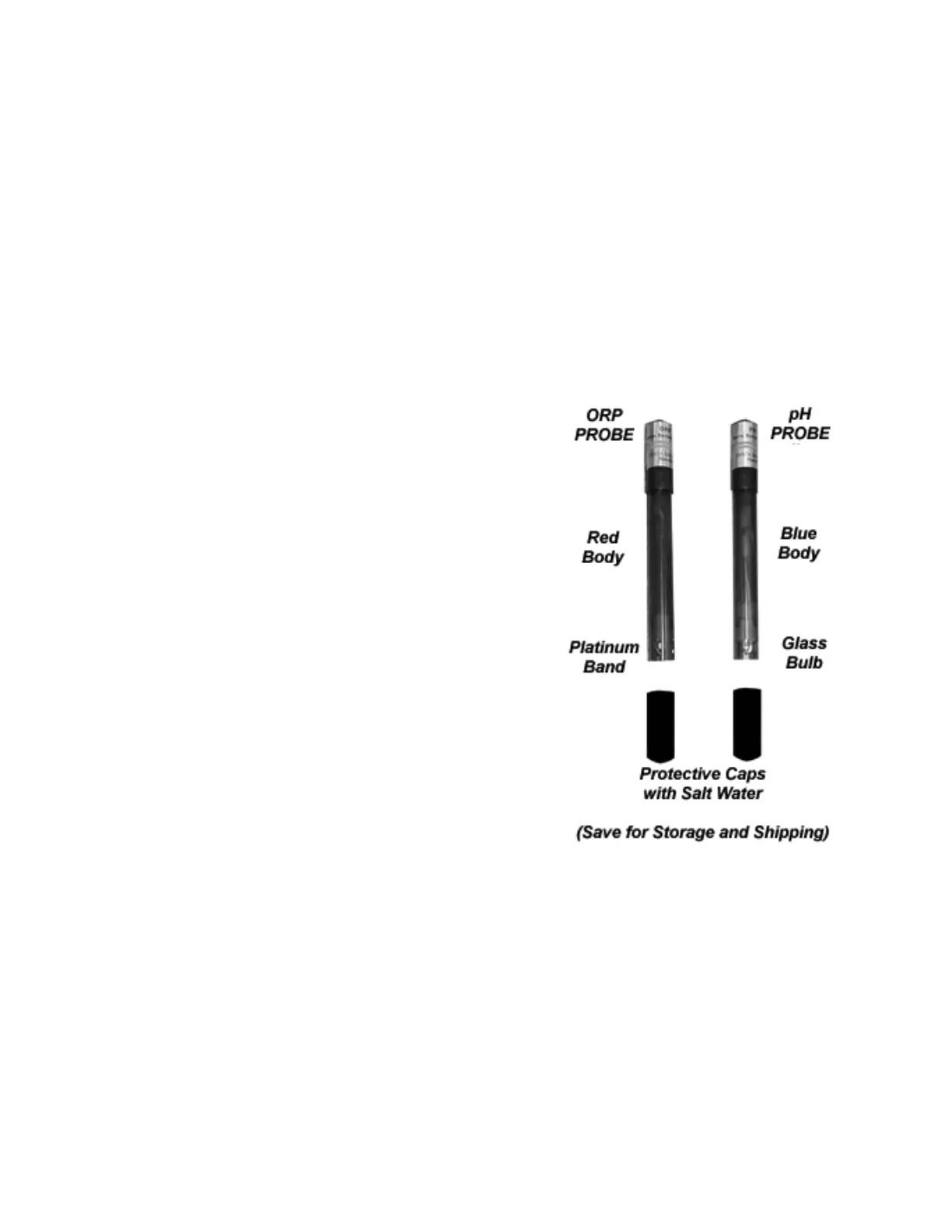
The ORP and pH sensors are non-corroding sealed
combination electrodes (Figure 14). They do not require
refilling. Each sensor has an external plastic body and an
inner glass tube that can be broken if stressed too severely.
The potentiometric sensors produce small voltages - in the
millivolts range. Since they have a high impedance (20 to 50
megohms), the electrical current produced by the sensors is
extremely small - in the picoamp (10
-9
A) range. The output is
so small that it cannot be measured with ordinary voltmeters
and must be internally amplified by the controller.
There is no electrical current flowing from the controller to the
ORP and pH sensors. They are optically isolated from the high
voltage circuit inside the electronic module. Therefore, they
create no electrical danger.
The ORP (Oxidation-Reduction Potential or Redox) Sensor
monitors the activity of the sanitizer (Fast Acting Free Chlorine,
Bromine or Ozone) through its oxidizing power. It is
recognized by its red color, the wide platinum band at the tip of
the electrode and the white plastic tag on the cable.
The pH Sensor monitors the acidity of the water. It works with
any acid or base. It is recognized by its blue color and by the
glass bulb at the tip.
Packaging
The pH and ORP sensors are shipped in individual cartons for
extra protection. When ready for installation, remove the
plastic cap on the tip of the sensor. If it is difficult to remove,
dip it in water for a few seconds. It should then slide off easily.
There may be a white crystalline deposit around the cap. This
is produced by the salt solution that is used for shipping. It
does not affect the performance of the sensor.
Sensor cables
The sensors are supplied with a standard 10' (3 m)-long cable
made of coaxial wire designed to minimize electrical
interference. For ease of identification, all ORP cables have a
white marker.
The cables are terminated with bayonet-type, spring-loaded,
push-and-twist male BNC connectors. These are connected to
the proper female BNC connectors located on the left side of
the controller cabinet.
If the cable is longer than needed, it should be coiled neatly
and attached under the cabinet. DO NOT ATTEMPT TO CUT
THE SENSOR CABLE under any circumstances.
If a longer cable is needed, custom-made extension cables
with BNC connectors can be ordered from the factory in
lengths of up to 1000 feet. For longer distances, a pre-
amplifier may be required. Consult your dealer or the factory
for details.
Electrical Interference
The CHEMTROL® PC controllers feature differential
amplification of the sensor signals to reduce electrical
interference from stray currents in the water.
Electrolytic chlorine generators are a frequent source of current
leakage. This should not be a problem with properly designed
commercial-type generators. If using several generators, DO
NOT install them in series. Instead, use a manifold and plumb
the generators in parallel.
To check for current leakage, compare the readings of the
sensors when they are in line and when they are dipped in a
plastic bucket containing the same water from the pool or spa.
If you get different readings, there is current leakage. Its
source must be identified and eliminated with proper grounding
by a qualified electrician.
Figure 14 - ORP and pH Sensors



 To Next Page