MANUALPC-2010 CHAPTER IV - OPERATION Page 38
4.6 - Time Limit
The TIME LIMIT sets the maximum amount of time in minutes
that is allowed for continuous dumping of water to correct a
high conductivity or TDS reading. This acts as a safety feature
to prevent overdumping of water in case of a malfunction of the
dump valve.
When in alarm, Time Limit is reset by highlighting the value
and pressing "OK". To defeat the safety timer, enter zero (0).
4.7 - Run Time
T
he RUN TIME line displays two separate values: the amount
of running time in minutes for each current activation event and
the total run time since last reset to zero.
To reset the cumulative run time, enter zero in the far right
column. To reset only the current run time, highlight Time Limit
value and press “OK” (see ORP submenus).
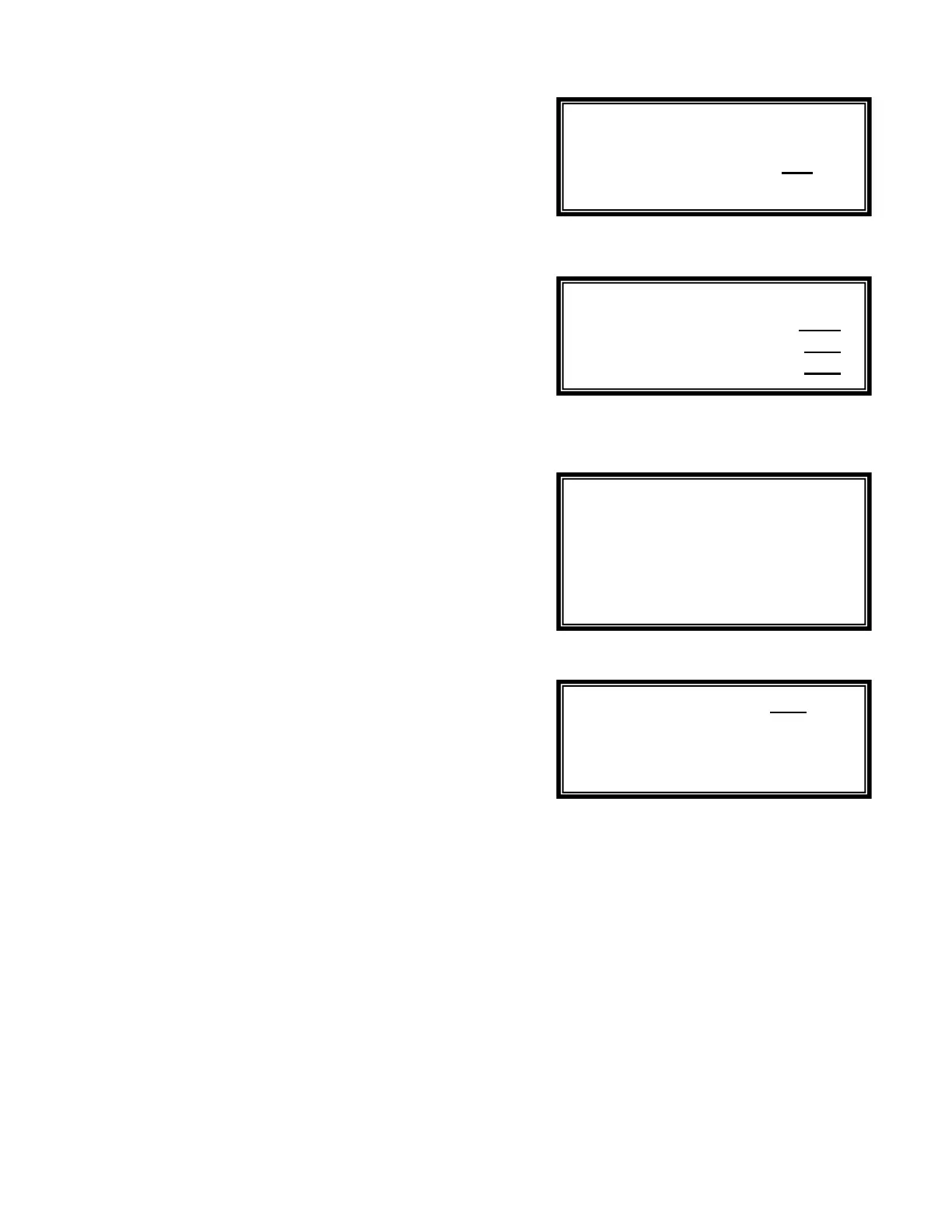
The Total Feed Time submenu 4.7.1 is used to show the feed
time from a tank since last reset to zero. Knowing the pump
feed rate, it can be used to monitor the emptying of the tank
and set a low-level alarm. This feature is particularly useful for
remote monitoring of the chemical tanks.
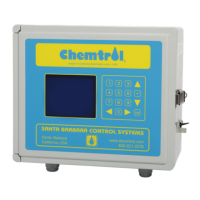
4.8 - Select Scale
The Select Scale prompt takes the operator to the SELECT
SCALE Submenu 4.8.
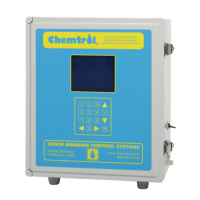
4.8.1 - Scale Selection
Submenu 4.8.1 is used to select the conversion parameters for
different types of conductivity sensors. The SCALE may be set
to 500, 2000, 5000, 10000, or 20000 µS/cm.
4.8.2 - Cell Constant
T
he Cell Constant is the aspect ratio of the conductivity sensor
(length divided by cross sectional area) in cm
-1.
It should be
set according to the probe manufacturer specifications.
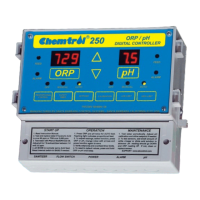
4.8.3 - TDS Factor
The TDS Factor is the conversion factor used to convert from
conductivity readings (in µS/cm) to Total Dissolved Solids
concentrations (in ppm or mg/l).
Because the conductivity of ionic species varies with the type
of electronic charges, the TDS factor is somewhat empirical.
For typical water treatment solutions, it is about 0.5. For
instance, a Sodium Chloride solution with a conductivity of
2,000 µS/cm contains about 1,020 ppm (mg/l) of NaCl. This
indicates a TDS factor of 1020/2000 or about 0.5.
When a TDS Factor different from 1 is entered in Submenu
4.8.3, all the readings and displays are changed automatically
from conductivity to TDS values. They can be changed back
to conductivity by re-entering a value of 1 for the TDS factor.
Submenu 4.7.1
Submenu 4.8
S
ubmenu 4.8.1
Submenu 4.8.3
Max (min) 120
Actual (min) 17
µS/cm 2000
Cell Constant 1.00
TDS Factor 0.50
For TDS Factor
different from 1
Display shows TDS
500 uS/cm
2,000 uS/cm
5,000 uS/cm
10,000 uS/cm
20,000 uS/cm



 To Next Page