MANUALPC-2010 CHAPTER II – INSTALLATION Page 20
CHEMICAL FEEDERS
WARNING: Tank Sizing
The CHEMTROL® PC controller includes many safeguards to
prevent overfeeding of chemicals. However, there is always a
risk of physical failure of the electronics or feed equipment that
could cause overfeeding of chemicals. To prevent damage or
injury to persons, it is imperative to size the chemical tanks so
that no dangerous amount of chemicals will be fed in case of
equipment failure.
Chemical Feed Pumps
Chemical feed pumps are used to feed liquid sanitizers, such
as sodium hypochlorite NaOCl, also known as liquid chlorine,
or solutions of calcium hypochlorite or dichlor powder. Liquid
chemicals for pH control include muriatic acid, caustic soda or
solutions of soda ash.
Any standard chemical feed pumps (diaphragm, piston or
peristaltic) approved by NSF (National Sanitation Foundation),
UL (Underwriters' Laboratories), ETL (Electrical Test
Laboratories), CSA (Canadian Standards Association) or
similar national and international organizations, can be used,
as long as they are properly sized for the installation.
Install the pumps as shown in Figure 5, following the electrical
code and the pump manufacturer's instructions.
Carbonic Acid (CO2) Valve
A special solenoid valve for carbonic acid can be used to
control the addition of CO2, an acid used to lower pH. It also
increases Total Alkalinity making pH control difficult. Add
muriatic acid, HCl, to reduce high alkalinity.
Gas Chlorinator
NOTE: Use of Chlorine gas is very dangerous.
Make sure to follow all local safety codes.
Gas chlorinators should be installed and maintained only by
factory-trained technicians following the instructions of the
manufacturer.
If required, the injection line for chlorine gas can be controlled
with a specially designed, corrosion-proof solenoid valve
installed between the gas chlorinator and a Venturi injector.
Alternatively, a magnetic starter can be used to control a
booster pump for the chlorinator bypass line.
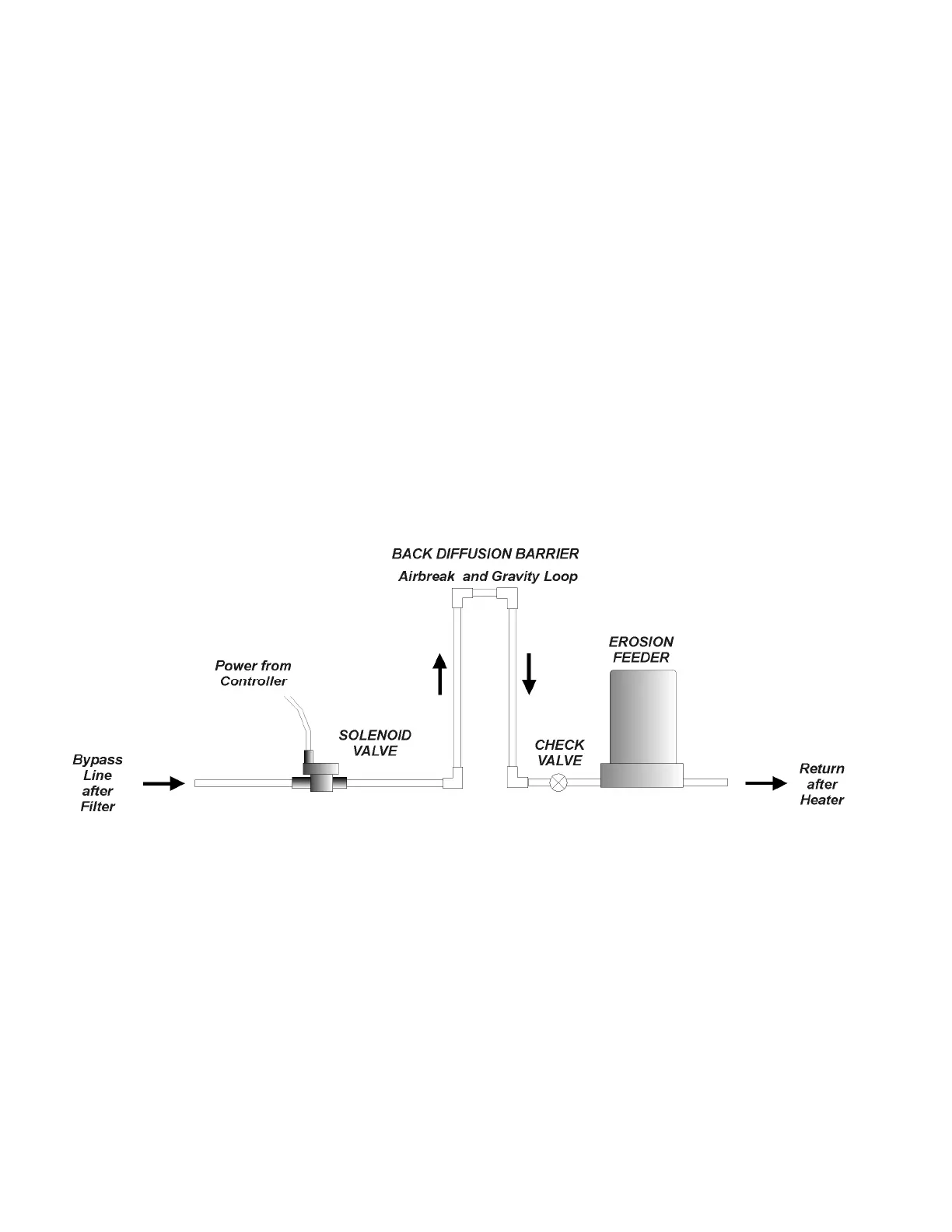
Figure 26 - Erosion Feeder Control
Erosion Feeders
Erosion feeders for bromine, chorine or cal hypo tablets can be
controlled with a solenoid valve that is mounted on the intake
side of the bypass line before the feeder (Figure 26). This
allows the controller to modulate the flow of water through the
feeder.
For proper valve operation, the pressure differential through
the feeder must be at least 15 psi (1 kPa). This may require
installation of a pump on the bypass line.
With less corrosive chemicals, such as bromine dihalo or cal
hypo tablets, the solenoid valve can be mounted before the
erosion feeder.
Back Diffusion
With corrosive trichlor tablets, it is recommended to protect the
solenoid valve with a check valve and an anti-diffusion loop, as
shown in Figure 26.
The loop must be narrow to facilitate formation of an air break
and tall to maximize the effect of the gravity barrier.
This design reduces – but does not eliminate – corrosive back
diffusion. A better idea is to switch to a less aggressive
sanitizer.


 To Next Page