1-2 Overview
5160 Service Aggregation Switch Hardware Installation and Start-up Manual
009-3207-001 Standard Revision A
Copyright
©
2013 Ciena
®
Corporation September 2013
The SAS units are designed to work with other products in the Ciena
Corporation family to deliver complete, integrated service offerings from a
single provider or multiple providers. The SAS devices incorporate advanced
QoS capabilities, flexibility through pluggable optics, superior multicast
control, manageability, and a small form factor chassis to present the
industry’s leading fiber-to-the-building solution.
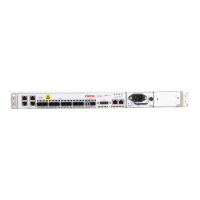
The 5160 has the following physical characteristics:
• 24 x 1/10 GbE SFP+ ports — The SFP+ ports support both 1 GbE and 10
GbE speeds. Ports are labeled 1-12 (top row) and 13-24 (bottom row).
Ports 1 to 24 can be configured as UNI ports. Ports 21 to 24 are NNI
capable. Optical SFP/SFP+ can be installed in any of these 24 ports.
Copper SGMII transceivers can be installed in any of the ports except
ports 19 and 20. When copper transceivers are used the supported
speeds are 10/100/1000M.
Note: If the 5160 is configured to use RFC 2544 benchmarking, then Port
20 becomes unavailable, thereby reducing the effective port count of the
5160 system by one. The RFC 2544 benchmarking feature is enabled
through the CLI and requires the Advanced-OAM license of SAOS. See
“Managing Licenses” on page 3-3 for more information. It is highly
recommended that the network operator determine at installation time
whether RFC benchmarking will run on the 5160, and does not change it
thereafter. If you subsequently disable RFC 2544 benchmarking, a
configuration save and system reboot is required before Port 20 becomes
available for use. If you subsequently enable RFC 2544 benchmarking, all
traffic configuration that is directly or indirectly associated with Port 20
must be removed, the configuration saved and the system rebooted.
• 1 x SYNC port — this port can be used to provide BITS-IN or BITS-OUT,
1 PPS and Time of Day.
• 1 x PPS — 1 PPS external synchronization port
• 1 x 10 MHz — 10 MHz external synchronization port
• 1 x Serial RJ-45 Console port — The Console port is used for initial
configuration and management.
• 1 x 10/100/1000 RJ-45 Management port — This port is provided for out-
of-band management and uses an RJ-45 connector.
• 1 x DB-26 Alarm Input — Closed contact alarm inputs. Uses a
26-pin D-sub
plug with custom pin-out.
The 5160 occupies 1 rack unit (RU) of a standard 19-inch equipment rack.
All ports, management interfaces, LEDs and power connections are
accessible from the front of the 5160 chassis. For more information see 39XX/
51XX Product Fundamentals.



 To Next Page