The Cisco FM4200 Fiber can be provided with power using the following
methods:
• A standard IEEE 802.3af Power-over-Ethernet (PoE) connection
(for example, from a compatible network switch).
• A compatible 48 Vdc passive PoE injector conforming to either
IEEE 802.3af or IEEE 802.3at.
• A 48 Vdc power source equipped with an M12A connector.
When providing the power source for the Cisco FM4200 Fiber, remember
the following important points:
• Install the power source as close to the unit as possible to minimize
voltage drop. The maximum suggested distance is 165ft (50m).
Connecting power to the Cisco FM4200 Fiber
NOTE
For detailed comparative information on which Cisco
hardware devices are capable of accepting power
through IEEE 802.3at or IEEE 802.3af power sources, or
through a DC IN power source, refer to “Electrical power
requirements” (page 172).
DC IN, LAN and fiber-optic ports
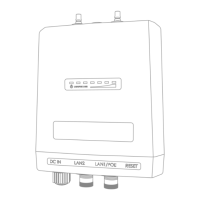
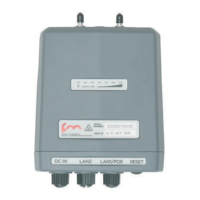
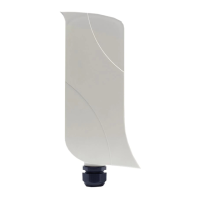
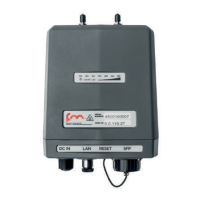
The Cisco FM4200 Fiber radio transceiver unit has three connector ports
(Figure 7 (page 32)):
Figure 7. Device connector ports
• The DC IN connection is a 5-pin M12A port, exclusively designed to
accept passive 48 Vdc power.
• The LAN connection is an 8-pin M12X port, designed to connect
the unit to a local area network (LAN) switch and/or to an IEEE
802.3 48 Vdc power source.
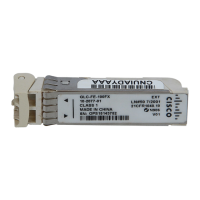
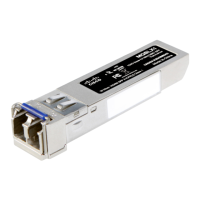
• The SFP connection is a small form-factor pluggable (SFP) port,
exclusively designed to connect the unit to a duplex fiber-optic data
link.
Hardware installation
© 2021 Cisco and/or its affiliates. All rights reserved. Page 32 of 189


 To Next Page