CLIMATEMASTER WATER-SOURCE HEAT PUMPS
Tranquility
®
Compact Belt Drive (TCH/V) Series
Rev.: July 25, 2017
20
ClimateMaster Water-Source Heat Pumps
ರ
ರ
ರ
* Some units include a painted drain connection.
Using a threaded pipe or similar device to clear
any excess paint accumulated inside this fitting
may ease final drain line installation.
ರ3HU
)RRW
Horizontal Installation
Figure 6: Horizontal Condensate Connection
CAUTION! Ensure condensate line is pitched toward drain
1/8 inch per ft [11mm per m] of run.
CAUTION!
Duct System Installation - Proper duct sizing and design
is critical to the performance of the unit. The duct system
should be designed to allow adequate and even airfl ow
through the unit during operation. Air fl ow through
the unit MUST be at or above the minimum stated
airfl ow for the unit to avoid equipment damage. Duct
systems should be designed for quiet operation. Refer
to Figure 3 for horizontal duct system details or Figure
8 for vertical duct system details. A fl exible connector
is recommended for both discharge and return air duct
connections on metal duct systems to eliminate the
transfer of vibration to the duct system. To maximize
sound attenuation of the unit blower, the supply and
return plenums should include internal fi berglass duct
liner or be constructed from ductboard for the fi rst few
feet. Application of the unit to uninsulated ductwork in an
unconditioned space is not recommended, as the unit’s
performance may be adversely affected.
At least one 90° elbow should be included in the supply
duct to reduce air noise. If air noise or excessive air fl ow
is a problem, the blower speed can be changed. For
airfl ow charts, consult submittal data for the series and
model of the specifi c unit.
DUCT SYSTEM INSTALLATION
.
,
Duct S
stem Installatio
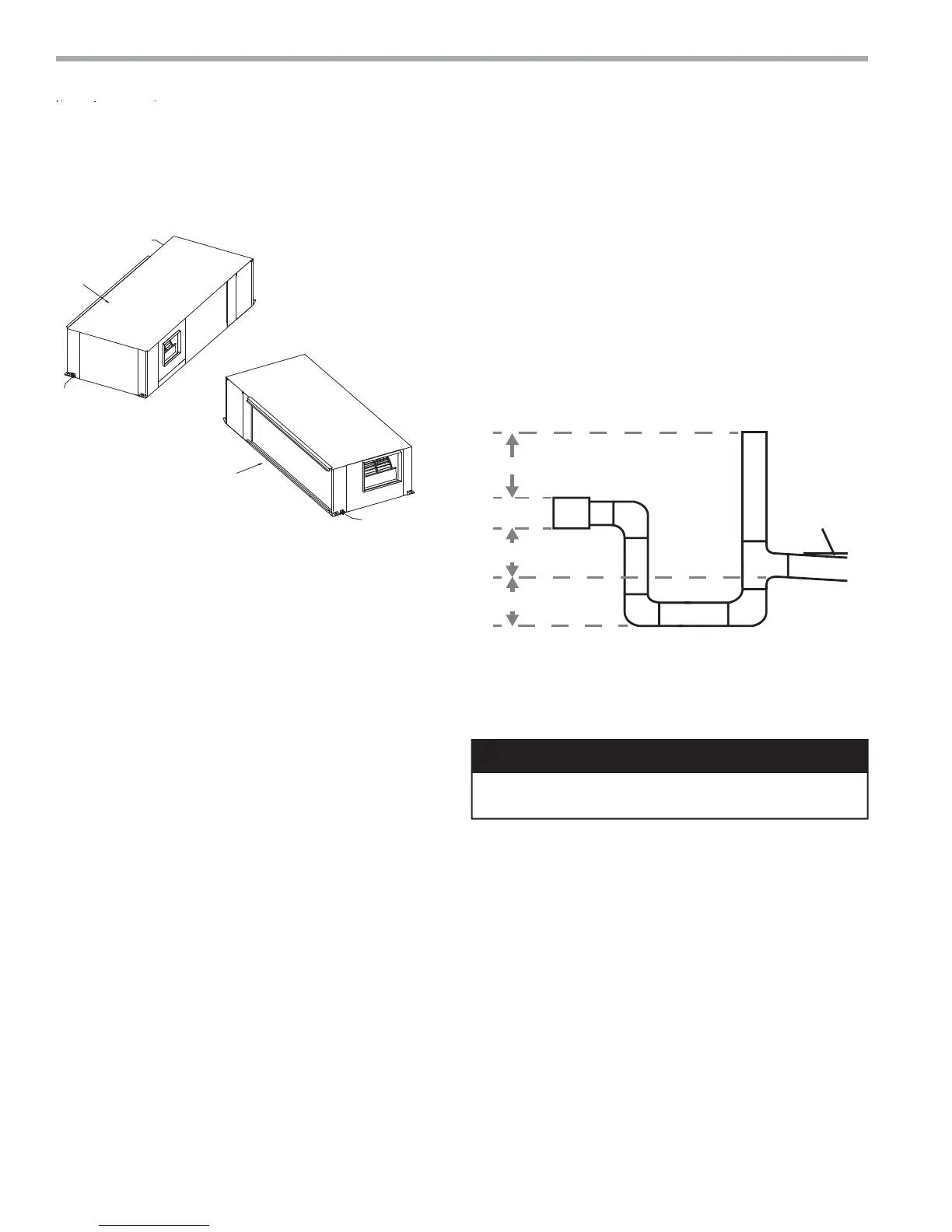
Horizontal Units Condensate Piping - Pitch the unit
toward the drain as shown in Figure 2 to improve the
condensate drainage. Ensure that unit pitch does not
cause condensate leaks inside the cabinet.
Install condensate trap at each unit with the top of
the trap positioned below the unit condensate drain
connection as shown in Figure 6. Design the depth of the
trap (water-seal) based upon the amount of ESP capability
of the blower (where 2 inches [51mm] of ESP capability
requires 2 inches [51mm] of trap depth). As a general rule,
1-1/2 inch [38mm] trap depth is the minimum.
Each unit must be installed with its own individual trap
and connection to the condensate line (main) or riser.
Provide a means to fl ush or blow out the condensate line.
DO NOT install units with a common trap and/or vent.
Always vent the condensate line when dirt or air
can collect in the line or a long horizontal drain line
is required. Also vent when large units are working
against higher external static pressure than other units
connected to the same condensate main since this may
cause poor drainage for all units on the line. WHEN A
VENT IS INSTALLED IN THE DRAIN LINE, IT MUST BE
LOCATED AFTER THE TRAP IN THE DIRECTION OF
THE CONDENSATE FLOW.
Figure 5: Right Return Side Discharge to Back
RIGHT RETURN SIDE DISCHARGE
CBP
Drain
FRONT
CBP
FRONT
RIGHT RETURN END DISCHARGE
RETURN AIR
Drain
RETURN AIR



 To Next Page