Basic Information
21
C3M2-OM-EN-02
2.6 Rated Capacity, Centre of Gravity and Stability
The rated capacity is the maximum weight that a truck is designed to lift at a
specified load height to a specific load centre distance under safe operating
conditions. To understand the rated capacity it is necessary to be familiar with the
term centre of gravity.
The centre of gravity is an imaginary point in a body where the
total weight of the body may be considered to be concentrated.
Every object has a centre of gravity. When a load is supported
on the forks the truck and load may be considered as a single
entity with a combined centre of gravity.
The Combilift has moving parts that change its centre of gravity. The centre of gravity
moves forward and back as the mast is extended and retracted and also as the mast
is tilted back and forth. The centre of gravity also moves up and down as the mast is
raised and lowered.
The position of the combined centre of gravity is affected by the size, weight, shape
and position of the load; the height to which the forks are raised; the position of the
reach; the tilt angle and side shift position.
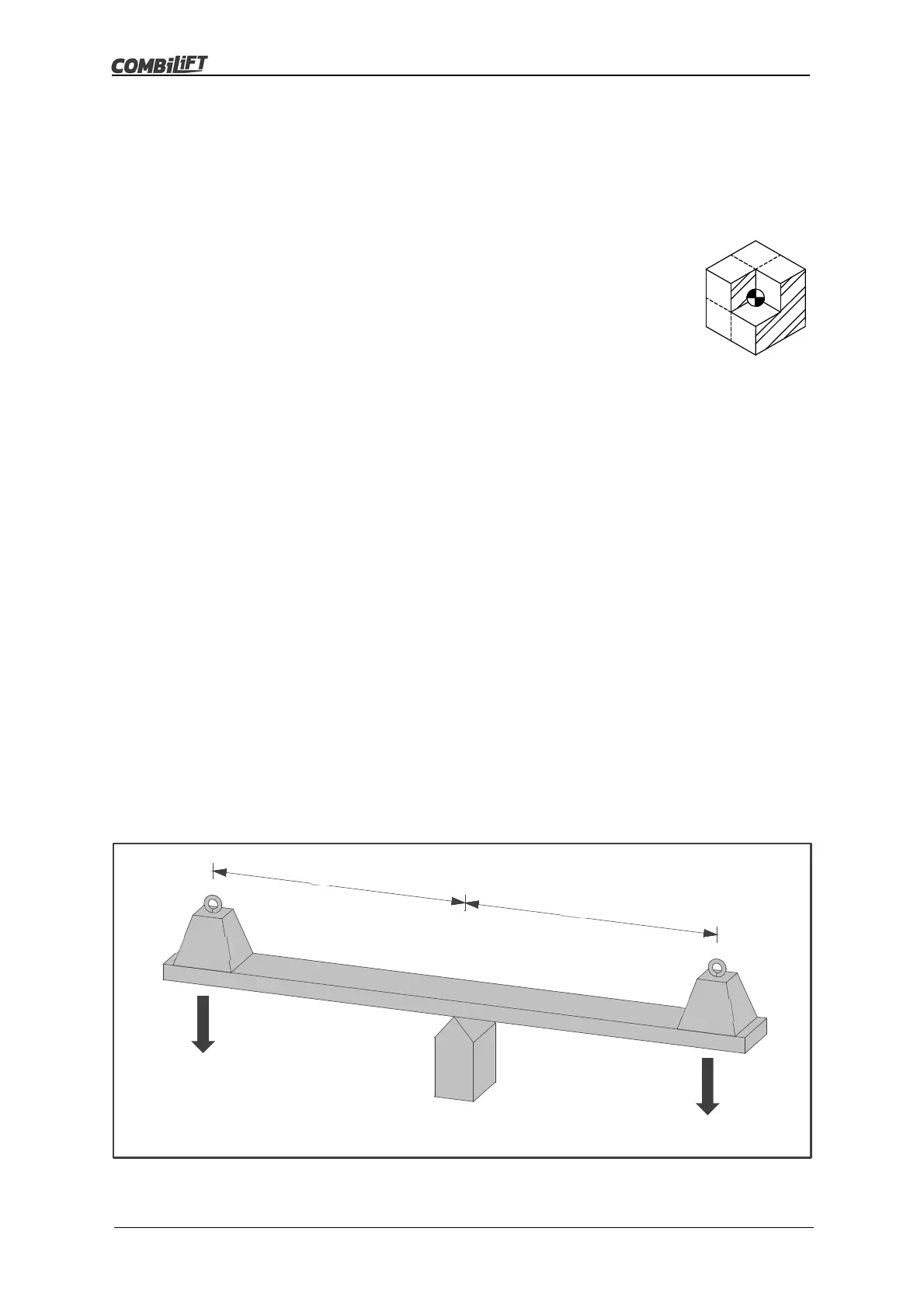
To understand the stability of the truck it is useful to use the analogy of a see saw
where two objects are placed on opposite sides of a beam and the beam is
supported at a single point halfway along its length. For the see saw to balance, the
two objects must be equal in mass and placed at an equal and opposite distance
from the support point, also known as the fulcrum. If the mass on one side is
increased the see saw will tip to the side of the heavier mass. This can be corrected
by moving the heavier mass in towards the centre or fulcrum. This principle is the
most important factor that must be taken into account when considering the
stability of the truck.
If we look at the diagram below what this translates to is that as long as F1 is equal
to F2 then the system will balance.
M1 = M2
D1 = D2
M2
M1
D1
D2
F2 = M2xD2
F1 = M1xD1
Fulcrum



 To Next Page