Series 300 Analogue Addressable Sensors - Technical Data Sheet:
Sensor installation:
Testing: General
Testing: Smoke sensors
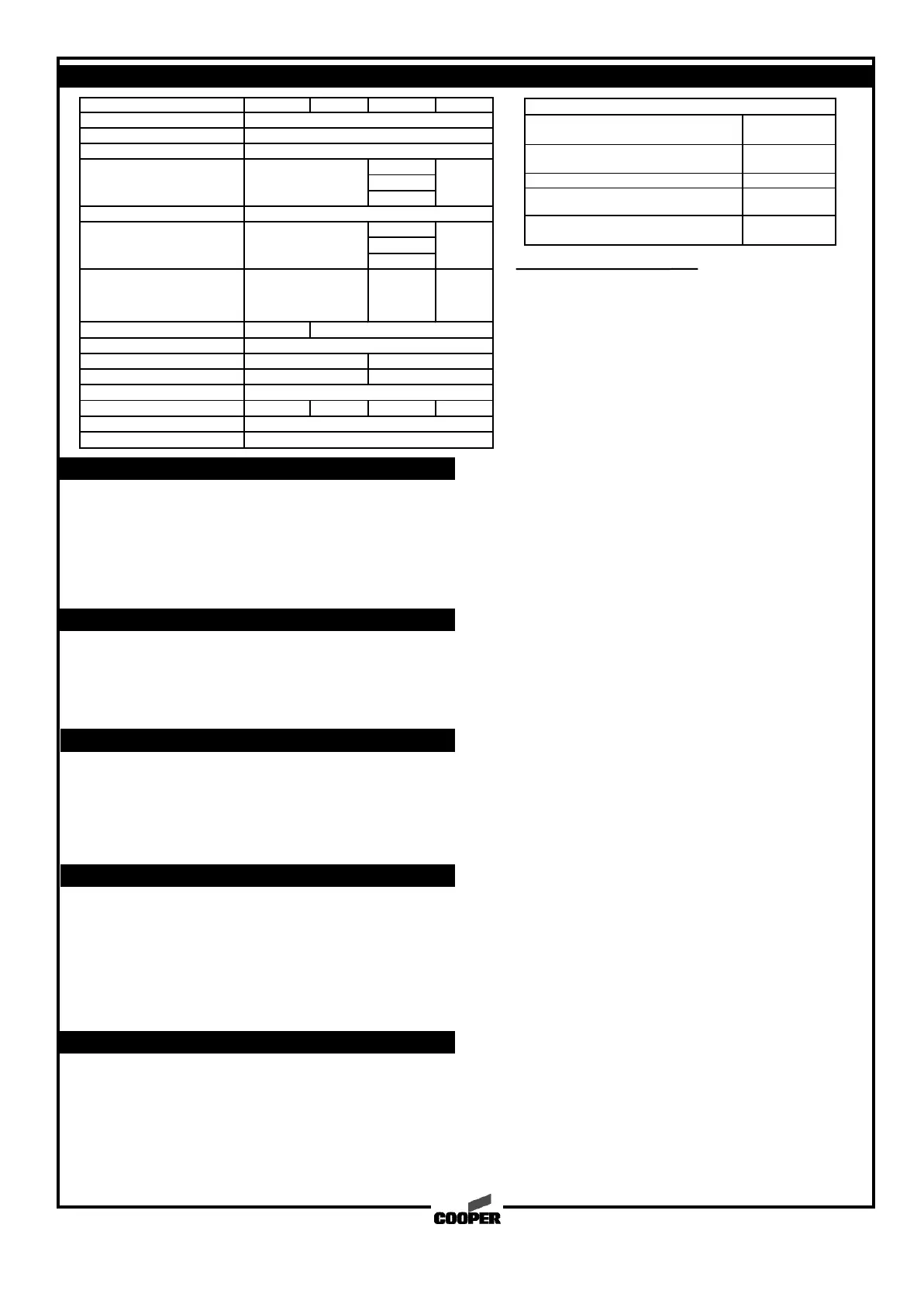
Total loop resistance for correct operation of
short circuit isolator
Continuous current allowable through isolator
Isolator resistance in closed state
Leakage current into a direct short circuit with
isolator open
Parallel fault resistance to be seen at the
control panel for isolators to open
13mA (max)
200 ohms (typ)
Integral short circuit isolator data
50 ohms (max)
700mA (max)
0.13 ohms (max)
Model CAI310 CAP320 CAH330 CAPT340
Operating voltage
Standby current (max)
Alarm current (max)
A1R 50ºC
BS 65ºC
CS 80ºC
Ambient Temperature (min)
A1R 60ºC
BS 77ºC
CS 90ºC
Heat sensor class
as defined by EN54-5:2000
Radioactive material/strength Am 18.5KBq
Relative humidity (non cond)
Height (w/o base)
Height (with base)
Diameter
Weight (w/o base) 86g 78g 76g 78g
Material
Colour
White
50ºC60ºCAmbient Temperature (max)
N/A 60ºCAlarm temperature (static)
47mm 56mm
100mm
N/A
A1R, BS, CS
control panel
selectable
A2S
PC/ABS
0 to 95%
34mm 43mm
N/A
18 TO 30V dc
220µA
5mA
-20ºC
Integral short circuit isolators:
Each of the senors in this range contain an integral
short circuit isolator, which operates between the -ve in
and -ve out terminal (terminals 1 & 2 as per base wiring
diagram overleaf). The isolator operates in conjunction
with the CF3000 control panel when a low parallel
resistance fault of typically 200 ohms is present
between the +ve and -ve of the loop wiring.
The isolator will isolate a short circuit on either side of
the sensor without loss of sensor functionality.
All sensors must be tested following installation or routine servicing and maintenance. It is recommended that these tests are
carried out by a competent person. Authorised personnel must be informed that the fire system will temporarily be ‘out of
service’ before commencing testing. To prevent unwanted alarms, ensure that the control panel is in ‘One Man Walk Test’ mode.
When all tests are complete, re-enable any previously disabled zones, exit the ‘One Man Walk Test’ mode and inform the
authorised personnel that the system is operational.
Testing: Heat sensors
Using a suitable heat gun capable of generating a temperature of up to 95°C, direct the heat source towards the heat sensing
element, visible through the side of the outer cover, from a distance of between 15 to 30cm. Care should be taken not to allow
the plastic surface temperature to exceed 110°C otherwise damage may occur.
When the temperature reaches the ‘alarm temperature’ (see specification table above), check that the red LED on the sensor
lights, the appropriate alarm address indication is displayed on the control panel and the appropriate alarm activation is give n.
If an optional remote LED is fitted, check that this also lights.
The control panel will automatically reset after a few seconds.
*The above procedure will test the heat sensing circuitry of the photo/thermal sensor (CAPT340).
A.
B.
C.
Maintenance:
A.
B.
C.
D.
Only minimal maintenance can be performed on this range of sensors, as they do not contain any site serviceable parts. The
frequency of maintenance will depend on the installed environment but should be at least annually. Damp or dusty environments
will demand more frequent maintenance.
Remove the sensor from its base
Use a vacuum cleaner to remove dust build up from around the smoke entry apertures or the heat sensing-element.
On smoke sensors visually inspect the insect mesh for blockages. If unable to clear with a vacuum cleaner the sensor must be
replaced.
Refit sensor and test as described above. Any sensor that fails the test procedure must be replaced.
A Fit sensor to mounting base and rotate clockwise until the sensor drops into place.
B Continue to rotate clockwise until the sensor 'clicks' into position and no further rotation is posible.
C If the sensor is required to be locked into position, refer to base installation instructions (see overleaf).
D Smoke sensors are supplied fitted with dust covers for general protection against airbourne contaminates. These must be
removed from all sensors prior to system commisioning.
NB. These dust covers to not provide adequate protection against quantities of dust generated by building work, sanding etc.
Therefore sensors should not be installed until this type of work has been completed.
A Fit sensor to mounting base and rotate clockwise until the sensor drops into place.
B Continue to rotate clockwise until the sensor 'clicks' into position and no further rotation is posible.
C If the sensor is required to be locked into position, refer to base installation instructions (see overleaf).
D Smoke sensors are supplied fitted with dust covers for general protection against airbourne contaminates. These must be
removed from all sensors prior to system commisioning.
NB. These dust covers to not provide adequate protection against quantities of dust generated by building work, sanding etc.
Therefore sensors should not be installed until this type of work has been completed.
A Subject the sensor to be tested to a controlled amount of an approved synthetic smoke aerosol via a smoke sensor test pole.
Suitable products are available from No Climb Products Ltd.
B Check that the red LED on the sensor lights within 30 seconds and the appropriate alarm address indication is displayed on
the control panel. If an optional remote LED is fitted , check that this also lights.
C The control panel will automatically reset after a few seconds.
*The above procedure will test the smoke sensing circuitry of the photo/thermal sensor (CAPT340)
A Subject the sensor to be tested to a controlled amount of an approved synthetic smoke aerosol via a smoke sensor test pole.
Suitable products are available from No Climb Products Ltd.
B Check that the red LED on the sensor lights within 30 seconds and the appropriate alarm address indication is displayed on
the control panel. If an optional remote LED is fitted , check that this also lights.
C The control panel will automatically reset after a few seconds.
The above procedure will test the smoke sensing circuitry of the photo/thermal sensor (CAPT340)*
110



 To Next Page