Kangaroo™ Console | 15
10. Choose the most patent nare.
Choose the most patent nare and insert the feeding tube with the stylet.
Direct the feeding tube posteriorly, aiming the tip parallel to the nasal
septum and superior surface of the hard palate. Advance the tube to the
nasopharynx, allowing the tip to seek its own passage. Once in place, do not
manipulate or pull the stylet back and forth within the feeding tube. When
the tube has reached the oropharnyx, encourage the patient to swallow.
Giving sips of cool or room temperature water may assist the passage of
thetube.
11. Using the insufflation device.
The insufflation device is for use during placement of the Kangaroo feeding
tube with IRIS technology to assist in the identification of anatomical
landmarks. Slight distension of the anatomy around the camera’s viewing
area can aid the visualization of the esophagus and the gastro-intestinal
surfaces. Air may be needed for improved viewing of anatomical landmarks
when tube tip insertion has progressed beyond the 25-35 cm mark. Additional
air may be needed when advanced beyond the esophagogastric (E-G)
junction. The volume of air needed for visualization will vary due to the
amount of air expelled naturally by the patient during the procedure as well
as the distribution of air in the GI tract. Do not administer more air than is
necessary for visualization. However, it should be expected that excess air will
be expelled naturally from the patient during and after insufflation.
To use the insufflation device, connect the insufflation ENFit™* connector to
the side port of the Kangaroo feeding tube with IRIS technology. The feeding
port should be closed off during tube insertion, either by maintaining the
stylet hub in the feeding port or by connecting the cap to the feeding port. At
the discretion of the clinician, air can be delivered through the feeding tube
during the placement by manually squeezing the insufflation bulb, which
provides approximately 30mL per hand squeeze. Monitor the patient’s level of
tolerance and visual signs of abdominal distention. At any time, the clinician
may press the black button on the insufflation device to release excess air. At
the end of the placement, the insufflation device should be disconnected from
the feeding tube and the side port should be closed. Alternatively, a syringe
can be used to conduct air insufflation.
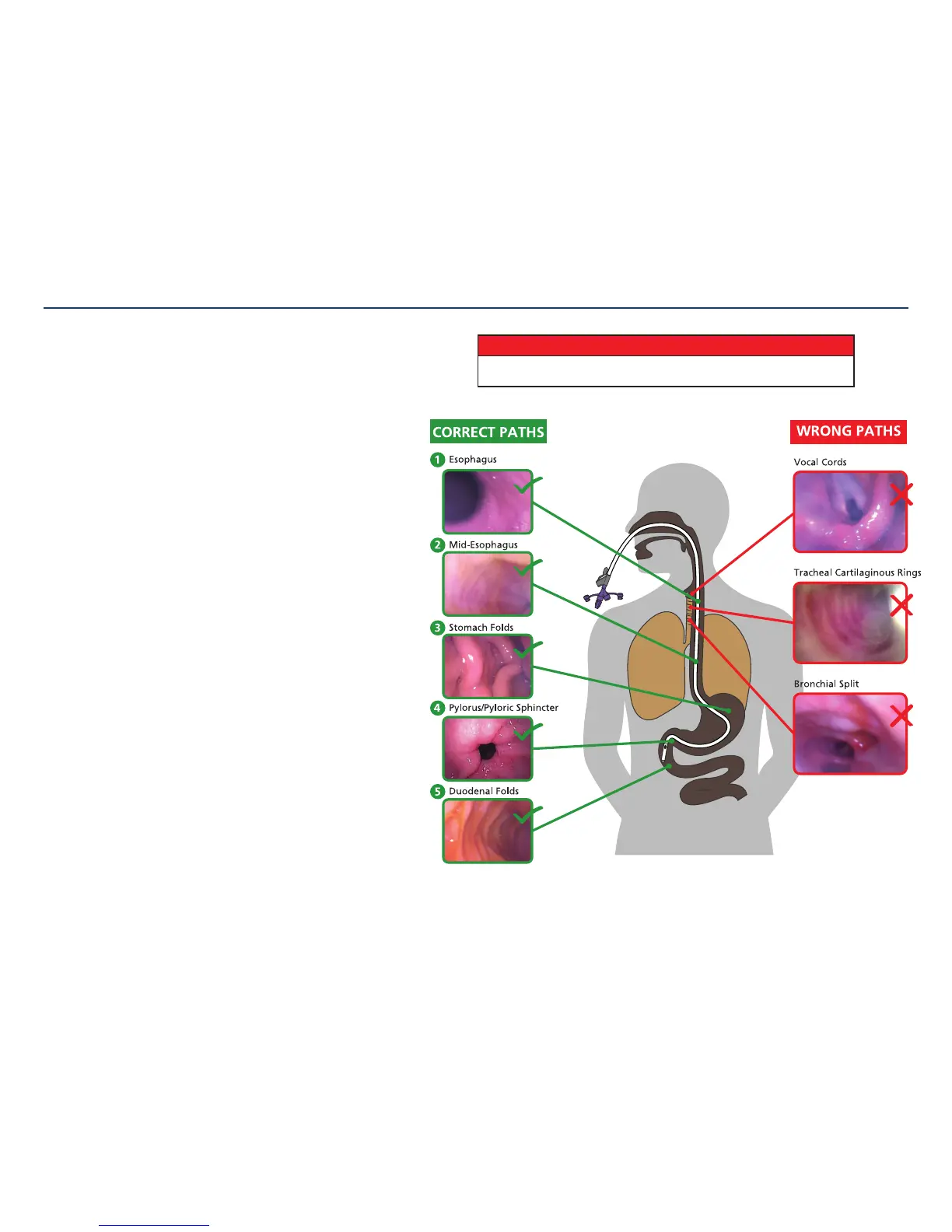
12. Using console for placement.
While inserting the Kangaroo feeding tube with IRIS technology, utilize the
console screen to correctly identify anatomical markers during placement (see
path images at right).
WARNING
Images of anatomical markers are for reference only. Refer to Kangaroo feeding tube
with IRIS technology system training. Only a trained professional should use thesystem.
Section III: Setting Up and Using the Kangaroo Feeding Tube with IRIS Technology for Placement


 To Next Page