SERVICING
31
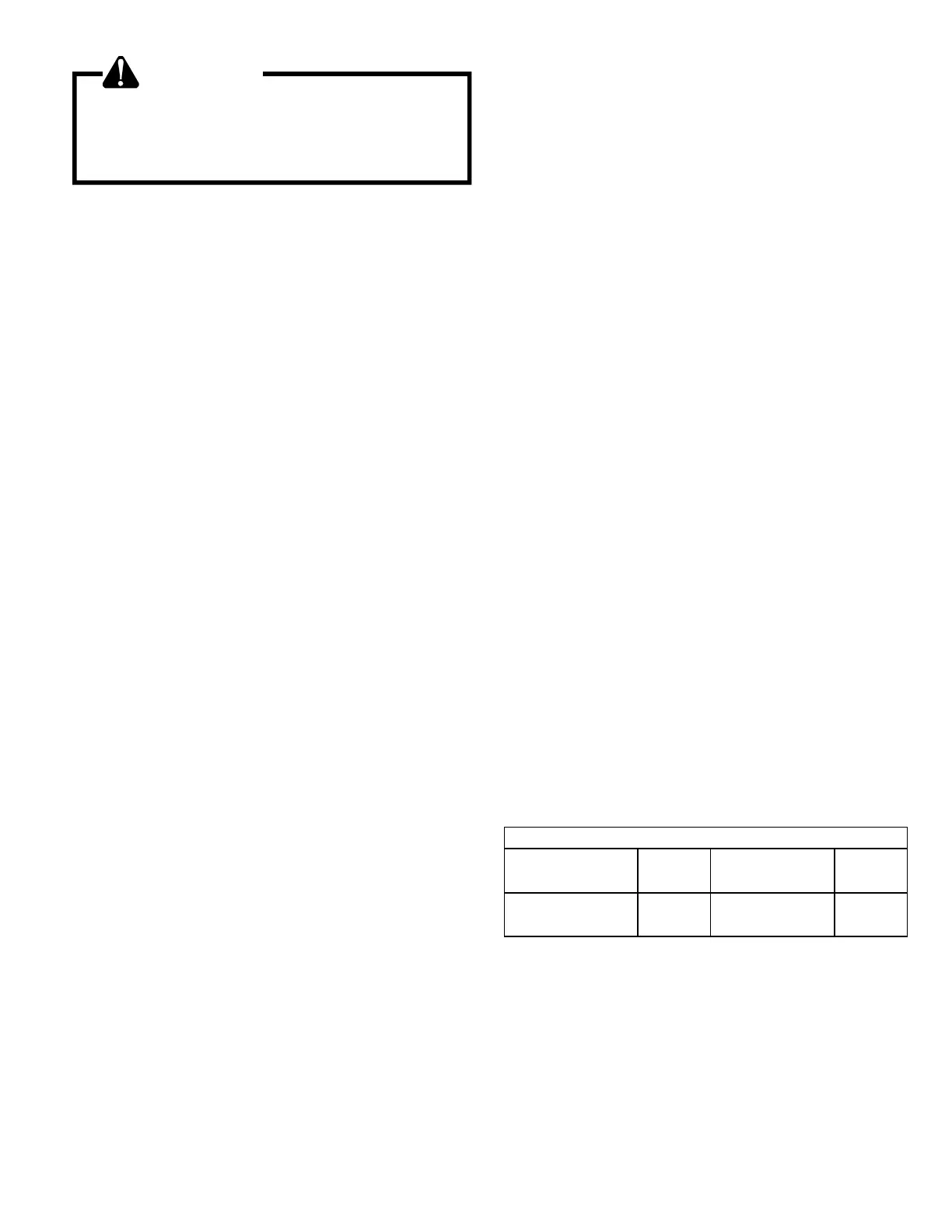
CAUTION
To prevent personal injury, carefully connect and
disconnect manifold gauge hoses. Escaping liquid
refrigerant can cause burns. Do not vent refrigerant
to atmosphere. Recover during system repair
or final unit disposal.
1. Run system at least 10 minutes to allow pressure to
stabilize.
2. For best results, temporarily install a thermometer on the
liquid line at the liquid line service valve and 4-6" from the
compressor on the suction line. Ensure the thermometer
makes adequate contact and is insulated for best possible
readings. Use liquid line temperature to determine sub-
cooling and vapor temperature to determine superheat.
NOTE: AN OPTIONAL METHOD IS TO LOCATE THE THERMOMETER
AT
THE SUCTION LINE SERVICE VALVE. ENSURE THE THERMOMETER
MAKES
ADEQUATE CONTACT AND IS INSULATED FOR BEST POSSIBLE
READINGS
.
3. Refer to the superheat table provided for proper system
superheat. Add charge to lower superheat or recover charge
to raise superheat.
Superheat Formula = Suct. Line Temp. - Sat. Suct. Temp.
EXAMPLE:
a. Suction Pressure = 143 PSIG
b. Corresponding Temp. = 50°F.
c. Thermometer on Suction Line = 58°F.
To obtain the degrees temperature of superheat, subtract 50.0
from 58.0°F.
The difference is 8° Superheat. The 8° Superheat would fall in the
± range of allowable superheat.
NOTE: The electronic expansion valve will maintain super heat
automatically.
S-109 CHECKING SUBCOOLING
Refrigerant liquid is considered subcooled when its temperature
is lower than the saturation temperature corresponding to its
pressure. The degree of subcooling equals the degrees of tem-
perature decrease below the saturation temperature at the exist-
ing pressure.
1. Attach an accurate thermometer or preferably a thermocouple
type temperature tester to the liquid service valve as it leaves
the condensing unit.
2. Install a high side pressure gauge on the high side (liquid)
service valve at the front of the unit.
3. Record the gauge pressure and the temperature of the line.
4. Review the technical information manual or specification
sheet for the model being serviced to obtain the design
subcooling.
5. Compare the hi-pressure reading to the "Required Liquid Line
Temperature" chart. Find the hi-pressure value on the left col-
umn. Follow that line right to the column under the design
subcooling value. Where the two intersect is the required liq-
uid line temperature.
Alternately you can convert the liquid line pressure gauge
reading to temperature by finding the gauge reading in the R-
410A Pressure vs. Temperature Chart, find the temperature in
the °F. Column.
6. The difference between the thermometer reading and pressure
to temperature conversion is the amount of subcooling.
ADD CHARGE TO RAISE SUBCOOLING. RECOVER CHARGE
TO LOWER SUBCOOLING.
Subcooling Formula = Sat. Liquid Temp. - Liquid Line Temp.
NOTE: To adjust subcooling, follow the sequence:
EXAMPLE:
a. Liquid Line Pressure = 417 PSIG
b. Corresponding Temp. = 120°F.
c. Thermometer on Liquid line = 109°F.
To obtain the amount of subcooling subtract 109°F from 120°F.
The difference is 11° subcooling. See the specification sheet or
technical information manual for the design subcooling range for
your unit.
There are other causes for high head pressure which may be found
in the "Cooling / Heating Analysis Chart."
If other causes check out normal, an overcharge or a system con-
taining non-condensables would be indicated.
If this system is observed:
1. Start the system.
2. Remove and capture small quantities of gas from the suction
line dill valve until the head pressure is reduced to normal.
3. Observe the system while running a cooling performance test.
If a shortage of refrigerant is indicated, then the system con-
tains non-condensables.
OD Ambient Temp
(degF)
<65°F 65°F to 105°F >105°F
Subcooling
(degF)
Weigh in
Charge
2T to 4T:8°F ±1°F
5T:10°F ±1°F
Weigh in
Charge
Charging Table
SUPERHEAT AND SUBCOOLING ADJUSTMENT ON TXV APPLICATIONS
NOTE: Subcooling and superheat information is valid only while
the unit is operating at 100% capacity or 100% compressor speed
in CHARGE MODE.
Compressor speed is displayed under STATUS menu in the
thermostat.
1. Run system at least 10 minutes to allow pressure to
stabilize. During the adjustment of subcooling, ambient
temperature should be greater than 65°F and less than


 To Next Page