SERVICING
38
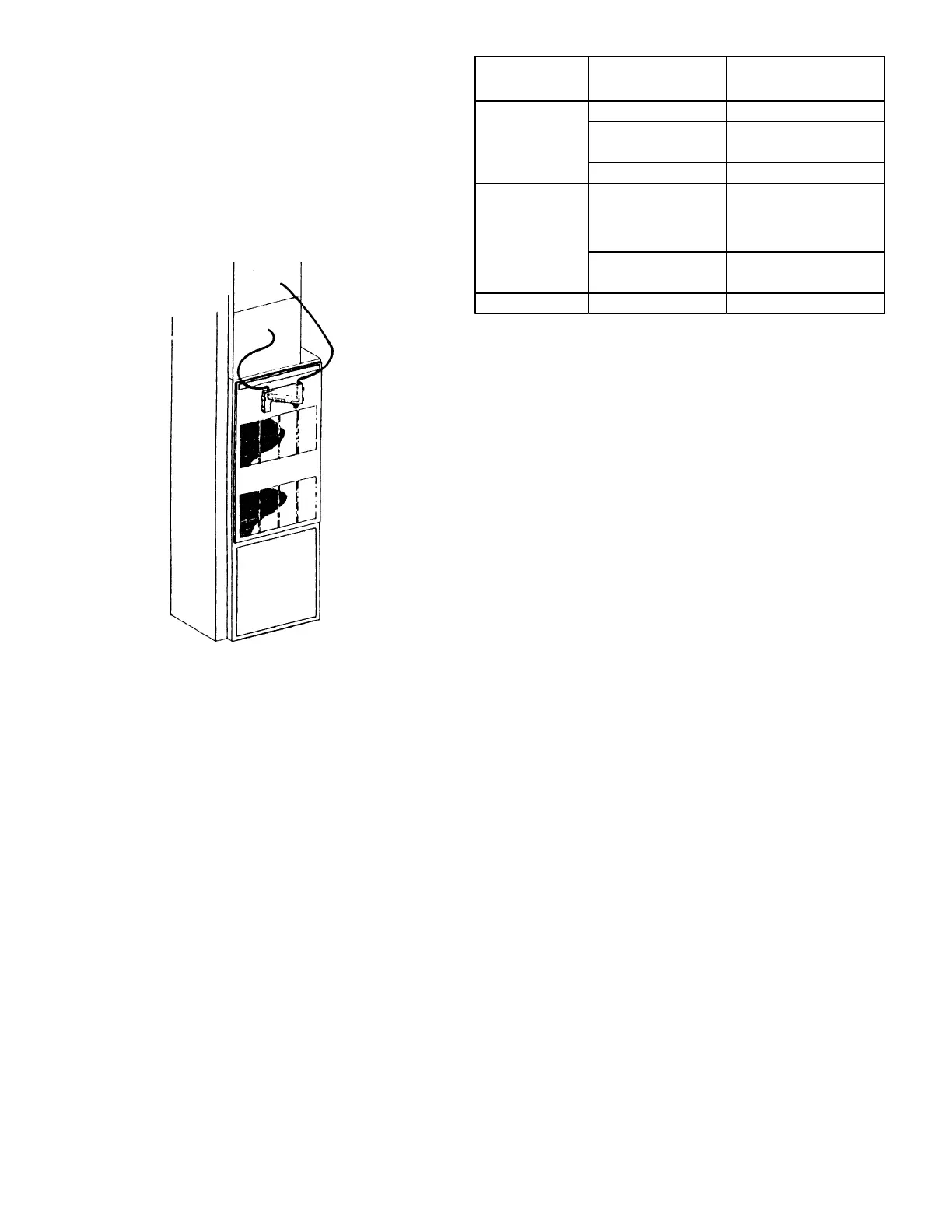
S-204 COIL STATIC PRESSURE DROP
1. Using a draft gauge (inclined manometer), connect the posi-
tive probe underneath the coil and the negative probe above
the coil.
2. A direct reading can be taken of the static pressure drop across
the coil.
3. Consult proper table for quantity of air.
STATIC PRESSURE DROP
If the total external static pressure and/or static pressure drop
exceeds the maximum or minimum allowable statics, check for
closed dampers, dirty filters, undersized or poorly laid out duct
work.
AIRFLOW CONSIDERATION
Airflow demands are managed differently in a fully
communicating system than in a non-communicating wired
system. The system operating mode (as determined by the
thermostat) determines which unit calculates the system
airflow demand. If the indoor unit is responsible for
determining the airflow demand, it calculates the demand and
sends it to the ECM motor. If the outdoor unit or thermostat is
responsible for determining the demand, it calculates the
demand and transmits the demand along with a fan request to
the indoor unit. The indoor unit then sends the demand to the
ECM motor. The table below lists the various communication
systems, the operating mode, and airflow demand source.
System
System Operating
Mode
Airflow Demand
Source
Cooling Outdoor Unit
Heat Pump Heating
Only
Outdoor Unit
Continuous Fan Thermostat
HP + Electric Heat
Strips
Either outdoor unit or
indoor unit, which has
higher Airflow demand
Electric Heat Strips
Only
Indoor Unit
Gas Furnace Combustion Heat Indoor Unit
Any
Air Handler or
Modular blower
For example, assume the system is an outdoor unit matched
with an indoor unit. With a call for cooling, the outdoor unit
will calculate the system’s cooling airflow demand. The
outdoor unit will then send a fan request along with the
cooling airflow demand to the indoor unit. Once received,
the indoor unit will send the cooling airflow demand to the
ECM motor. The ECM motor then delivers the cooling airflow.
In continuous fan mode, the communicating thermostat
provides the airflow demand. The communicating provides
4 continuous fan speeds (25%, 50%, 75% and 100% of
maximum airflow). During continuous fan operation, the
thermostat sends a fan request along with the continuous
fan demand to the indoor unit. The indoor unit, in turn, sends
the demand to the ECM motor. The ECM motor delivers the
requested continuous fan airflow.


 To Next Page