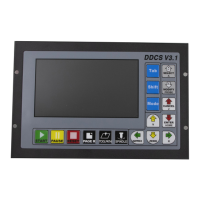
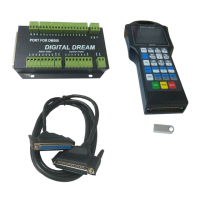
Digital Dream Standalone Motion Controller DDCS V3.1 DDCS V3.1 Users Manual
Page -54
It uses the following parameters:
#2000 ["Cutter diameter"] The diameter of the probe tip
#2001 ["Tool plate thick for X"]
#2002 ["Tool plate thick for Y"]
#2003 [“Tool plate thick for Z"]
#2004 ["shift of X axis before probed"] If Positive it will probe the right hand side of the block.
#2005 [“shift of Y axis before probed"} If negative it will probe the front face of the block
#2006 [“Z position before X(Y)-axis probed"] The distance to descend before moving the X or Y
axes to establish probe contact
#2007 ["Back distance when the tool touches the X-axis edge"] After an axis is touched off
these 3 parameters
#2008 ["Back distance when the tool touches the Y-axis edge"] define how much to pull back
before the next
#2009 ["Back distance when the tool touches the Z-axis edge"] movement
#2010 ["center of tool plate"] If you want to set the X & Y zero to the corner of the test block you
would set #2001 & #2002 to 0. Refer to Figure 67, and if this is the case when #2010 = 0 the tip of
the tool has to be exactly on the corner. If you set #2010 to a value, the tool is offset (in X) when
probing for Y. This should lead to better accuracy.
#2011 ["Probe feedrate"] The feed rate to be used when probing. Probing is done by a G01
command in relative (G91) mode.
In order for this the tool sensor must be a conductive cube isolated from the machines table.
It could be a piece of insulating material with 3 conductive corners as shown in Figure 3-55 or a
metal cube cube sitting on top of an insulator as shown in Figure 3-57.
C: #68=3 Probe of Rectangular Block,by this methods it can probe X/Y/Z 3 axes.
This mode is the most complex and useful as it probes all three axes. In order for this the tool
sensor must be a cube or similar regular rectangular block. The mode will first probe for Z, then
probe the side of the block [left or right] for X and finally it will probe the face or the back of the
block for Y. It then retracts back as dictated by parameter #75 and moves to the X & Y zero position
as defined by #2001 and #2002.
Note if you want to locate onto the corner you just probed set #2001 and #2002 to 0.
Note:
#69 is NOT used
#71 is NOT used in this mode
#75 is NOT used in this mode


 To Next Page
 Loading...