IGNITION COIL—4.7L ENGINE
DESCRIPTION
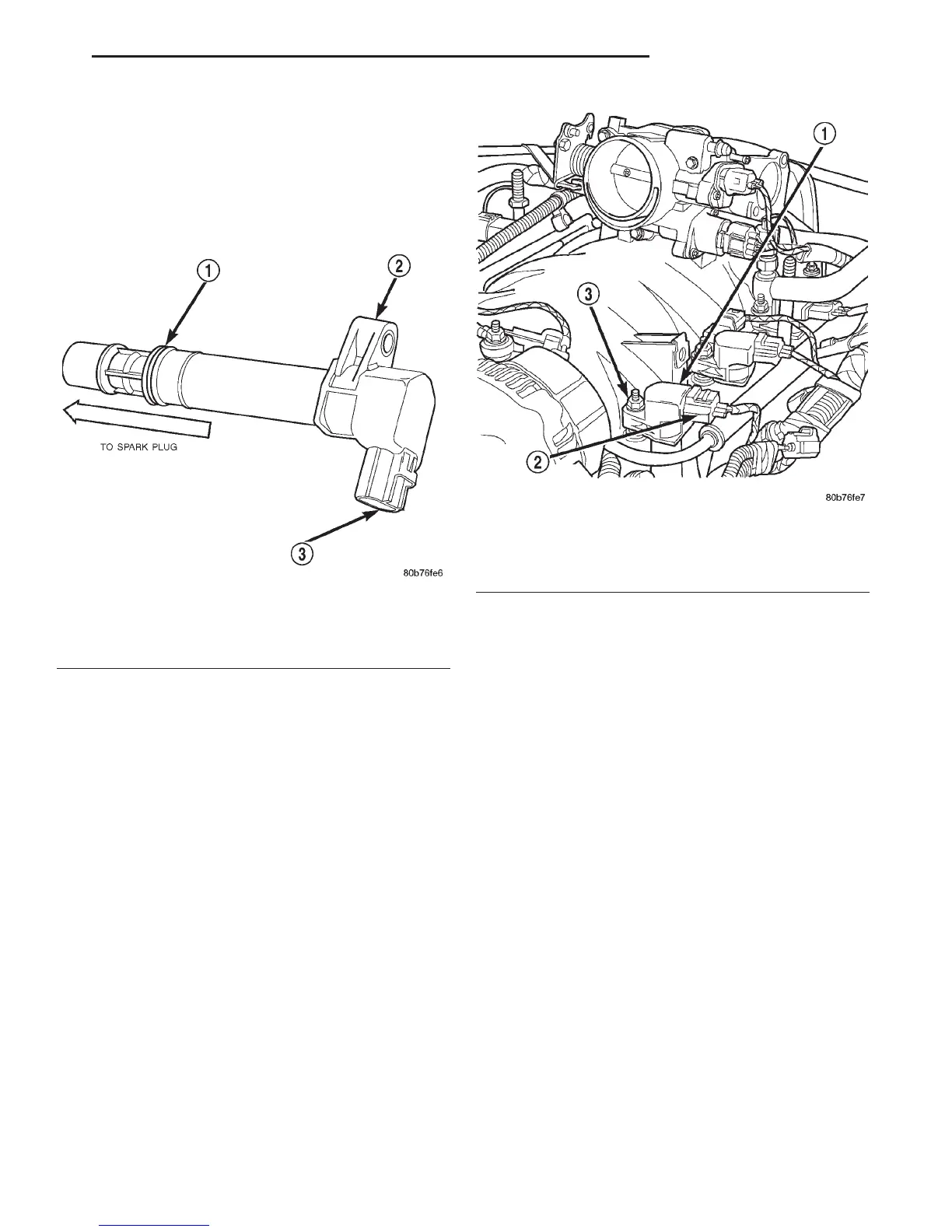
The 4.7L V–8 engine uses 8 dedicated, and individ-
ually fired coil (Fig. 2) for each spark plug. Each coil
is mounted directly to the top of each spark plug
(Fig. 3).
OPERATION
Battery voltage is supplied to the 8 ignition coils
from the ASD relay. The Powertrain Control Module
(PCM) opens and closes each ignition coil ground cir-
cuit at a determined time for ignition coil operation.
Base ignition timing is not adjustable. By con-
trolling the coil ground circuit, the PCM is able to set
the base timing and adjust the ignition timing
advance. This is done to meet changing engine oper-
ating conditions.
The ignition coil is not oil filled. The windings are
embedded in an epoxy compound. This provides heat
and vibration resistance that allows the ignition coil
to be mounted on the engine.
Because of coil design, spark plug cables (second-
ary cables) are not used.
CRANKSHAFT POSITION SENSOR—5.2/5.9L
V-8 ENGINE
DESCRIPTION
The Crankshaft Position (CKP) sensor is located
near the outer edge of the flywheel (starter ringear).
OPERATION
Engine speed and crankshaft position are provided
through the CKP sensor. The sensor generates pulses
that are the input sent to the Powertrain Control
Module (PCM). The PCM interprets the sensor input
to determine the crankshaft position. The PCM then
uses this position, along with other inputs, to deter-
mine injector sequence and ignition timing.
The sensor is a hall effect device combined with an
internal magnet. It is also sensitive to steel within a
certain distance from it.
On 5.2/5.9L V-8 engines, the flywheel/drive plate
has 8 single notches, spaced every 45 degrees, at its
outer edge (Fig. 4).
The notches cause a pulse to be generated when
they pass under the sensor. The pulses are the input
to the PCM. For each engine revolution, there are 8
pulses generated on V-8 engines.
The engine will not operate if the PCM does not
receive a CKP sensor input.
CRANKSHAFT POSITION SENSOR—4.7L
ENGINE
DESCRIPTION
The Crankshaft Position Sensor (CKP) is mounted
into the right-rear side of the engine block (Fig. 5).
Fig. 2 Ignition Coil—4.7L Engine
1 – O-RING
2 – IGNITION COIL
3 – ELECTRICAL CONNECTOR
Fig. 3 Ignition Coil Location—4.7L Engine
1 – IGNITION COIL
2 – COIL ELECTRICAL CONNECTOR
3 – COIL MOUNTING STUD/NUT
DN IGNITION SYSTEM 8D - 3
DESCRIPTION AND OPERATION (Continued)















 To Next Page