ParaMon-Pro X instruction manual DOC.60391-01/21
K.Seating point from target torque (%)
Modification not recommended for hard joint
Modified recommended for soft joint only
The part where target starts to increase when the screw head touches the surface of a target object is called
‘seating point’.
For example, in the event of 10.00 kgf.cm of target torque and 40% in seating point from target torque, tool
torque starts to increase. A seating point is detected when 4.00 kgf.cm is reached.
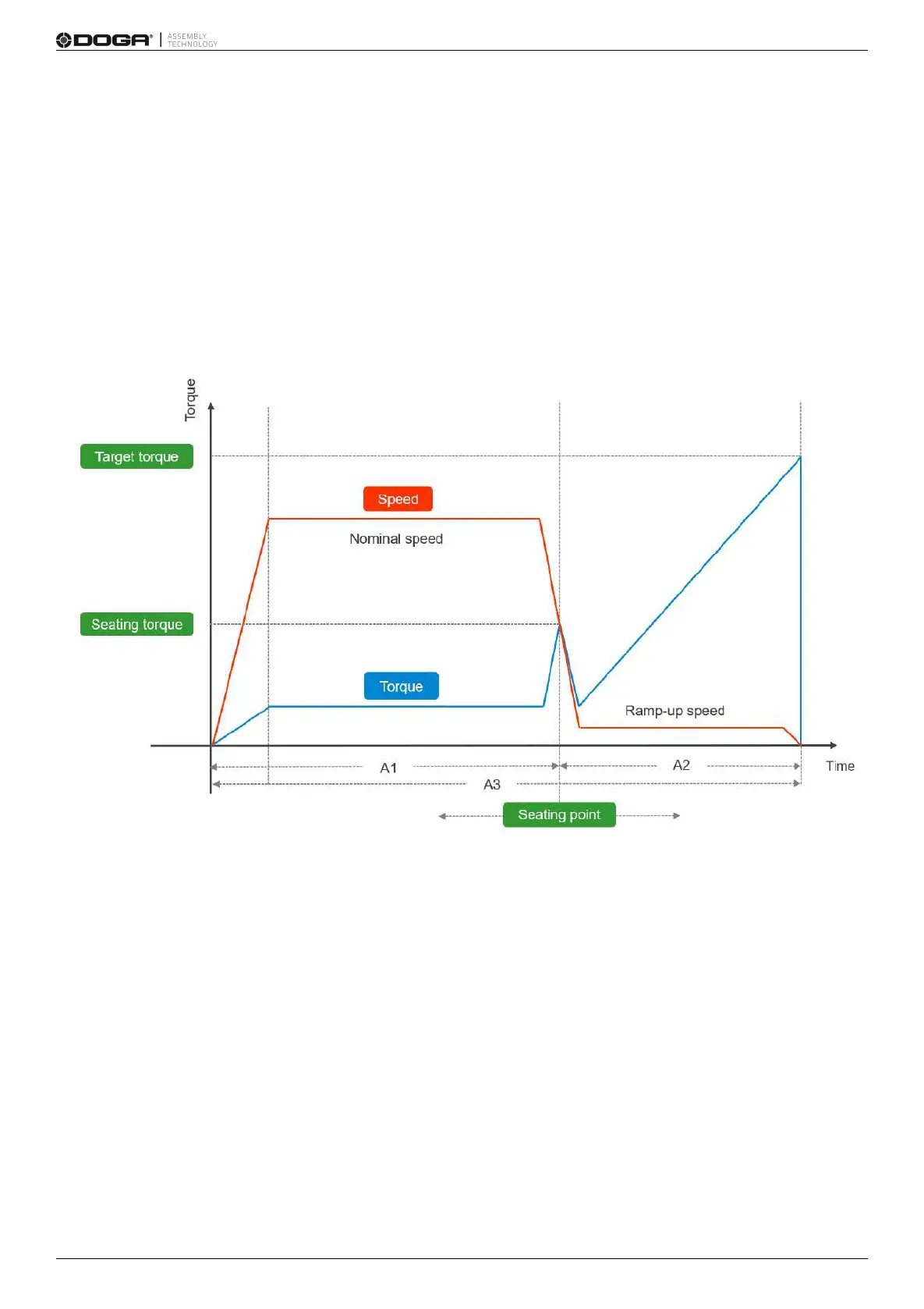
The figure below reveals correlations among torque, speed and seating:
Once a seating point is sensed, speed is adjusted to ‘Ramp-up speed (RPM)’, increasing torque.
As illustrated in the above graph, nominal speed before a seating point is usually higher than ramp-up speed
after the seating point.
Therefore, the position of a seating point on the time axis is closely related with total fastening time.
In the graph, the left nominal speed, right ramp-up speed and total (A1+A2) areas are set to A1, A2 and A3
respectively.
As stated above, nominal speed in the A1 section is usually higher than ramp-up speed in the A2.
Therefore, total time (A3) increases when the A1 section is reduced by lowering the seating point from target
torque (%) while it decreases if the A1 section is enlarged by increasing the seating point from target torque
(%).
As a usual, the latter is more common than the former.
If tool speed drops to the ramp-up speed level, and total fastening time increases after a seating point is
sensed before the screw head touches the surface of a target object in soft-joint environment, total fastening
time can be reduced by moving the seating point to the right by increasing a seating point from target torque
(%).


 To Next Page
 Loading...