Maintenance Section
-174-
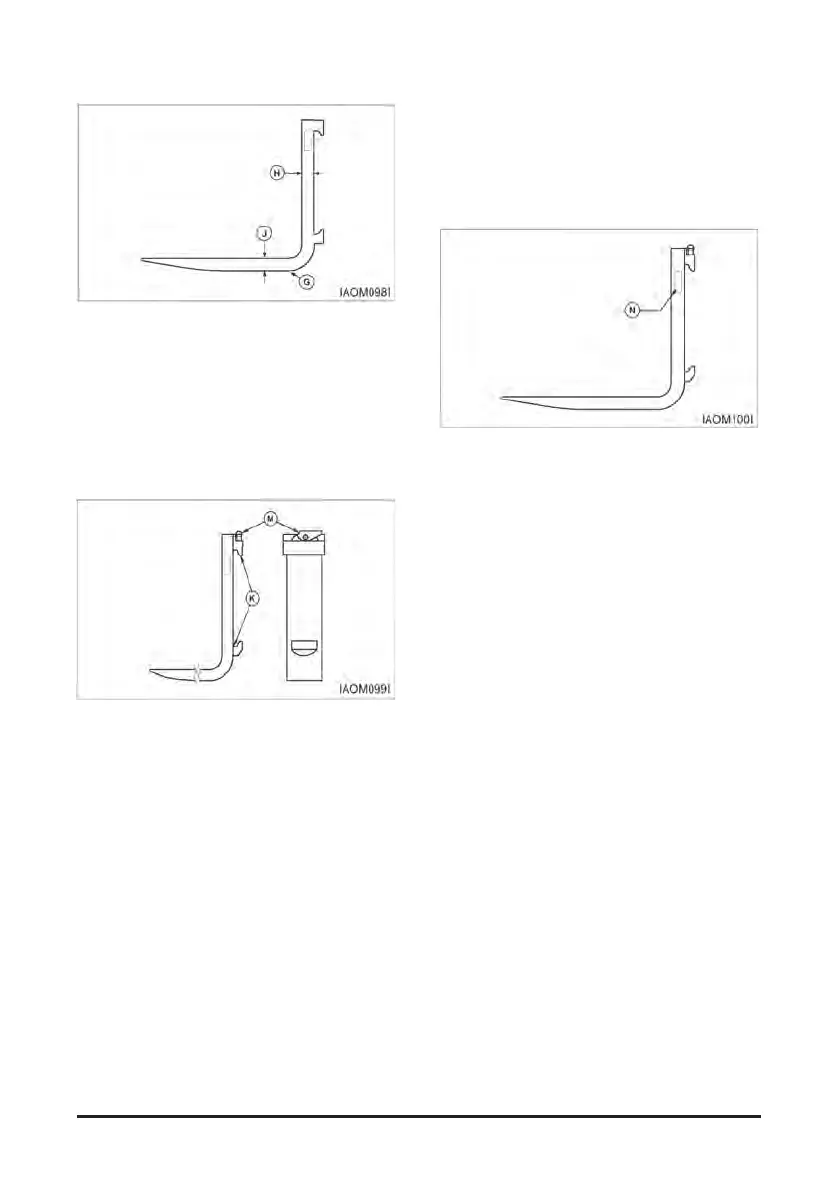
5. Check the fork blade (J) and shank (H) for wear
with special attention to the heel (G). The fork
should be withdrawn from service if the
thickness is reduced to 90 percent or less of the
original thickness.
Fork blade length may also be reduced by wear,
especially on tapered forks and platens.
Remove the forks from service when the blade
length is no longer adequate for the intended
loads.
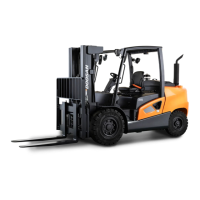
6. Check the fork mountings (K) for wear, crushing
and other local deformation, which can cause
excessive side to side wobble of the forks.
Excessive clearance on hook type forks may
allow them to fall from the carrier. Forks which
show visible signs of such damage should be
removed from service.
7. Check the positioning lock and other fork
retention devices to make sure they are in place
and working.
Hook type forks use a spring loaded pin (M),
located in the top hook, to engage notches in
the top carriage bar to hold the fork in place.
When adjusting the fork spacing, the forks are
prevented from sliding off the end of the
carriage by stop blocks. These stop blocks are
at both ends of the carriage and in the path of
the bottom fork hook. The load backrest
extension may be used in place of the stop
blocks in some cases.
Shaft mounted forks may use set collars or
spacers on the shaft to either side of the fork.
They may also use U bolts, pins, or similar
devices which engage the fork through the top
structure of the carriage.
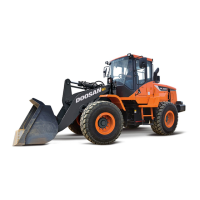
8. Check fork markings (N) for legibility. Renew
markings as required to retain legibility.
9.a.
Lift the mast and operate the tilt control lever,
until the top surface of the forks is parallel with
the floor. Place two straight bars that are the
same width as the carriage, across the forks as
shown.
b. Measure the distance from the bottom of each
end of the two bars to the floor. The forks must
be parallel within 3 mm (.12 in) for Full Tapered
and Polished (FTP) forks, all other forks 6.4 mm
(.25 in), for their complete length.
c. Put one fork, one third from the tip, under a
fixture that will not move. Then operate the tilt
control with caution until the rear of the truck lifts
just off the floor. Follow the same procedure
with the second fork. Repeat Step a.



 To Next Page