162
WSG-1068 IGNITION SYSTEM
Short Check
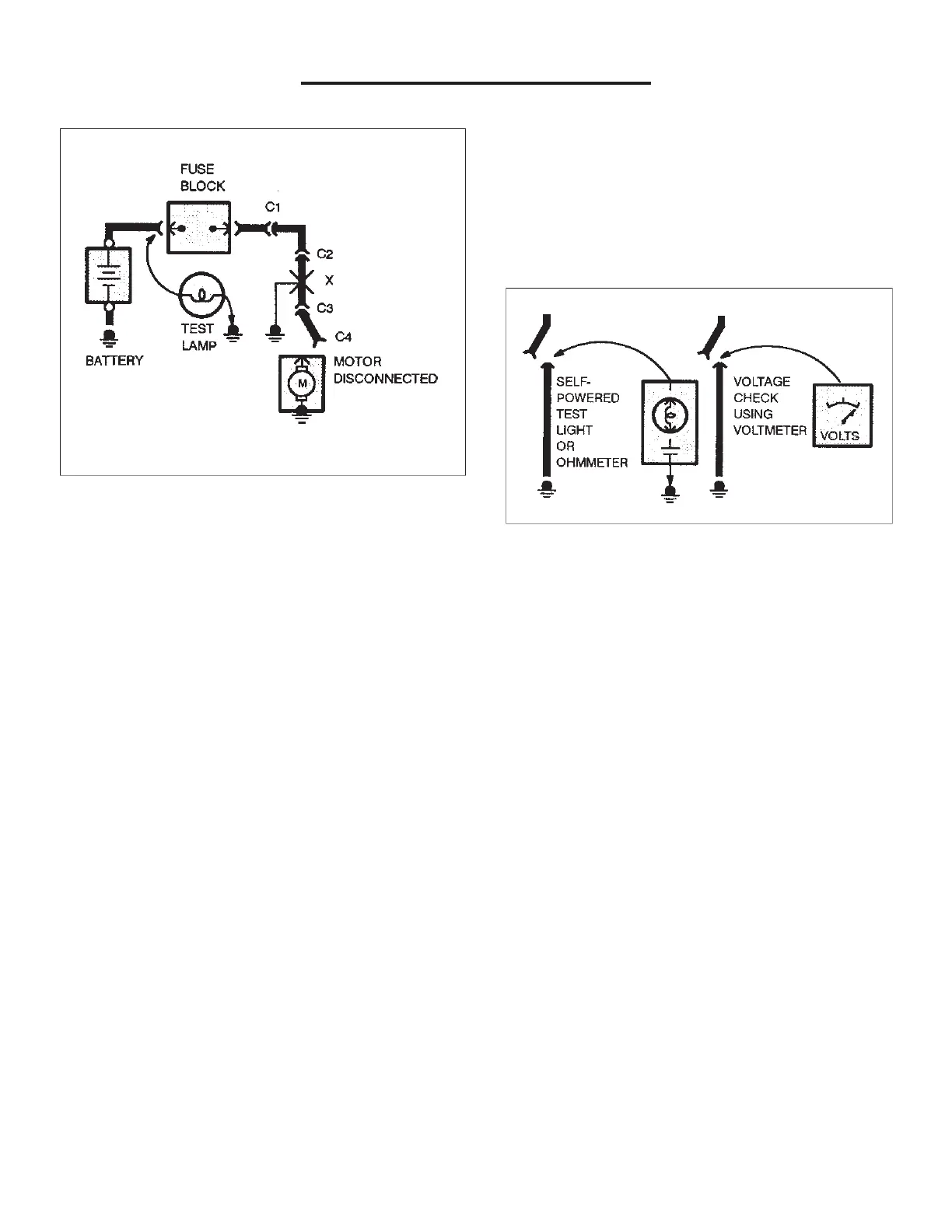
Figure 5 – Short Check
A fuse that repeatedly blows is usually caused by a short
to ground. It’s important to be able to locate such a short
quickly (Figure 5).
1. Turn off everything powered through the fuse.
2. Disconnect other loads powered through the
fuse:
Motors: disconnect motor connector
(Connector C4 in Figure 5).
Lights; remove bulbs.
3. Turn the Ignition Switch to RUN (if necessary) to
power fuse.
4. Connect one Test Lamp lead to the hot end of
the blown fuse. Connect the other lead to
ground. The bulb should glow, showing power to
fuse. (This step is just a check to be sure you
have power to the circuit).
5. Disconnect the test lamp lead that is connected
to ground, and reconnect it to the load side of
the fuse at the connector of the disconnected
component. (In Figure 5, connect the test lamp
lead to connector C4).
If the Test Lamp is off, the short is in the
disconnected component.
If the Test Lamp goes on, the short is in the
wiring.You must find the short by
disconnecting the circuit connectors, one at a
time, until the Test Lamp goes out. For
example, in Figure 5 with a ground
at X, the bulb goes out when C1 or C2 is
disconnected, but not after disconnecting C3.
This means the short is between C2 and C3.
Figure 6 – Ground Check
Ground Check
Turn on power to the circuit. Perform a Voltage Check
between the suspected inoperative ground and the
frame. Any indicated voltage means that the ground is
inoperative (Figure 6).
Turn off power to the circuit. Connect one lead of a Self-
Powered Test Lamp or Ohmmeter to the wire in question
and the other lead to a known ground. If the bulb glows,
the circuit ground is OK (Figure 6).
The circuit schematics in this manual make it easy to
identify common points in circuits. This knowledge can
help narrow the concern to a specific area. For example,
if several circuits fail at the same time, check for a
common power or ground connection. If part of a circuit
fails, check the connections between the part that works
and the part that doesn’t work.
For example, if the low beam headlamps work, but the
high beams and the indicator lamp don’t work, then the
power and ground paths must be good. Since the
dimmer switch is the component that switches this power
to the high beam lights and the indicator, it is most likely
the cause of failure.



 To Next Page