RXB PLUS ROTARY SCREW COMPRESSOR UNITSS70-101 IOM
Page 30
OPERATION
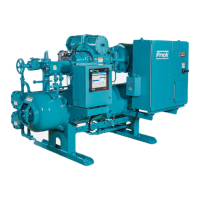
RXB COMPRESSOR
The Frick RXB rotary screw compressor utilizes mating,
asymmetrical-profile helical rotors to provide a continuous
pulse-free flow of refrigerant vapor and is designed for both
high pressure and low pressure applications. The compres-
sor incorporates the following features:
1. High-capacity roller bearings to carry radial loads at both
the inlet and outlet ends of the compressor.
2. Heavy-duty, four-point, angular-contact ball bearings to
carry axial loads are mounted at the discharge end of com-
pressor.
3. Moveable slide valve to provide infinite step capacity con-
trol from 100 to 25% of full load.
4. VOLUMIZER
®
adjusts to the most efficient of three vol-
ume ratios (2.2, 3.5 or 5.0) depending upon system require-
ments.
5. A hydraulic unloader cylinder to operate the slide stop
and slide valve.
6. Compressor housing suitable for 350 PSI pressure. Dual-
compressor casing design for very low airborne noise trans-
mission.
7. Most bearing and control oil vented to closed thread in
the compressor instead of suction port to avoid performance
penalties from superheating suction gas.
8. Shaft seal design to maintain operating pressure on seal
well below discharge pressure for increased seal life.
9. Oil injected into the rotors to maintain good volumetric
and adiabatic efficiency even at very high compression ra-
tios.
IT IS MANDATORY THAT THE COU-
PLING CENTER BE REMOVED
AND THE DIRECTION OF MOTOR
ROTATION BE CONFIRMED
BEFORE
RUNNING THE
COMPRESSOR. Proper rotation of the compressor shaft
is clockwise looking at the end of the compressor shaft.
FAILURE TO FOLLOW THIS STEP COULD RESULT IN
BACKWARD COMPRESSOR ROTATION WHICH CAN
CAUSE COMPRESSOR FAILURE OR EXPLOSION OF
THE SUCTION HOUSING.
COMPRESSOR LUBRICATION SYSTEM
The RXB compressor is designed specifically for operation
without an oil pump for high stage service. Boosters and
some low-differential-pressure applications will require the
full-lube pump option.
The lubrication system on an RXB screw compressor unit
performs several functions:
1. Lubricates the rotor contact area, allowing the male rotor
to drive the female rotor on a cushioning film of oil.
2. Provides lubrication of the bearings and shaft seal.
3. Serves to remove the heat of compression from the gas,
keeping discharge temperatures low and minimizing refriger-
ant or oil breakdown.
4. Fills gas leakage paths between or around the rotors with
oil, thus greatly reducing gas leakage and maintaining good
compressor performance even at high compression ratios.
5. Provides oil pressure for development of balance load on
the balance pistons to reduce bearing loading and increase
bearing life.
FULL-LUBE OIL SYSTEM
RXB PLUS booster compressors and high-stage compres-
sors, that operate with very low differential pressures across
the compressor suction and compressor discharge, require
a full-time oil pump to produce the oil flow and pressures
required. Oil is pumped from the oil separator through the
oil filter to the main oil injection feed and the compressor.
An oil pressure regulating valve downstream of the pump is
used to regulate oil pressure at the compressor by returning
excess oil to the separator.
Oil pressure on RXB PLUS compressors with full-time oil
pumps should be adjusted to provide 20 – 25 PSI (high stage)
or 30 – 35 PSI (booster) pounds of oil pressure at the high-
est normal head pressure or intermediate pressure expected
with the compressor fully loaded. The compressor will re-
quire maximum oil flow under these conditions.
COMPRESSOR OIL SEPARATION SYSTEM
The RXB PLUS is an oil flooded screw compressor. Most
of the oil discharged by the compressor separates from the
gas flow in the oil charge reservoir. Some oil, however, is
discharged as a mist, which does not separate readily from
the gas flow and is carried past the oil-charge reservoir. One
or more coalescer filter elements then coalesce the oil mist
into droplets; the droplets of oil fall to the bottom of the
coalescer section of the oil separator. The return of this oil
to the compressor is controlled by a needle valve on both
high-stage and booster applications.
NOTE: Open needle the valve only enough to keep the
coalescer end of the separator free of oil.
The sight glass located near the bottom of the coalescer
section of the oil separator should remain empty during nor-
mal operation. If an oil level develops and remains in the
sight glass, a problem in the oil return separation system or
compressor operation has developed. Refer to Maintenance
for information on how to correct the problem.



 To Next Page