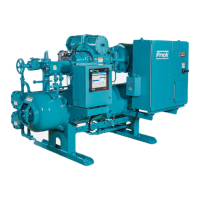
RXB PLUS ROTARY SCREW COMPRESSOR UNITSS70-101 IOM
Page 46
PRESSURE TRANSDUCERS -
REPLACEMENT
1. Shut off control power.
2. Close the applicable transducer isolation valve. NOTE: To
change the discharge pressure transducers, it will be
necessary to depressurize the entire compressor pack-
age. Follow "General Instructions For Replacing Com-
pressor Unit Components" (p. 36) before going to step
3.
3. Open the microprocessor console door.
4. Use the chart to identify transducer terminals of the SBC.
P & I
TRANSDUCER CONNECTION
Oil Pressure PE-1
Discharge Pressure PE-3
Suction Pressure PE-4
5. Disconnect transducer leads by loosening the terminal
screws for the transducer to be changed.
6. Tape a 3 ft. length of pull wire to the leads of the transdu-
cer to be removed.
7. Pull the transducer leads through the conduit until pull
wire extends out of the conduit hole in the transducer mani-
fold. Separate the transducer leads from the pull wire.
8. Unscrew the transducer using a wrench on the metal hex
at the base of the transducer.
DO NOT ATTEMPT TO LOOSEN
OR TIGHTEN TRANSDUCERS BY THEIR TOP CASING.
9. Install new transducer and tape leads to the pull wire.
10. Pull new transducer leads into the microprocessor con-
sole and reconnect them to the terminal strip.
11. Close the microprocessor console door.
12. Reopen the transducer isolation valve.
13. Turn on control power.
2. Isolate suction transducer PE-4 from the unit and open it
to atmosphere using valves provided at the transducer
manifold.Close the applicable transducer isolation valve.
NOTE: To change the discharge pressure transducer
(PE-3), it will be necessary to depressurize the entire
compressor package. Follow "General Instructions For
Replacing Compressor Unit Components" (p. 36) before
going to step 3.
3. Measure the voltage of PE-4 on connector P4 (terminals
WHT and BLK) on the SBC with a digital voltmeter.
4. The voltage reading should be 1.48 VDC to 1.72 VDC at
standard atmospheric pressure (14.7 PSIA or 0 PSIG). When
checking transducers at higher elevations, an allowance in
the readings must be made by subtracting approximately
0.02 VDC per 1000 feet of elevation above sea level. There-
fore, if PE-4 is measured at 5000 feet elevation under rela-
tively normal weather conditions, the output voltage should
differ by 0.10 VDC to read between 1.38 VDC and 1.62 VDC.
5. Subtract 1 from the voltage.
6. Multiply by 25.
7. This result is the absolute suction pressure (PSIA). The
Operating display will indicate PSIG (14.7 PSIA = 0.0 PSIG).
8. Measure the voltage of PE-1 on connector P4 (terminals
WHT and BLK) on the SBC.
9. The voltage reading should be between 1.1 VDC and 1.29
VDC at standard atmospheric pressure. PE-1 and PE-3 have
a span of 300 PSI as compared to PE-4 with a span of 100
PSI. Therefore, atmospheric pressure changes have a lesser
effect which is 0.0067 VDC per 1000 feet of elevation and
0.00067 VDC per 0.1 inch Hg barometric deviation.
10. Measure the voltage of PE-3 on connector P4 (termi-
nals WHT and BLK) on the SBC.
11. Measure the voltage of PE-1 on connector P4 (termi-
nals WHT and BLK) on the SBC.
12. These two voltages should be within .04 VDC of one
another.
13. Test complete.
MAINTENANCE



 To Next Page